
Ether is still considered a higher risk asset than bitcoin, says Ignacio Moreno De Vicente.
Given the uncertainty, many funds choose to first reduce their exposure to ETH.
The influx of capital from large investors into the cryptocurrency market after the market bottom reached last February shows a marked disparity between bitcoin (BTC) and ether (ETH), the two main cryptoassets.
While bitcoin consolidates its recovery, “ether struggles to regain institutional trust,” stated Ignacio Moreno de VicenteSpanish analyst at the CryptoQuant data platform, in a report published yesterday, May 7, 2026, which analyzes the behavior of exchange-traded funds (ETFs).
This divergence comes after a period of high volatility in the global digital asset market. After reaching an all-time high of $126,000 on October 6, 2025, the price of bitcoin began a deep correction. This bearish trend culminated on February 6, 2026, when the currency touched $60,000, its lowest point in this cycle and which represented a 50% drop from its peak.
After that market crash, capital began to return to ETFs, although unevenly between both assets.
Moreno de Vicente highlights that “one of the clearest structural divergences within digital assets has emerged through the metric of the behavior of fund holdings.” This tool measures the total amount of coins held by institutional vehicles, such as exchange-traded funds (ETFs), trusts, and other regulated funds. In practice, it works as an indicator of indirect demand from large Wall Street investors.
From the minimum reached on February 6 to the present, bitcoin investment funds and financial instruments They increased their reserves from 1.27 million to 1.37 million BTC. This net accumulation of 92,000 BTC represents a 7.2% growth in confidence towards the currency, as seen in the graph.
In contrast, ether, a cryptocurrency from the Ethereum network created by Vitalik Buterin, experienced a trend of capital outflow from ETFs during the same period analyzed. Holdings in ether-based funds decreased from 5.93 million to 5.8 million ETH. This reduction of 127,000 ETH represents a 2.1% drop in institutional exposure.
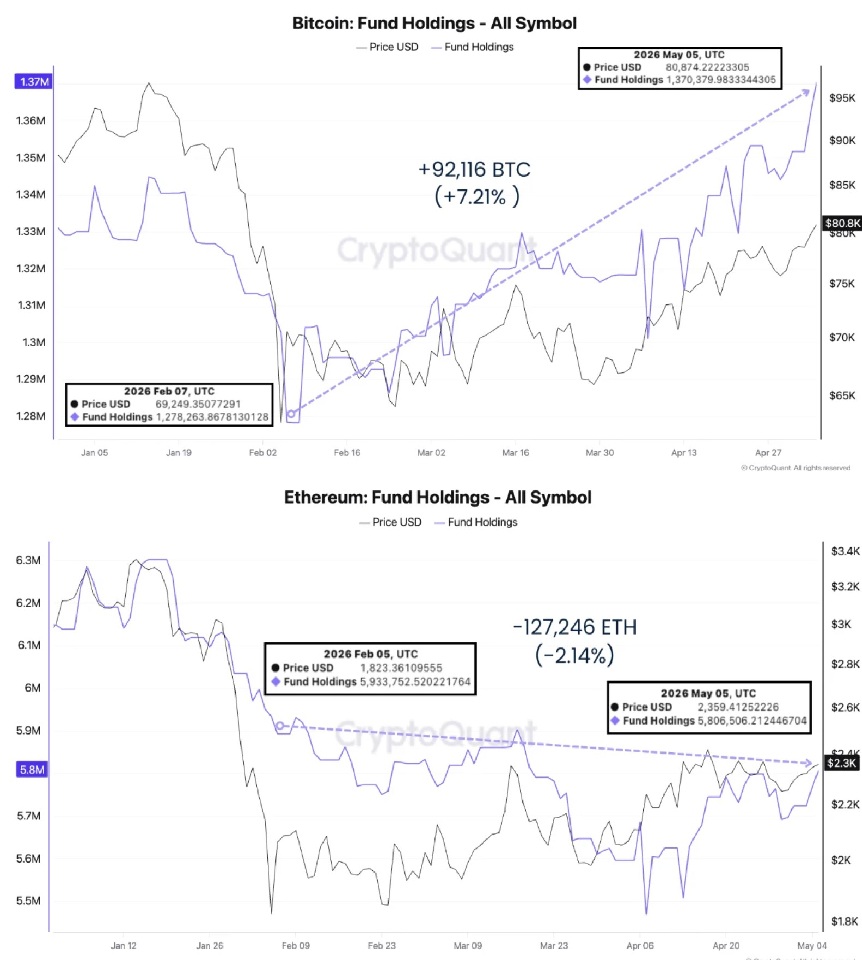
“What makes this particularly interesting is not only the divergence itself, but the relationship between the holdings and price behavior,” explains Moreno de Vicente, highlighting that the market recovery has closely followed the direction of these positions.
For the analyst, “this suggests that the institutional position is not only reacting to price action, but may be actively participating in shaping the market structure.” Under this premise, the accumulation of BTC accelerates while ETH shows clear signs of hesitation among managers.
“Bitcoin continues to strengthen its position as the macro reserve asset, the deepest liquidity and the strongest ETF narrative,” maintains the specialist. In contrast, ether tends to be perceived as a higher risk allocation. During periods of doubt, “many funds appear more willing to reduce ETH exposure first, while maintaining or rebuilding positions in BTC as the safest allocation.”
Despite this caution about ether, CriptoNoticias has reported that firms such as CoinShares maintain an optimistic long-term stance. In an analysis published on May 5, 2026, the manager stated that ETH is an “early investment opportunity.” They argue that few investors value their infrastructure, which is becoming a “key component for the future global financial system” and the support of digital finance.