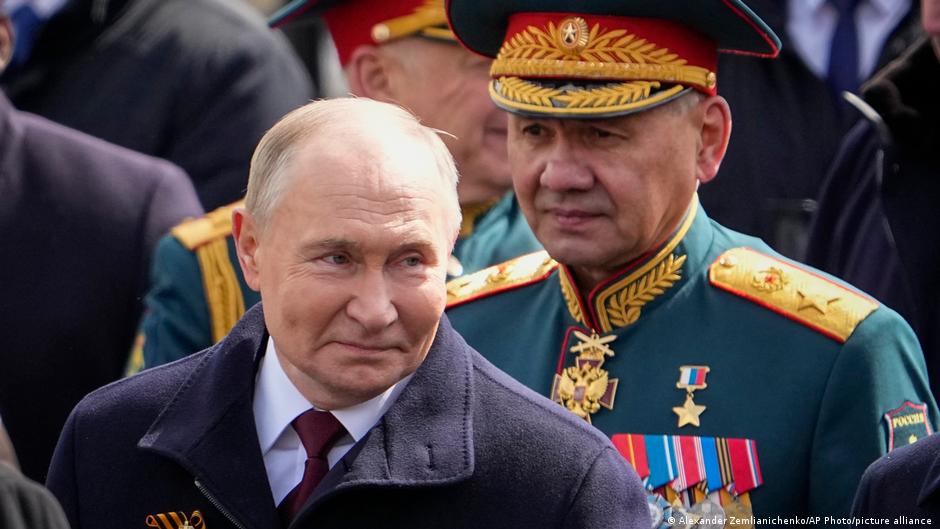
The Kremlin has drastically increased security around Russian President Vladimir Putin, apparently due to growing fears of an assassination or a coup. This is according to an unnamed European intelligence agency report that was cited by independent Russian investigative media outlets, iStories or important stories, as well as American broadcasters cnn and the British newspaper The financial Times.
The publication of these reports has divided Russia observers. Some believe that such a scenario, including threats to Putin, is likely. He argues that successful operations conducted by the Ukrainian secret service inside and outside Russia make it credible. But others think such a scenario is highly implausible and consider the leaked information another part of an ongoing campaign to destabilize the Russian leadership system.
But most experts are convinced that Putin himself is becoming more concerned about his own security, and that economic problems and increasing pressure from security forces on technocrats are increasing tensions among the Russian elite.
‘Destabilizing Actor’
The leaked report sees former Russian Defense Minister Sergei Shoigu, now secretary of Russia’s Security Council, as a potentially destabilizing actor. Russian investigative journalist Roman Anin, who founded iStories, points out that, although Shoigu has lost his former influence, he still wields great power in the military and poses a threat to Putin. The media outlet is based in Riga, Latvia.
Anin believes that tensions are rising within Russia’s state security organs and the “siloviki” or “securocrat” clans that hold most of the power in Russia.
uk newspaper Guardian The “siloviki” are described as “Russian security men who have surrounded [Putin]Many of whom have served in the KGB and maintain conservative, often conspiratorial political views.” Putin’s role as a mediator between all these groups has weakened and therefore increased tensions, Anin argued.
“For many years, Shoigu was the leader of an extremely influential clan,” he told DW. “As Defense Minister and head of the Disaster Relief Ministry, he managed to unite a large number of people under him and involve them in corrupt networks. They follow a mafia-like code.”
Shoigu and Putin were close friends for years and even spent holidays together. Pictures distributed by the Kremlin show them gathering mushrooms or fishing together in a Russian forest. For 12 years under Putin, Shoigu led the Russian Ministry for Emergencies until 2012, when Putin named him defense minister. In 2024, he was fired from that job and replaced by Andrei Belousov. Observers suggest that Shoigu lost support due to failures in Ukraine.
So far, he has avoided the fate that has happened to other high-ranking people close to Putin who have fallen out of favor.
The most recent incident involved former Deputy Defense Minister Ruslan Tsalikov, who was arrested on charges of setting up a criminal organization whose members allegedly embezzled public funds and engaged in bribery between 2017 and 2024. Another deputy defense minister, Timur Ivanov, was arrested in 2024 and sentenced to 13 years in prison in a similar case. Pavel Popov, who held the same position, was sentenced to 19 years for embezzlement; And proceedings continue against another Deputy Defense Minister, Dmitry Bulgakov, accused of corruption.
security tightened
As the unnamed European spy agency said, Putin now fears an assassination attempt organized by someone from those elite groups, possibly using drones. In April, VCHK-OGPU, a Telegram channel run by an anonymous Russian military blogger known for publishing alleged data breaches from Russian security agencies, posted that the Kremlin feared a threat from within. Among other aspects, there were concerns about a possible drone attack from inside Russia.
Because Russian intelligence services thought it might be too dangerous, the traditional Russian military parade on Victory Day on 9 May, usually held in Moscow’s Red Square, has been largely scaled down. At one point, Putin was apparently considering canceling it altogether.
In Moscow, security has been tightened in general, with communications disrupted in parts of the Russian capital as well as mobile electronic warfare systems deployed in the center – which can be used to intercept drone flights. Security is also being increased in the Kremlin.
Putin is really concerned about his security, political analyst Ekaterina Shulman confirmed on her Telegram channel. That’s why the Victory Day parade was shortened and Putin has also reduced his public appearances.
“When safety is the top priority, the safest thing to do is not be seen anywhere,” he said.
There are also concerns over the latest Ukrainian assassination attempts on the lives of Russian generals, said Abbas Galyamov, a former speechwriter turned political analyst for Putin, who now lives outside Russia for his safety. “Right now, his security is more important than his image,” he told DW.
Galyamov says he has also seen how internal conflicts within Russia’s elite military-political circles are worsening and how some clans within that milieu are acting more independently – without the Kremlin’s say-so than they would have needed in the past.
But in his opinion, various groups are avoiding open confrontation and are simply waiting for circumstances to become favourable. Galyamov is not convinced that Shoigu’s role is that big, as he sees the former defense minister as a very weak actor without the necessary resources or support.
Shulman also said that in the stories about the leaked security report, neither financial Times Nor did CNN talk about “some conspiracy led by Shoigu”.
Meanwhile, Mark Galeotti, an expert on Russian politics and head of the Mayak intelligence consultancy, said that talk of a coup “may be a deliberate deception.”
Galeotti wrote in a commentary for the British magazine, “The sudden flood of news reporting that a conveniently unknown ‘European intelligence agency’ claims the Kremlin fears a coup sounds suspiciously more like a ploy to induce paranoia in the Russian elite than a serious assessment.” audienceThis week.
They also believe that Shoigu lacks the authority and trust within leadership circles to attempt a coup.
Rival systems of protection
Additionally, the ruling elite is not a homogeneous group with common interests, former Central Bank of Russia adviser and political scientist Alexandra Prokopenko said during an interview on CarnegiePolitica, a forum run by the Carnegie Center for Russian and Eurasian Studies, a think tank in Berlin.
This is why there has been no meaningful coup attempt against Putin yet. The exception to this was the June 2023 rebellion by Yevgeny Prigozhin, founder of the militia group Wagner.
Prokopenko describes Putin’s power hierarchy as being like pyramids, each built around an individual patron, linked to the distribution of resources in Russia and access to decision-making. The patrons lack coordination with each other, which means it is difficult for them to act collectively. And as long as patrons get more from Putin than they could without him, Prokopenko explained, they have no incentive to take action against him.
However, she does not rule out that the situation could change if resources become scarce. Because of the war and international sanctions, the “cake” shared by Russia’s elite has become smaller. Often, resources are instead directed to the military or military-related industries.
All this increases rivalry and competition between different clans, and destabilizes the system in which they operate. According to Prokopenko, different groups are competing for Putin’s interest and attention so they can get a greater share of the existing pie.
In that sense, the fight is not really aimed at changing the system, she explained. It is a fight for resources and a seat at the decision-makers’ table that benefits Putin. It divides Russia’s ruling elite, forces them to prove their loyalty, and reminds them that whatever wealth and rights they have today have nothing to do with the rule of law. It all depends on the goodwill of the Kremlin.
This story was originally written in Russian.