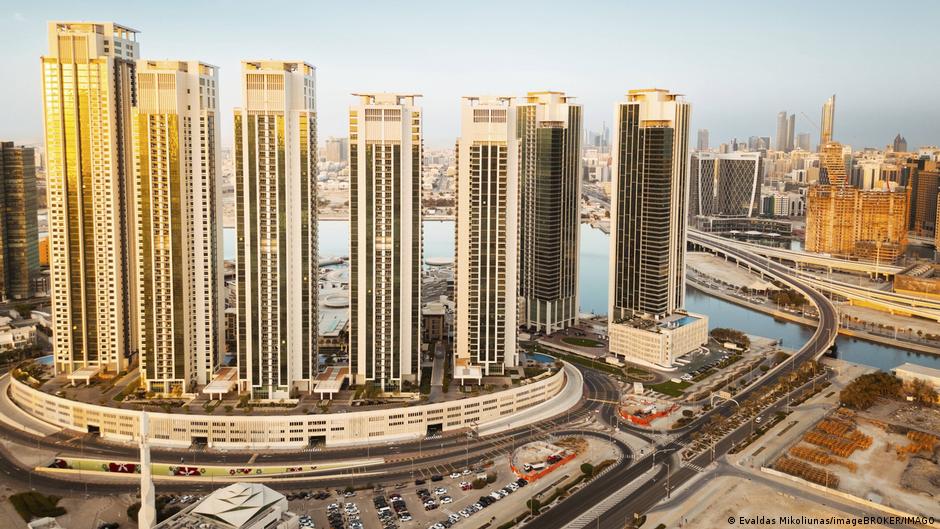
The United Arab Emirates repelled another Iranian missile and drone attack on Friday morning (May 8), despite the existing ceasefire between the United States and Iran.
The UAE Ministry of Defense advised residents not to “approach, photograph, or touch any debris or fragments that may have fallen as a result of a successful air interception.”
Earlier this week, Mohammed Abushab, the UAE’s UN ambassador to Washington, accused Tehran of targeting the Emirati Fujairah oil industry zone with 12 ballistic missiles, three cruise missiles and four drones. Iran’s military denied the allegations.
Even if disputed, the allegations reflect a widespread perception in Abu Dhabi that the UAE is increasingly the target of Iranian attacks, with more than 2,800 drone and missile attacks since the United States and Israel launched the war in Iran in late February.
UAE has relations with America and Israel
In 2020, the US brokered diplomatic relations between the UAE and Israel, named the Abraham Accords.
“The UAE’s relationship with Israel is one of the main reasons Iran attacked the UAE as punishment,” Michael Stephens, senior Middle East security adviser at the London-based Royal United Services Institute (RUSI), told DW.
“In Iran’s view, it feels like we have been hit hard by Israel, so we are going to strike at Israel’s friends,” he said.
However, in response to Iranian attacks, the UAE intensified military, security and intelligence cooperation with Israel. according to a reportby American news platform axiosIsrael sent its Iron Dome air defense system as well as operational personnel to the UAE for the first time.
“The closer the UAE and Israel get, the more reason Iran will see to target the UAE,” Stephens said. The decades-long dispute over the Abu Musa and Tunb islands – which are controlled by Iran but also claimed by the UAE – has deepened tensions between the two neighbours.
After Iran closed the Strait of Hormuz, which blocks oil exports to Bahrain, Kuwait and Qatar and halts exports to Oman, Saudi Arabia and the United Arab Emirates, it was Abu Dhabi that also called for not only the reopening of the Strait of Hormuz but also for stronger international action.
Emirati officials have been more harshly critical of Tehran than other targeted Gulf countries such as Saudi Arabia, Oman or Qatar. “Plus, it puts them closer to the US and Israel,” Stephens said.
Cinzia Bianco, a Gulf analyst at the European Council on Foreign Relations who is currently in the UAE, argues that Tehran wants to inflict enough pain on the UAE to pressure it into urging US President Donald Trump to halt military operations on its behalf.
“Only, the Iranian hostility pushed them in the opposite direction, so it was incredibly misguided,” he told DW.
Meanwhile, the Iranian attacks have taken on an existential dimension for the UAE, Bianco says.
“UAE officials told me that Iran wants to undermine the country’s core model, which is built on the idea that the Gulf can remain secure and extremely prosperous despite regional instability,” he said.
UAE deviation course
Over the past years, the UAE has increasingly aligned its foreign policy with a plan to diversify away from oil and transform itself into a regional hub for digital infrastructure, tourism, trade and investment, called UAE 2031.
It has also adopted policies that differ from those of its much larger neighbor, Saudi Arabia. While the United Arab Emirates and Bahrain normalized ties with Israel, Saudi Arabia suspended normalization talks on October 7, 2023, following Hamas terrorist attacks on Israel and the ensuing two-year war in Gaza.
On May 1, the UAE also left the Organization of the Petroleum Exporting Countries (OPEC) and the broader OPEC+ alliance, which remains dominated by Saudi Arabia, the group’s biggest oil exporter.
Saudi Arabia and the United Arab Emirates are also supporting opposing sides in several conflicts in Africa.
“The UAE has become one of the most aggressive external actors in African conflicts,” says Wolfram Lacher, senior associate for Africa and the Middle East at the German Institute for International and Security Affairs.
In recent years, it has been involved in Libya and Ethiopia, and is currently most prominently involved in Sudan, Somalia and Yemen, he told DW.
“This is essential for the UAE as these corridors ensure long-term access to strategic resources and trade routes,” Recently said. Analysiswhich was co-authored by Latcher on the think tank’s website, states. “Military intervention can therefore be seen as a tool to protect these economic interests,” it concluded.
However, there are hardly any Emirati shoes on the ground.
Lacher said, “A defining feature of the Emirati involvement is the limited deployment of its own military forces, but exerting influence through local partners, often non-state armed actors such as Khalifa Haftar in Libya and the leader of Sudan’s Rapid Support Forces, Mohammed Hamdan Dagalo, known as Hemedati.”
He said the UAE also provides military equipment to foreign fighters and mercenaries, including Sudanese fighters in Libya and, most recently, Colombian mercenaries in Sudan.
Emirati officials consistently deny any involvement in these activities. “But the available evidence is sufficient,” Lacher said.
Edited by: Rob Mudge