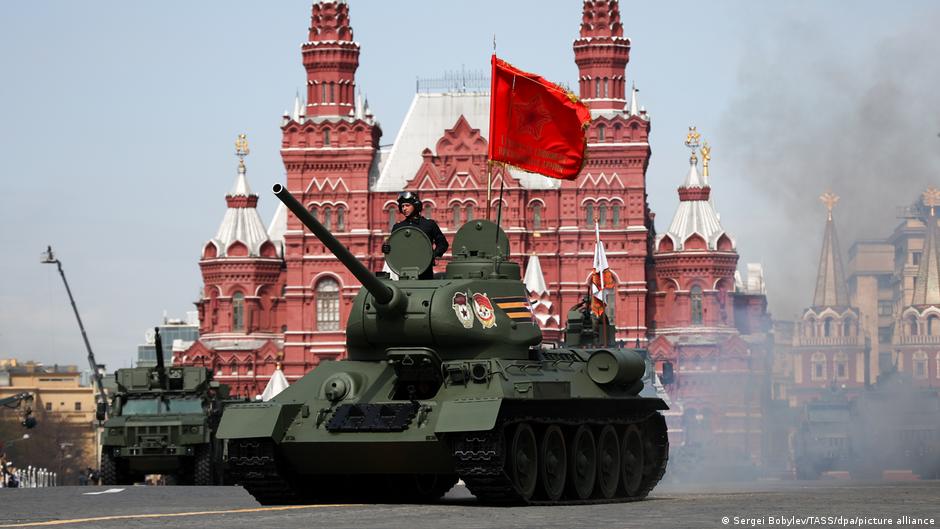
The traditional Victory Day parade in the Russian capital Moscow on May 9, 2026 will be scaled down. There will not be the usual display of military vehicles on Red Square, and no cadets from prestigious military academies will participate in it.
Russia’s Defense Ministry cited “the current operational situation” as the reason for the decision. Russian President Vladimir Putin’s press secretary Dmitry Peskov reported that no military hardware would be used at the ceremony due to the “terrorist threat” from Ukraine.
Victory Day celebrations have been completely canceled in some regions of Russia. There will be no parades in Nizhny Novgorod, Saratov, Chuvashia and Kaluga, and no fireworks in Voronezh, Kursk, Bryansk and Belgorod.
St. Petersburg descended to a tribune on Palace Square
According to Russian news site fontankaCelebrations in St. Petersburg, Russia’s second-largest city, will also be more subdued than usual: “There won’t even be a restored T-34 tank on display – in recent years, it was usually the first tank presented.”
And instead of the usual three tribunes, there will be only one on Palace Square, which will seat about 300 people. Veterans of “special military operations”, as Russia’s war in Ukraine is officially called, have been invited to take part.
Markus Reisner, a historian at the Theresian Military Academy in the Austrian city of Wiener Neustadt, told DW that recent Ukrainian drone attacks on the Russian city of Perm showed that “Ukraine is capable of attacking practically any target in western Russia.” He added that “despite the dense air defense network around Moscow” the risk of a saturation attack was increasing.
He also pointed out that the equipment and vehicles used in the parade were currently in use at the front, as well as the logistics support that would have been used to transport them.
He argued that the reason they would not be displayed was, “not because of the terrorist threat that Peskov has talked about, but because the war is swallowing up all the resources.” Russia still has enough equipment, he said, “but the logistics required to move it back and forth require a disproportionate effort.”
Kremlin doesn’t want to ‘attract too much attention’
According to military expert Jan Matveyev, the Russian Armed Forces have sufficient military equipment in addition to air defense. “Tanks, armored vehicles, infantry fighting vehicles and artillery are currently being deployed to the front lines only to a limited extent. It is entirely possible to provide equipment for the parade,” he told DW.
“Possibly,” he said, the Kremlin feared that using the equipment in the parade could make it a target of Ukrainian forces. “The second reason is that, given the unsuccessful war, he does not want to draw too much attention to military equipment so as not to further anger an already dissatisfied public.”
Matveyev pointed out that so far Moscow’s air defense system had been able to effectively thwart Ukrainian drone attacks, but he acknowledged that it was impossible to predict what would happen in the event of a large-scale attack. “There is always a risk that one or three drones could breach the security. All other measures like shutting down the internet will certainly not stop them.”
Military parades follow Soviet patterns
Alexey Uvarov, a historian at Ruhr University in Bochum, pointed out that military parades held on Victory Day in post-Soviet Russia largely followed the tradition of communist celebrations held on May Day (1 May) and October Revolution Day (7 November).
However, he pointed out that during Boris Yeltsin’s presidency in the 1990s, the May 9 parade was not yet a regular event.
“In 1995 and 1996, an attempt was made to appropriate the theme of the ‘Great Patriotic War,'” he said, explaining that the government in this way “tried to win over communist voters and unite various social strata around it, including those who did not support Yeltsin.”
He said that later much importance was given to inviting foreign guests. In 2005, European leaders, US President George W. Bush and the Chinese President attended. But with time the importance of foreign guests diminished and now their role has become secondary.
Today, demonstrating “normality and control” was the main focus, Uvarov explained. “It’s as much a symbolic parade piece as the president’s New Year’s address.”
‘The parade must happen, simply because it must happen’
For Uvarov, the year 2020 demonstrated how important the parade was to the Russian government, given that it took place despite the COVID-19 pandemic. As it expected this year, the Kremlin wanted to show that it had the situation under control. Uvarov said, “The parade must happen, because it must. It serves to maintain the appearance of normality, even if that normality is already crumbling.”
“The memory of World War II and the victory of the Soviet Union is an important instrument in the Kremlin’s memory politics,” political scientist Ivan Fomin told DW. “These narratives play an important role in underpinning the regime’s legitimacy. Even the current war with Ukraine is often interpreted as a parallel to that war.” This, he said, illustrated the Kremlin’s desire to “preserve the familiar forms and rhythms of the commemoration.”
Fomin does not believe that fewer parades will have much effect on Putin’s popularity [people’s] Trust in government. “This may be another symptom of the state’s inability to fully address current challenges and maintain normal life in wartime,” he said, pointing out that there were already “internet blackouts, drone attacks, etc.”
He speculated that the parade could lose its significance for many Russians who previously watched it for the military equipment on display, causing them to skip it this year and possibly in the future.
Fomin also believes that Peskov’s comments linking the reduced parade to the possibility of Ukrainian attacks could have an impact on the Russians as well.
On the one hand, he said, he suggested that the government was unable to guarantee security in the capital. On the other hand, they may further inflame anti-Ukrainian sentiment.
Fomin said, “People may see this as Ukraine disrupting their normal celebrations, losing the opportunity to celebrate an important anniversary. Reactions will vary.”
This article was originally written in Russian.