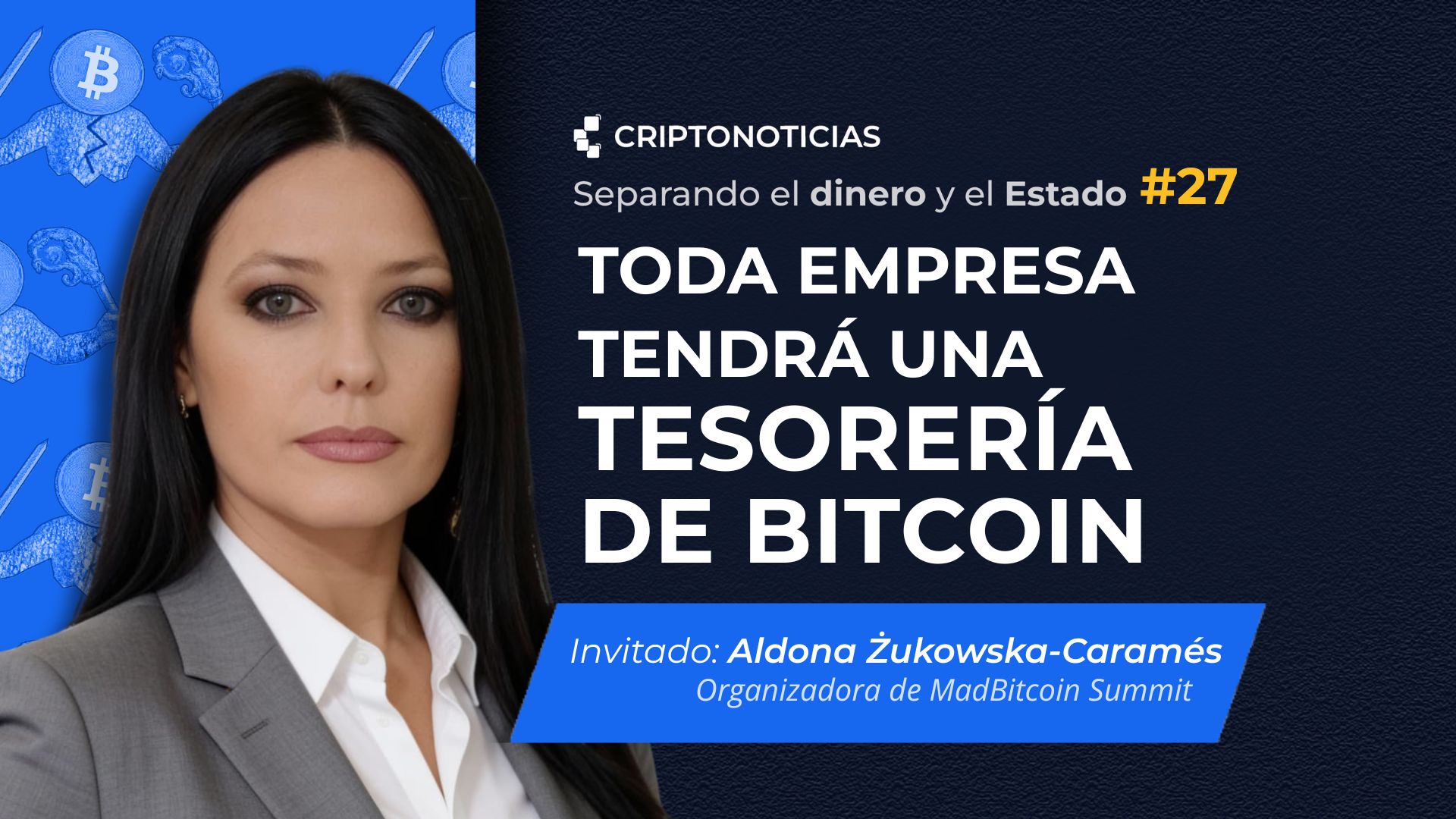
Aldona Żukowska-Caramés arrives at episode twenty-seven Separating Money and State with an unusual credential: twenty years in traditional banking—Santander, Unicredit, Openbank—building operations, technology centers and transformation projects, before crossing over to Bitcoin after Michael Saylor’s discovery during the pandemic. Its central thesis, today materialized in MadBitcoin and in the MadBitcoin Summit held in Madrid, is that Bitcoin is the only real alternative to the fiat system, but mass adoption will not come through cypherpunk but through institutional means: banks forced by MiCA, pension funds diversifying, treasury companies integrating Bitcoin into their balance sheets. The conversation intertwines his Polish biography—childhood under communism, passport control, scarcity—with his current diagnosis of Europe: a society that is losing freedoms without realizing it, and where Bitcoin operates as a tool of individual sovereignty.
The episode turns towards its harshest core when Iván introduces suspicions about the financialization of the ecosystem: are Bitcoin treasurers replicating the structured products that exploded in 2008? Are they companies with a product or funds disguised as a company? Does institutional adoption liberate or capture? Aldona pragmatically defends the opening of institutional avenues—ETFs, preferred ones like STRC, bonds with Bitcoin collateral, pension funds—arguing that the underlying changes the risk equation and that Without these doors there will be no mass adoption. It recognizes the counterparty risk and the persistence of the fiat system as an inevitable short-term horizon, but is betting on a “Trojan horse” strategy: entering the system by selling Bitcoin to transform it from within. The episode closes with a personal statement: Bitcoin, Aldona says, gave her life and hope back, and that is the underlying pedagogical commitment of the Summit she organizes.
The most relevant:
- Aldona Żukowska-Caramés is Polish, she arrived in Spain in 2007 having recently graduated in economics, finance and banking.
- His first job was in one of the Big Four; She went through university as a professor of macro, micro and finance; He later moved to Spain to work at Banco Santander.
- He has almost 20 years of career linked to banking or banking consulting, specializing in transformation, expansion and operations projects.
- His first serious encounter with Bitcoin and blockchain was at the European Blockchain Convention in Barcelona in 2018, the first edition of the event.
- He received a three-day internal course on Bitcoin during his time at Openbank, taught by Luis Pastor of Bit2Me.
- He began public outreach about Bitcoin starting in March 2024, first with articles on LinkedIn, then with the MadBitcoin Podcast (35 episodes recorded at the time of the interview).
- She is the founder and CEO of MadBitcoin and organizer of the MadBitcoin Summit, the first major Bitcoin-only and institutional conference in Spain.
- The first edition of the conference will be held in Madrid in May 2026.
- Aldona affirms that the banking system continues to depend, behind modern apps, on manual processes carried out by people.
- He cites the case of Canada during the pandemic, where bank accounts of protesters were blocked, as an example of the fragility of the fiat system in the face of political pressure.
- His father, in communist Poland, had to ask for permission to travel to Germany and return his passport upon returning.
- He mentions that his parents were able to pay for their house in five years; In Spain, mortgages currently extend up to 30 or 35 years.
- He cites that “the dollar has lost 50% in the last five years” as an argument for diversifying into Bitcoin.
- It identifies Vanari as the first Bitcoin treasury company in Spain.
- It confirms that Standard 21, a Spanish Bitcoin developer company, plans to go public next year.