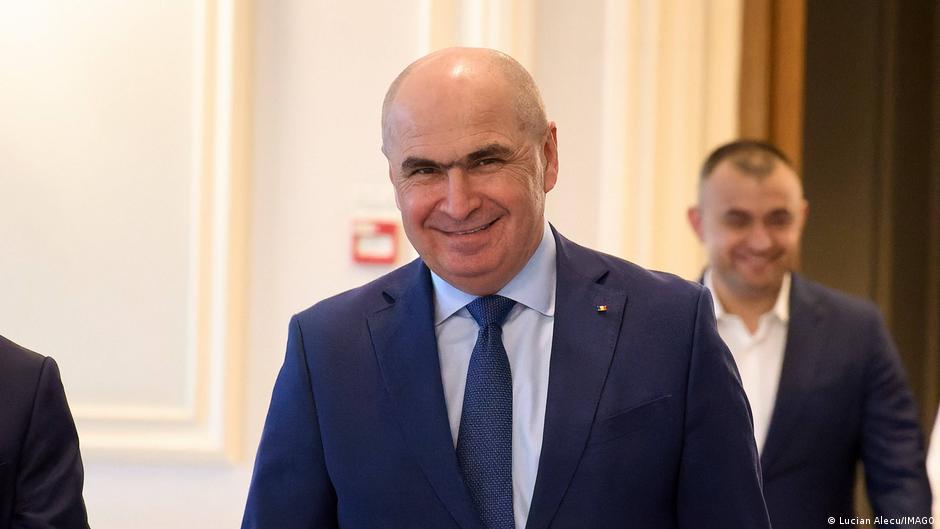
Lawmakers in Romania voted on Tuesday to oust Prime Minister Ilie Bolojan from office.
The motion passed with 281 votes, a majority of about 50 out of 464 seats in both houses of Parliament.
It is unclear what this would do to the debt-laden EU member state, which has long been unable to join the eurozone because of its own economic difficulties.
More than 254 MPs voted to remove Bologen, who supported the motion to table a vote, any number above 233 would have been enough to remove him.
Who was in the coalition government and why did it break?
Romania formed a rainbow coalition last year after President Nicosor Dan won re-election in May 2025 presidential elections, amid the growing influence of the far-right opposition in parliament.
Dan named Bologen as his prime minister in June after signing an agreement between four parties, Bologen’s centre-right National Liberal Party (PNL), the Social Democrats (PSD) – the largest bloc in parliament with 93 seats – and two other pro-European parties.
The new government inherited the faltering public finances and the need to comply with the EU’s excessive debt procedures, which Romania has been facing continuously since 2020. In the last quarter of 2025, the public deficit reached 7.9% of GDP, while EU rules for bidding members exceeded 3%.
The swingeing cuts required to try to keep in touch with European debt targets were particularly unpopular with the PSD, which left the coalition last month and filed a vote of no confidence with far-right opposition parties.
The PSD’s early allies, the more centrist or centre-right pro-European parties, were highly critical of the move, saying it risked normalizing once-ostracized, Eurosceptic right-wing parties.
In the debate before the vote, Bologen called the proposal “eccentric and artificial” and said it seemed to be on behalf of those who did not participate in the government.
“This is condemnable, because it does not take into account the context in which we find ourselves,” he said. “I took up the post of Prime Minister, knowing that it comes with immense pressure and that I would not get appreciation from the citizens. But I chose to do what was urgent and necessary for our country.”
What did Romanian politicians say in response?
George Simeone, leader of AUR, Romania’s largest far-right party, celebrated the result online.
Simeone wrote, “The Bologna government has recently been ousted by the Romanian Parliament. The end of ten months, during which the so-called pro-Europeans have delivered nothing but taxes, war and poverty.” “The voice of the Romanian people was heard today. Time for national reconciliation!”.
The leader of the Social Democrats, Sorin Grindeanu, said after the vote that his party was willing to work toward a quick solution, saying, “Let’s quickly form a government” and insisting that “all options are open.”
“I hope that in the times to come, [President] Nicosur Dan will call us for consultation. “It would be normal for Ilie Bologen to resign as prime minister, even if it is interim, because we are talking about a massive voter turnout,” Grindeanu said, adding that he wanted to find a quick solution and move on.
Before the vote, he had said that the PSD was not interested in a coalition with the far-right, only that they shared a common goal of removing Bologen as Prime Minister and breaking the coalition government he had left.
what happens next?
What will happen now that Bologna has fallen is not set in stone. As Grindeanu said, Bologen would likely lose his position, and the more likely scenario is a much longer prolongation of coalition talks.
This could eventually lead to a four-party coalition as before – as all four parties are needed to claim a stable majority. It appears that a new Prime Minister could possibly even be from a different party within the coalition.
President Nikosor Dan sought to assure journalists and other European leaders gathered in Armenia on Monday that he would work to maintain stability and fiscal discipline.
“The political discussion will be difficult, but as president it is my responsibility and the responsibility of the political parties to take Romania in the right direction,” he told reporters. “I invite you to remain calm. I want to tell the market that Romania is sticking to its commitments on the deficit.”
The value of the Romanian currency, the leu, has fallen slightly against the euro in recent days amid the uncertainty. Bucharest plans to join the eurozone single currency but does not yet meet the economic requirements to do so.
Edited by: Roshni Majumdar, Alex Berry