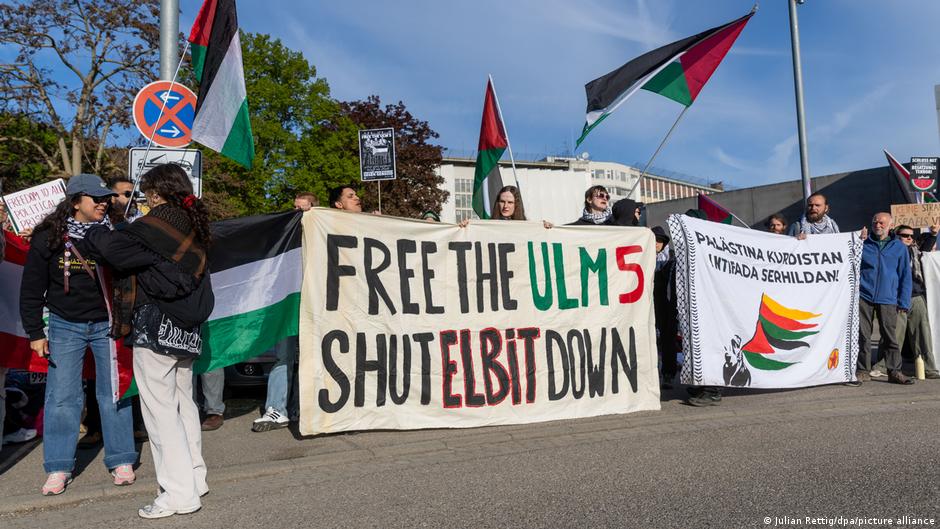
The trial of five activists accused of attacking a German branch of Israeli arms manufacturer Elbit Systems in September 2025 has started. The first hearing began on April 27 in a high-security court in Stuttgart, but was canceled within minutes after defense lawyers objected to the fact that they were unable to communicate confidentially with their clients.
Elbit Systems is one of Israel’s largest arms manufacturers, with subsidiary factories in several countries. The company makes drones, command-and-control and telecommunications equipment for many other militaries, including the German Bundeswehr. Germany is Israel’s second largest arms supplier.
The defendants, who hold UK, Irish, German and Spanish citizenship, have been charged with trespass, destruction of property, membership of a criminal organization and using symbols of terrorist organisations. He has been held in different prisons since his arrest on September 8, 2025 and faces several years in prison if found guilty.
Videos posted online showed activists breaking into Elbit System’s subsidiary offices in the southern city of Ulm, damaging several computers and other technology equipment and spray-painting slogans on the walls, including “baby killer.” According to the defense, when security personnel at the site alerted the police, the workers waited at the site to be arrested.
Prosecutors describe ‘Palestine Action’ group as ‘criminal organization’
The group is being charged under section 129 of the German Criminal Code, which prohibits the formation and membership of criminal organizations. This section has become controversial in recent years as prosecutors have increasingly used it against other protest movements such as the climate group Last Generation. Amnesty International and others have argued that this section is being abused by German prosecutors. “This risks linking legitimate civil engagement with organized crime,” Amnesty International Germany spokeswoman Paula Zimmermann told DW in a statement.
Stuttgart state prosecutors argued that the use of section 129 was lawful, because the group “Palestine Action Germany”, to which they say the defendants belong, has been considered a “criminal organization” for prosecution by several courts. “This legal interpretation has also been adopted by various courts in all rulings handed down to date in this case – most recently by the Higher Regional Court of Stuttgart,” a statement from DW said. The defense told DW that prosecutors have not proven that “Palestine Action Germany” even existed as a formal organization.
The defense argues that the “Ulm 5”, as the group is known, were trying to stop Israel’s genocide in Gaza by “assisting in self-defense”. German media, citing Elbit Systems spokespeople, reported that the Ulm facility was used for telecommunications parts sold to the German military.
Matthes Breuer, defense attorney for defendant Leandra R., said, “This is false. We have evidence that the research they are doing in Ulm is critical to drone manufacturing. We have evidence that parts from Ulm are being delivered to Elbit facilities in Israel – technical components for tanks and drones.” He said that this evidence will be presented before the court in the trial.
Proceedings adjourned
The trial took place in a high security court in Stammheim prison, the same courtroom where the infamous trial of leftist RAF terrorists took place in the 1970s. The defense and many observers of the German media have taken the choice of site as an attempt to portray the Ulm 5 as terrorists.
The trial got off to a stormy start in late April, as 11 defense lawyers refused to sit because their clients were placed behind a glass separator, preventing direct contact with their lawyers – a clear violation of attorney-client confidentiality, the lawyers said.
“At one point I had to shout over the window,” Breuer told DW. “There was no possibility of our conversations taking place without surveillance. In theory, whatever my client discussed with me would have been overheard by the court.”
“I’ve never had this problem before,” Breuer said, adding that he had written to the court a month before the hearing to clarify these issues, but received no response. “That was not a court hearing, that was a show to make our clients look like terrorists. This court is not neutral.”
After a two-hour break, the judge adjourned the proceedings completely, and it is still unclear how the impasse will be resolved, as the next two court dates have been cancelled, and the next hearing is scheduled for May 11.
Speaking from outside the courtroom on April 27, Josie, a partner of defendant VK, said the state’s actions have been inconsistent. “These are five activists who carried out this action targeting only material property,” Josy told DW. “They did not attempt to harm anyone, they are not a danger to society, they do not deserve to be in a glass separator.”
conditions of detention
Partners and relatives of the defendants, known as the “Ulm 5”, say the German state is trying to make an example of them, both through unusually long pre-trial detention – more than seven months – and what they say are particularly harsh detention conditions.
In a statement emailed to DW, the Stuttgart Higher Regional Court said the law allows the court to determine that pre-trial detention can be extended beyond the prescribed six months under certain conditions. “The Higher Regional Court based its decision, inter alia, on the existence of a flight risk, which would not be adequately reduced even by the posting of bail,” the statement said. “Visitations and telecommunications require authorization and are monitored if the requirements of such order are met.”
Meanwhile, the Stuttgart prosecutor said he had not requested any special conditions of detention. A spokesperson said, “These are standard sanctions under German criminal procedure law that accompany a court order for pre-trial detention.”
But friends and family of the defendants are not happy. “I think this is all completely unfair,” Josie said. “The five took this action and waited for the police to arrive. They did not resist arrest, they did not hide their faces, they did not attempt to flee. The action was clearly a political statement. They all have studies or work or other commitments in Berlin. They have no incentive to flee the country. They were willing to take responsibility for their actions the entire time.”
The International Court of Justice (ICJ) is investigating Israel’s conduct in Gaza as South Africa launches a case at the UN’s top court in December 2023, alleging it amounts to genocide. Israel’s conduct in the war has been considered genocide by many international rights organizations and a United Nations commission. Israel denies this.
Edited by Reena Goldenberg