Berlin is a city full of graffiti: colorful and loud, imaginative, annoying and often political. It seems that spray paint has taken over the city for a long time. Yet on April 11 this year, three large words were sprayed on the side of a building in the Prenzlauer Berg district, calling in English for the murder of all Jews, sparking outrage and shock.
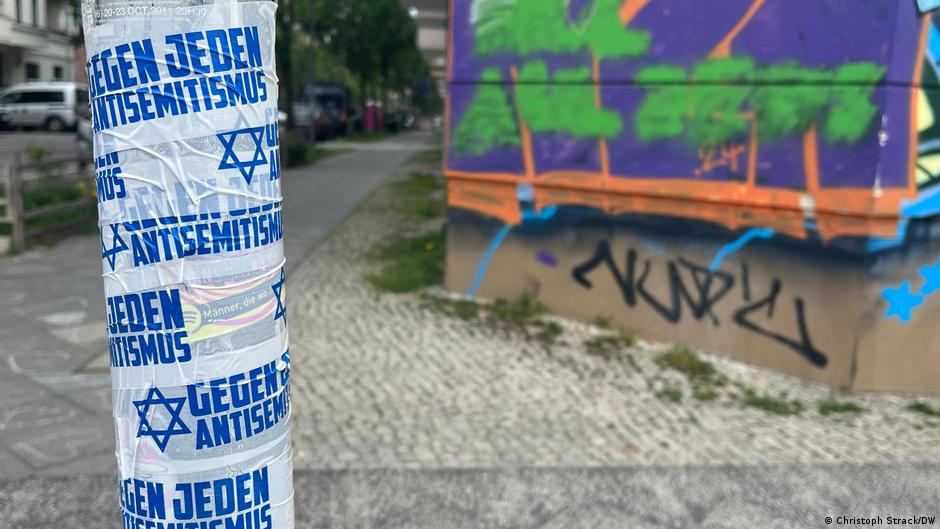
The words were quickly covered over and then painted over – yet if you look carefully the message is still visible (top photo). True to the character of Berlin, civil society reacted: residents held vigil. Blue and white ribbons now hang from lampposts and traffic signs with the words “Against all anti-Semitism” next to the Star of David.
‘No room for hatred’
Children covered about a hundred meters of sidewalk in the district’s Uckermunder Strasse with chalk and wrote messages such as “No room for hate,” “Respect,” “Solidarity,” and “Our neighborhood stands together.” Police notices were pasted on front doors in the area, declaring: “Inciting anti-Semitic hatred by causing damage to property through graffiti.”
The day after the vigil, a few kilometers away in West Berlin, at the premises of the Jewish Chabad movement, the executive committee of the centre-right Christian Democratic Union (CDU), led by party leader Chancellor Friedrich Merz, convened. They are welcomed by the capital’s most prominent rabbi, Rabbi Yehuda Teichtel, who appeals to focus on the good, rather than on the signs of hope and darkness.
And the rabbi has built an excellent campus with a gymnasium, classrooms and a multi-purpose hall, a kindergarten and a café. All this is located behind a fortified entrance area that may also belong to the airport security checkpoint. Outside under the open sky, school children welcomed the leaders by singing songs. Merz responded to them by saying: “We protect you.” To ensure the safety of the children, members of the press were instructed not to take photographs of the pupils.
“Jewish life in Germany is more in danger than ever before,” Merz said on camera. Much has been written in the German press these days about Merz’s leadership style and his alleged lack of empathy. Yet in Berlin and Munich last fall, when he gave two speeches recalling the horror of Nazi Germany’s mass murder of the Jewish people and addressing the new fear felt by Jewish women and men, he briefly appeared to fight back tears.
Such a meeting of the Chancellor’s Party Executive, held in this form for the first time in a Jewish institution, required careful preparation – it was not simply a reaction to outrage over the graffiti. However, in his statement, Merz explicitly mentioned not only the “rapidly increasing number of crimes and attacks”, but also “stains containing anti-Semitic material on the walls of the house”. He said that anyone attacking Jewish life in Germany “attacks our society and attacks our democracy.”
Along with other executive committee members, Merz attended a reception at the synagogue on the Chabad campus. The rabbi said a brief prayer for peace and tolerance, and each guest received a gift: a Jewish book of psalms embossed with their name. But the party leadership also wanted to give a political signal.
‘Combat all forms of anti-Semitism’
“Jewish life is part of Germany,” declared the five-page resolution that the party’s top leadership later adopted during their meeting at the education center. “As Germany’s CDU, we will clearly recognize and combat every form of anti-Semitism.”
The document states in the familiar register of political proposals: “Where hatred of Jewish life grows, democracy is in danger.” But what does this mean in concrete terms for the people whose building facades are suddenly scrawled with hate slogans, whose names are sprayed and marked on doorbell plates, who – as has also been recently documented in Berlin – are harassed in the street because they wear a kippah, a traditional Jewish head covering?
In search of answers to protect Jewish life, the CDU is noticing growing popular dissatisfaction with the way Israel’s government treats its neighbors: between Israel’s war in Gaza, which has killed thousands of civilians, according to conservative estimates, Israeli attacks in Lebanon, and the US-Israeli war with Iran, anti-war protests in Berlin have become a recurring theme.
The CDU’s declaration includes some concrete points on criminal law and financial sanctions. Yet, it repeatedly relies on calls for a “comprehensive social stance”, a “comprehensive social stance”, a “clear stance”. However, when it comes to actual measures, the document remains vague.
On May 5, Israeli Foreign Minister Gideon Sa’ar arrived in the capital for a two-day visit, speaking with German politicians and attending an event organized by the CDU Economic Council.
Saar also visited the German Foreign Ministry and gave a brief statement to the media along with his German counterpart Johann Wadefull. At one point he said that Jews “are the only people who are physically attacked everywhere – because they are Jews – even when they live far away from the conflict in the Middle East.”
He visited the Track 17 Holocaust Memorial at Berlin’s Grünewald S-Bahn station, where visitors can stand on the edge of the same platform from which the Nazis deported more than 10,000 Jewish women and men to their deaths in 1941 and 1942. Part of the memorial consists of steel plates laid out along the track, each listing a deportation train, its date, the number of people aboard, and its destination in Eastern Europe.
Despite having a railway line and motorway nearby, it is a quiet place. Trees have grown between the tracks for a long time. Escorted by several police officers, Saar arrived in a convoy of fifteen limousines without any German politicians. The minister was given a brief description of the site, lit two candles, and then stood in front of the memorial plaque alongside Israel’s Ambassador to Germany Ron Prosor and Rabbi Teichtel.
Berlin’s eyewitness and his warning
Meanwhile, Berlin and its Jewish community sent their own message this week: The square in front of the Berlin State Parliament is now named Margot Friedlander Platz. The street sign was unveiled by Mayor Kai Wagner, who previously said it “sends a powerful signal against anti-Semitism, against forgetting – and for democracy and human dignity.”
May 9 marks the first anniversary of the death of Margot Friedlander (1921–2025) and will be celebrated for the first time. The honorary citizen of Berlin survived the Holocaust as a young woman, before emigrating to New York in 1946. In 2010, she returned to live in the capital city.
With each new shock and new incident of hatred towards Jews in Berlin, the importance that Friedlander placed on his last years becomes even more apparent. As an eyewitness to terror and a voice warning against hatred, he did not press charges – he spent the rest of his life appealing to a common humanity.
This article was translated from German.