Religious and ethnic divisions are deepening in Bengal, a region divided between India and Bangladesh. Politicians on both sides of the border are trying to capitalize on religious sentiments.
In Bangladesh, February’s parliamentary elections marked a major moment for Islamic politics, with Jamaat-e-Islami winning almost a third of the vote nationwide – its strongest showing to date.
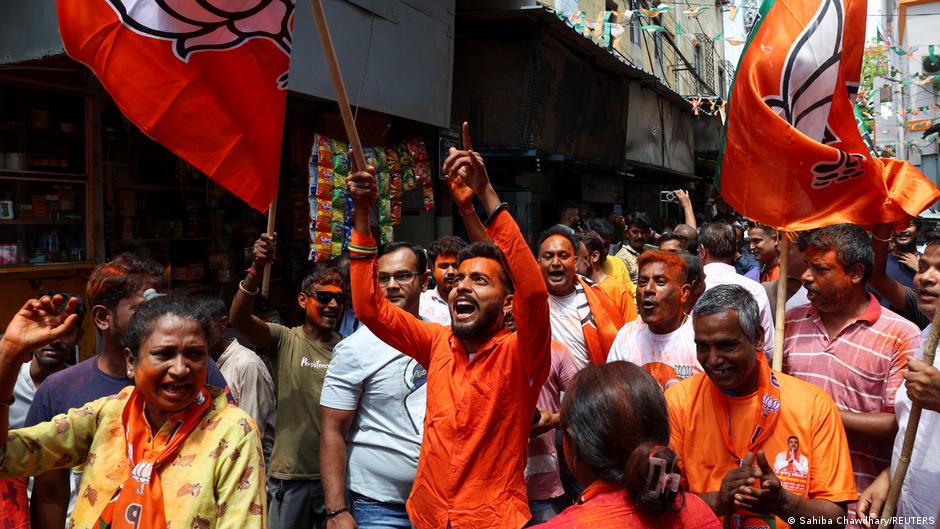
In West Bengal, India, the Hindu nationalist BJP’s vote share rose from about 10% in 2016 to about 46% this year. Under the state’s “first past the post” electoral system, this was enough for the BJP to secure 207 out of 294 seats in the state assembly last month.
Bangladeshi anthropologist Rezwana Karim Snigdha has warned of a “misguided” change in rhetoric in Bengal.
He told DW that the region once boasted a “shared identity” that “allowed people to be both Bengali and Hindu, or Bengali and Muslim.” “But on both sides of the border, political narratives are increasingly framing identity in religious terms, sidelining language, culture and heritage.”
New politics on old fault linesS
Bengal, largely the land of Bengali-speaking people, has been divided several times over the centuries, most notably in 1905 when the British rulers under Viceroy Lord Curzon divided the Bengal Presidency on religious lines.
At the time, Bengal was the center of anti-colonial resistance, and partition was intended to break this unity by setting the Hindu-majority West against the Muslim-majority East. London hoped to weaken the growing nationalist movement before it could seriously challenge British rule.
Muslim Bengalis, formerly concentrated around Dhaka, largely welcomed the partition of 1905 because it created an area where they became the majority. In contrast, many Hindu elites opposed the move, considering it a threat to their political influence, economic interests, and cultural identity.
Britain’s strategy of ‘divide and rule’ continues
Indian historian and post-colonial theorist Dipesh Chakraborty says that the “divide and rule” strategy introduced by the British a century ago still shapes the region today.
“The Hindu elite failed to understand this moment,” he told DW. “Accepting partition would have given Muslims reassurance that they were not being dominated.”
Stiff opposition forced the British to reverse the 1905 partition in 1911, but the underlying divisions persisted. They re-emerged in 1947, when Bengal was again divided – this time permanently – between Hindu-majority India and Muslim-majority East Pakistan.
Identity politics is reshaping Bengal’s shared past
When Bangladesh was created in 1947, it was originally a part of Pakistan. Within a few years, Bengali Muslims began to protest for the recognition of Bengali as the state language.
Over time, economic and political marginalization strengthened Bengali nationalism, ultimately leading to the War of Independence in 1971, which established Bangladesh as a Muslim-majority independent country.
Bangladesh’s founding leader Sheikh Mujibur Rahman made secularism one of the core principles of the country’s constitution. However, after his assassination in 1975, the constitution was changed to include the phrase “Bismillah ar-Rahman ar-Rahim” (In the name of Allah) and Islam was recognized as the state religion.
Gradually, political elites promoted religious narratives over secular ones.
Anthropologist Snigdha describes this change as “nothing but a political tool” to “keep people divided and controlled”.
Angry Bangladeshi youth in search of change
In 2024, a popular uprising led by Gen Z took place in Bangladesh that ended the 15-year rule of Sheikh Hasina’s Awami League. The rebellion was sparked by anger over democratic decline, corruption, restrictions on freedom of expression and curbs on press freedom.
Similar criticism has also been leveled against Mamata Banerjee’s Trinamool Congress (TMC) rule in West Bengal. However, unlike in Bangladesh, the party was removed from power through elections.
Indian Bengali author and analyst Abhra Ghosh argues that the BJP’s landslide victory reflected voter dissatisfaction more than ideological support for Hindutva – an assertive Hindu nationalist identity.
“It was less a vote for Hindutva and more a vote to reject TMC at any cost,” he said.
Also, Ghosh believes that the BJP’s efforts to promote Hindutva could gradually take root in West Bengal if the party remains in power.
“Early signs of this change are already visible,” he said.
BJP is in power at the national level in India under the leadership of Narendra Modi. The nationalist party also now rules the states of West Bengal, Assam and Tripura – all of which border Bangladesh and are home to significant Bengali-speaking populations.
Ghosh said that since its victory in West Bengal last month, BJP leaders have largely refrained from making statements openly promoting hatred or hurting religious sentiments.
Appeasement politics has backfired in Bangladesh
Under Hasina’s leadership, Bangladesh made partial concessions to religious and nationalist forces – expanding madrassas, removing secular content from textbooks under Islamist pressure, and building hundreds of mosques. The government justified the mosque construction as an effort to counter radicals such as Jamaat-e-Islami.
“There is still a search for a form of secular identity that is compatible with Islam, not contrary to it,” Chakraborty told DW.
Across the border, critics have accused TMC’s Mamata Banerjee of adopting a similar strategy, including support for projects like the Digha Jagannath temple, a major pilgrimage site, to attract Hindu voters while maintaining a secular stance to maintain support among Muslim communities.
“These appeasement policies have strengthened fundamentalist politics rather than promoting harmony,” Chakraborty said.
Ideals put under pressure by Bengali stalwarts
Snigdha argues that balancing secularism “without hurting religious sentiments” is deeply rooted in Bengali culture, but efforts to reshape it for political gain have “backfired”.
He said that famous Bengali thinkers and poets like Lalan, Rabindranath Tagore and Kazi Nazrul Islam were supporters of unity among all religions. However, his views are “now under pressure” as politics is becoming more divisive, Snigdha said.
“When someone identifies themselves as Bengali rather than Hindu or Muslim, it transcends boundaries and challenges the political narratives built on those divisions,” he told DW.
Edited by: Darko Janjevic