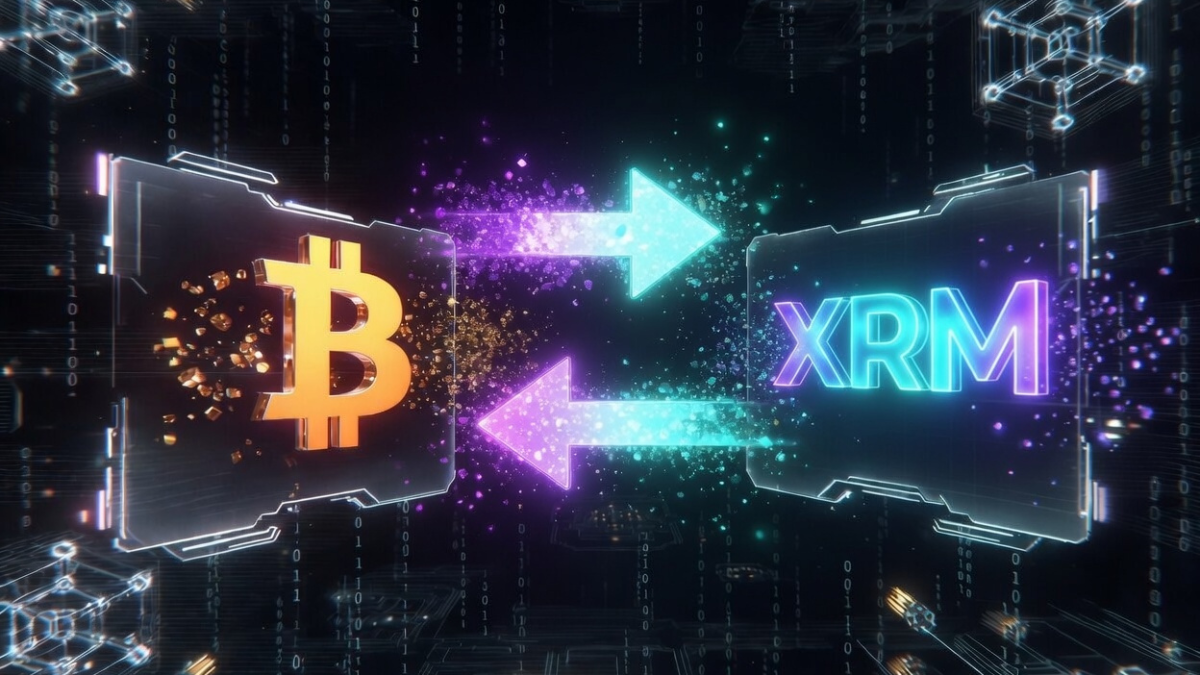
The integration would allow trading with XRM and BTC without leaving a trace or going through any registration.
The XRM token was removed from most centralized exchanges due to its private qualities.
The team behind decentralized exchange (DEX) THORChain announced that it will natively integrate monero (XMR) into its infrastructure, enabling exchanges (swaps) direct between bitcoin (BTC) and XMR without intermediaries, without third-party custody and without identification requirements. The announcement does not include a release date.
In the statement, they highlighted that the integration of the mechanism would work with “only BTC on one end and XMR on the other, with nothing in between except open source code running on a decentralized network. “That’s what’s to come.”
Monero, for its part, is a cryptocurrency network designed so that its transactions are private by default. Hides the sender, recipient and amount of each operation using cryptographic techniques such as ring signatures, sneaky addresses and RingCT (a mechanism that encrypts transferred amounts without publicly disclosing them).
That privacy is what motivated Kraken, Binance and other centralized exchanges will withdraw XMR of their platforms under pressure from regulators in Europe and the United States, who argue that these characteristics hinder the traceability required by anti-money laundering regulations, as reported by CriptoNoticias.
If realized, the BTC/XMR pair on THORChain would enable, for example, a user to convert bitcoin into monero to make movements that are not associated with your transaction history on the public Bitcoin chain (visible to any observer), and then reconvert XMR into BTC without going through any platform that requires identification.
This possibility has applications such as protecting financial privacy, avoiding the exposure of amounts and counterparties in commercial transactions, or simply operating without leaving a permanent public trace.
The result would be functionally similar to a “BTC mixer” (a service to break the trail of transactions), but with extra steps: the conversion to XMR acts as an intermediate privacy layer, and the reconversion to BTC returns the user to the public network without both ends being linked in any record.
In that sense, it is also relevant to mention that on several occasions, after hacking platforms or protocols, Attackers use systems like THORChain to move stolen crypto assets. This is what the Lazarus Group did after the hack of the Bybit exchange, as reported by CriptoNoticias.
Other risks in using THORChain
Finally, there are also other risks inherent in using this protocol. For example, THORChain suffered hacks significant in the past. In two attacks that occurred on July 15 and 22, 2021, he lost more than USD 13 million.
Likewise, since there are no intermediaries, There is no legal recourse or refund mechanism. If a transaction fails, a vulnerability in the code results in funds being lost or stolen.
THORChain thus positions itself at a complex intersection: that of financial privacy, technical innovation and regulatory scrutiny. If the integration with Monero is completed and resolves outstanding technical questions, the protocol would significantly expand the options for those seeking to operate without leaving a public trace. But that same characteristic is what attracts both legitimate users and malicious actors, and what could intensify pressure from regulators on the nodes that support the protocol.