VanEck estimates that this segment could generate more than USD 60 billion by 2030.
XRP Ledger, Canton and Kinexys stand out for privacy, control and regulatory compliance.
VanEck, an investment firm specializing in digital assets, published a report on May 5, 2026 in which it maintains that the economic value of the sector is shifting from general-purpose network tokens toward infrastructure developed for primarily corporate purposes.
In this context, the company highlights the growth of XRP Ledger, Canton, Kinexys, Provenance, Base and other institutional networks, called by the firm as “corpochains”.
According to VanEck, this change has already begun to be reflected in market behavior. The report shows that since the beginning of 2025, altcoins linked to layer 1 (L1) networks suffered sharp declines, while stocks related to digital financial infrastructure advanced strongly.
“L1 blockchain tokens are down 49% since early 2025; cryptocurrency stocks are up 48%,” notes the report.
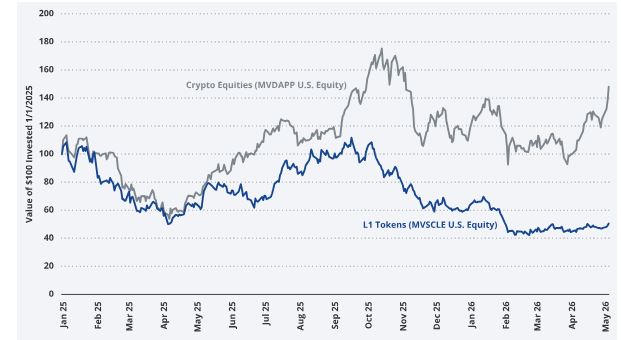
The central graph of the report compares two curves. The gray line represents the MVIS Global Digital Assets Equity Index (MVDAPP), an index that follows the performance of listed companies linked to the digital assets sector, such as financial infrastructure companies, payments, institutional services and platforms related to this market.
The blue line shows the performance of layer 1 public network tokens. In that group, VanEck especially highlights the falls in ether (ETH) and solana (SOL), which since the beginning of 2025 have fallen 32% and 57%, respectively.
According to the report, this divergence shows that the market is rewarding the shares of companies in the sector more than various tokens associated with public networks.
What are “corpochains”?
VanEck uses the term “corpochains” to describe distributed ledger networks developed or controlled by corporations, banks, fintechs or financial consortia.
Unlike networks like Ethereum or Solana, these infrastructures work with authorized validators, regulatory compliance tools, privacy and permission systems tailored to financial institutions.
“Corpchains offer strong value propositions to regulated corporate clients,” the report states. In turn, VanEck maintains that many financial institutions prefer these networks because they allow “controlling validators and counterparty participation”, “preventing asset leaks”, “guaranteeing privacy and regulatory compliance” and “ensure deterministic performance and costs.”
The report adds a key definition about the change the sector is going through: “The distributed ledger revolution is already here, but companies are harnessing its value while many tokens are left behind.”
XRP Ledger, Canton and Base among the featured networks
Among the networks mentioned is XRP Ledger (XRPL), the Ripple Labs network historically linked to cross-border payments and settlements. VanEck positions it as an infrastructure capable of competing within the global international payments business.
It also highlights Canton Network, a network focused on institutional financial markets, guarantees and repurchase operations, as explained by CriptoNoticias. Players such as Goldman Sachs, Nasdaq, Tradeweb and Broadridge already participate in this ecosystem.
VanEck rates Canton as one of the networks with the greatest institutional integration within traditional finance.
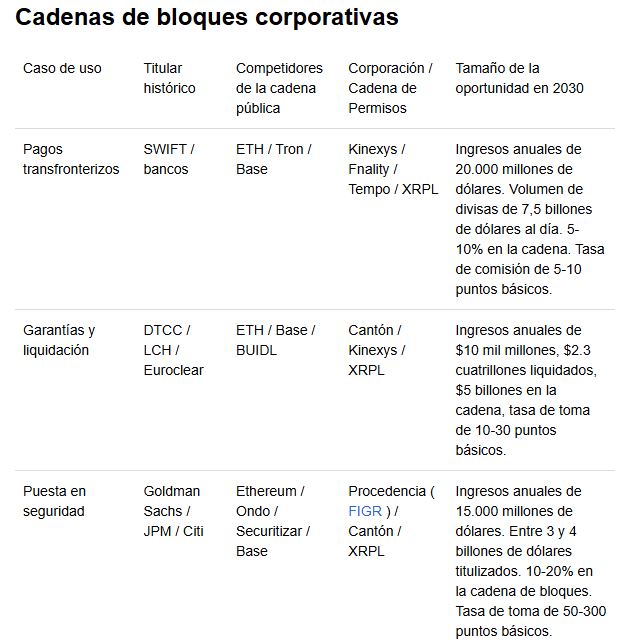
Kinexys, the infrastructure developed by JPMorgan, appears as another relevant actor. Your goal is to facilitate interbank payments and collateral mobility using distributed ledger technology.
Provenance, for its part, focuses on tokenization of mortgages and asset-backed lines of credit. The report notes that more than 15 of the top 20 mortgage lenders already use this infrastructure.
Base, powered by the American exchange Coinbase, occupies a different place. VanEck describes it as a network aimed at payments, stablecoins, tokenized assets and digital financial applications, supported by verified users of the platform. Although, it is worth clarifying that in Base there are all kinds of popular developments, even memecoins, so perhaps the name “corpochain” is not so precise. For this reason, as can be seen in the table above, it would occupy a hybrid place, since it is also classified as an open network.
Two laws that could change the market
VanEck identifies two factors behind the growth of corpochains. One of them is the GENIUS Act, a US regulatory proposal focused on stablecoins, which was approved and enacted in July 2025.
According to the report, GENIUS “creates a legal framework for stablecoins to operate as restricted banking entities,” requiring liquid reserves, mandatory disclosures, and compliance with anti-money laundering regulations.
For the firm, this would allow stablecoins to function as a regulated form of digital money usable by financial institutions and businesses.
The second regulatory axis mentioned is the CLARITY Law. Unlike GENIUS, which focuses on stablecoins, this initiative, which has not yet been approved, seeks to define the legal structure of the digital asset market in the United States.
VanEck maintains that this regulation could help clarify which assets are considered financial securities and which activities fall under certain regulatory rules. “If CLARITY enables compliant financial products, some activity could return to open networks,” the report notes.
However, the firm considers that corpochains have already taken advantage within the regulated financial segment. due to its institutional integration and connection with banking infrastructure.
The report concludes that the central discussion of the market is already It doesn’t just revolve around what technology each project uses. In this regard, the firm’s specialists propose:
The key is not whether a distributed ledger network is used or not, but rather who controls the validators, who benefits financially, and whether ultimate ownership resides in the network or remains an external right.
VanEck Report.
In this context, the firm projects that Corporate chains could generate more than $60 billion in revenue by 2030especially in international payments, asset tokenization, derivatives and financial settlement.
VanEck clarifies that public networks can still remain relevant if they can demonstrate sustainable economic advantages within regulated finance. But, for now, he considers that the market is rewarding companies more than They build corporate infrastructure than many tokens associated with open networks.