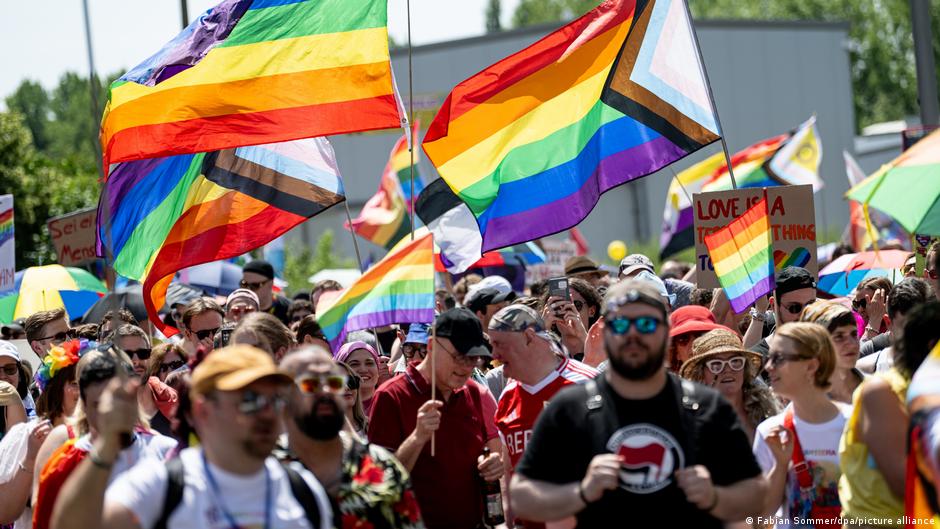
After ten years in the lead, Malta has been overtaken by Spain to take the top spot in ILGA Europe’s annual Rainbow Map. The ranking, compiled by the International Lesbian, Gay, Bisexual, Trans and Intersex Association (ILGA), compares laws and policies affecting LGBTQ+ people in 49 countries in Europe and Central Asia.
Katrin Hugendubel, deputy director of ILGA Europe, told DW that Spain’s rise shows what is possible when governments make deliberate decisions to advance equality rather than retreat from it.
Why did Spain rise in European LGBTQ+ rankings?
Spain’s rise reflects a series of measures taken under the leftist government of Spanish Prime Minister Pedro Sánchez. These include new equality laws, national action plans, an independent equal treatment authority and the decriminalization of trans identities in health care.
According to Hugendubel, this progress is particularly significant because it occurred despite pressure from far-right and conservative forces. The Spanish government continues to defend its reforms against attempts to roll back them, he said.
Spain is followed in the ranking by Malta, Iceland, Belgium and Denmark. The ILGA map of Europe shows that these countries have strong legal protections for LGBTQ+ people. There has been further progress downwards in the rankings. For example, Czechia and Sweden made it easier for people to legally change their gender.
Return of LGBTQ+ rights in some European countries
At the bottom of the list are Armenia, Belarus, Türkiye, Azerbaijan and Russia. Romania remains the EU’s lowest ranked country, at 42nd out of 49.
The countries at the bottom have poor scores for different reasons. Turkey continues to ban Pride events and uses its penal code to pressure gay activists. Belarus has adopted an anti-LGBTQ+ propaganda law similar to Russia. Slovakia has made it impossible for trans people to legally change their gender.
Hugendubel told DW that trans rights have become one of the main battlefields in this year’s map. She said anti-trans stories spread easily because public knowledge remains low and fear can be used to divide society.
Remi Bony, head of Forbidden Colours, a Brussels-based LGBTQ+ advocacy group, is more cautious about positive changes in the rankings.
“In the last few years, there has been a reaction to LGBTQ+ rights everywhere in Europe,” he told DW.
Far-right parties as a threat
Boni warned that even progressing countries remain unsafe. He points to Spain, where the far-right party Vox and the conservative Partido Popular have made gains in recent years, while Sanchez’s government remains politically fragile. Boney believes that if these parties come to power they may try to overturn key LGBTQ+ protections. And Spain is just one example; far-right parties are emerging in many countries across Europe.
According to Bonnie, the threat is not coming only from within Europe. He says the political climate has changed since the Trump administration returned to power, particularly after dismantling USAID programs that had funded LGBTQ+ rights work in parts of Eastern Europe. They argue that anti-LGBTQ+ narratives are increasingly supported by state actors.
Hugendubel also emphasizes that the Rainbow Map has limitations. It measures laws and policies, not the daily reality of LGBTQ+ people. Despite remaining in first place, Spanish LGBTQ+ organizations report that attacks against gay people have increased by 15% in the country since 2024, driven by a climate of hate speech that promotes violence against vulnerable groups.
Both Hugendubel and Boni see a clear connection between minority rights and the health of Europe’s liberal democracies.
first target minority group
Boni points to Hungary under Viktor Orban as an example. They argue that LGBTQ+ people were used as scapegoats, while the government also restricted freedom of expression, freedom of assembly, and freedom of democratic institutions.
“They start with a minority group, then they take away the rights of everyone else,” he said.
Boni wants the European Commission to take stronger action when member states ignore court rulings or roll back LGBTQ+ protections. He argues that the body has the tools to initiate infringement procedures, but that he often hesitates because the issue has become so politically sensitive.
He also says that the impact of the shift to the right in the European Parliament is also being felt in Brussels. According to Boni, progressive parties should be more willing to confront the European People’s Party if it cooperates with the far right or blocks action on LGBTQ+ rights.
A test for liberal democracies
Hugendubel asks whether countries that have not yet chosen a clear direction will succumb to far-right pressure. She includes Germany among the countries where future progress is uncertain.
For both analysts, the stake goes beyond rankings. The question is whether governments are willing to protect minority rights not only on paper, but also in daily life. For them, it is one of the clearest tests of what a liberal democracy should stand for.
Edited by Cai Nebe