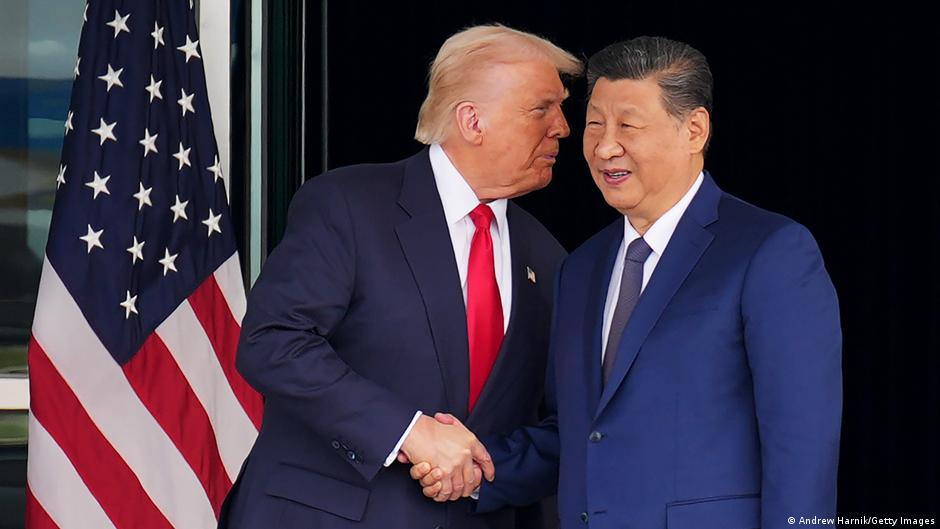
As the old saying goes, “Good things take time.” US President Donald Trump is set to meet China’s leader Xi Jinping in Beijing at the weekend, after postponing his visit in March after starting a war with Iran.
The meeting comes as the world is still facing an ongoing energy crisis caused by the blockade of the Strait of Hormuz, and peace talks between Tehran and Washington appear to be at an impasse. Moreover, the trade dispute between China and the US is still hidden behind the scenes.
Against this backdrop, both countries have an incentive to ensure that the meeting between the two leaders is successful. Neither Trump nor Xi can afford to lose. Both want to remain the “strong man”.
“Trump desperately needs some good news on the foreign policy front,” said Chu Yin, a political scientist at the Beijing-based Pangol think tank and former professor at Beijing University of International Relations.
“Trump’s poll numbers are weak ahead of the midterm elections in November. Obviously, his plan to bring China’s ally Iran to its knees through military attacks, celebrate his victory in Beijing and use it as a bargaining chip has not worked,” Chu told DW.
Chu said Trump should now hope to reach at least a partial deal on trade that he started with a crippling tariff regime last year. Ahead of the meeting, negotiators from both countries will try to make progress on concrete agreements during talks in Seoul, South Korea.
Trump will mention Jimmy Lai during talks with Xi
If nothing else, Trump can count on communist-ruled China for fanfare and praise. After all, Beijing doesn’t want to embarrass its own president – who has been firmly in power for 13 years – by failing to attend the ceremony.
Trump also told reporters he would talk to Xi about releasing Jimmy Lai, the Hong Kong media mogul and prominent pro-democracy figure who was sentenced to 20 years in prison under a tough national security law imposed by Beijing.
“Jimmy Lai – he caused a lot of chaos for China. He tried to do the right thing. He didn’t succeed, went to jail, and people will like him and I’d like to see him out, too,” Trump said Monday.
Will Trump maintain the status quo for Taiwan?
In Beijing’s view, the question of Taiwan’s legal status is a red line that should not be crossed in diplomatic relations with the United States.
Beijing considers Taiwan a breakaway province from the “People’s Republic of China (PRC)”, founded by Mao Zedong in 1949. However, the democratically governed island still operates under the constitution of the “Republic of China (ROC)”, which was established in 1912.
According to Beijing’s legal interpretation, “Taiwan” should not be used to refer to an independent country. They insist that there is only one China and that Taiwan is part of it, with the Beijing government being the only legitimate government of China. Beijing refers to this concept as the “one-China principle”, which serves as the basis for all diplomatic relations with the PRC.
In the Shanghai Communiqué of 1972, which along with two other documents is considered the basis for the resumption of diplomatic relations between the US and the PRC, the US only “accepts” the one-China principle.
Nevertheless, the Taiwan Relations Act, a US federal law enacted in 1979, authorizes the US government to “supply defensive weapons to Taiwan” and to counter “any use of force or other form of coercion that would endanger the security of the people of Taiwan or the social or economic system.”
Beijing believes that US President Trump has considerable leeway within this legal framework. It is therefore expected that Xi will try to persuade Trump to make statements favorable to Beijing on Taiwan, which may include explicitly opposing Taiwan’s “independence.” The US President’s statement to this effect will have massive diplomatic implications. Washington’s current official terminology is that the US “does not support” Taiwan independence.
Trump administration is moving slowly on arms deal with Taiwan
Xi could also use promises of economic deals to put pressure on Trump over arms supplies to Taiwan.
In December, Trump approved the largest-ever sale of weapons systems to Taiwan, worth $11.1 billion. Beijing was furious at this deal. However, it is worth noting that arms deliveries have not moved forward, and another $14 billion package is still awaiting Trump’s approval.
On May 8, after much political wrangling with Taiwan’s opposition party, Taiwan’s parliament passed a law authorizing the purchase of $25 billion of military equipment, a much smaller number than the $40 billion imposed by Taiwan President Lai Ching-tey the previous year.
Taiwan has been pressured by the Trump administration to increase its defense spending.
On Monday, when asked about US support for the defense of Taiwan, Trump told reporters: “I’m going to have a discussion with President Xi.”
He said, “President Xi wants us not to do that and I will discuss that. That’s one of the many things I will talk about.” Trump said he suspected the China-Taiwan conflict would erupt on his watch.
“I don’t think that’s going to happen,” he said. “I think we’ll be OK. I have a very good relationship with President Xi. He knows I don’t want that to happen.”
Can China help Trump in Iran issue?
Peter Qiu, president and founder of the Center for Globalization think tank in Hong Kong, said as Trump faces a standoff with Iran, Beijing may find some leverage in distracting Trump from Taiwan to help mediate the conflict.
“The United States needs China’s support in the Iran war,” he told DW.
But Washington is not the only country seeking diplomatic support in Beijing – last week, Iranian Foreign Minister Abbas Araghchi visited China.
Chinese Foreign Minister Wang Yi expressed concern that the war in Iran is undermining regional and global peace. At the same time, he said China supports Iran’s peaceful use of nuclear energy for civilian purposes as it is “the right of every sovereign state”.
Wang also expressed hope that “all parties involved in the Iran conflict will respond positively to the international community’s expectation that they will ensure safe passage through the Strait of Hormuz.”
The threat of Iranian attacks has effectively closed the strait since early March, cutting off about 20% of global oil supplies. The US has responded with its own blockade of Iranian-aligned vessels.
US Secretary of State Marco Rubio said it is in China’s interest “as an export-oriented economy” that Iran no longer block the strait.
“I hope the Chinese people send this message to Iran,” Rubio said at the White House last week.
However, Iran still sends oil to China. On Monday, the US government announced sanctions against people and companies based in Hong Kong, Oman and the United Arab Emirates for assisting in the shipment of Iranian oil to China.
Time out on trade war?
A year ago, as part of his global tariff blitz, Trump imposed massive tariffs on Chinese products, invoking the trade deficit between the world’s two largest economies. China threatened to cut off supplies of critical rare earth minerals in response. Trump backed off from some of the more extreme tariff threats, such as the 145% tariffs he once threatened.
However, the status of the game remains in limbo, and negotiators from both countries are yet to announce any significant agreement.
Trump’s message to the Chinese leadership is clear. The world should not just buy Chinese products. To compensate for the trade surplus, China should also buy American products.
“China is willing to buy American products,” analyst Qiu said. “But China also wants to see something in return, such as the lifting of export restrictions on specific US semiconductor products for artificial intelligence.”
The US has imposed strict export controls on advanced AI chips needed to develop and deploy more advanced frontier models. China is trying to develop its own advanced chips, but is being somewhat hampered by US barriers.
The last meeting between the two leaders in South Korea last year ended without any major breakthrough, beyond tariff cuts and a promise to meet again. Analyst Qiu said he hopes this time will be different.
“The main thing is that I hope for some kind of ‘grand deal’ involving the national interests of the two major countries,” Qiu said.
This article was translated from German