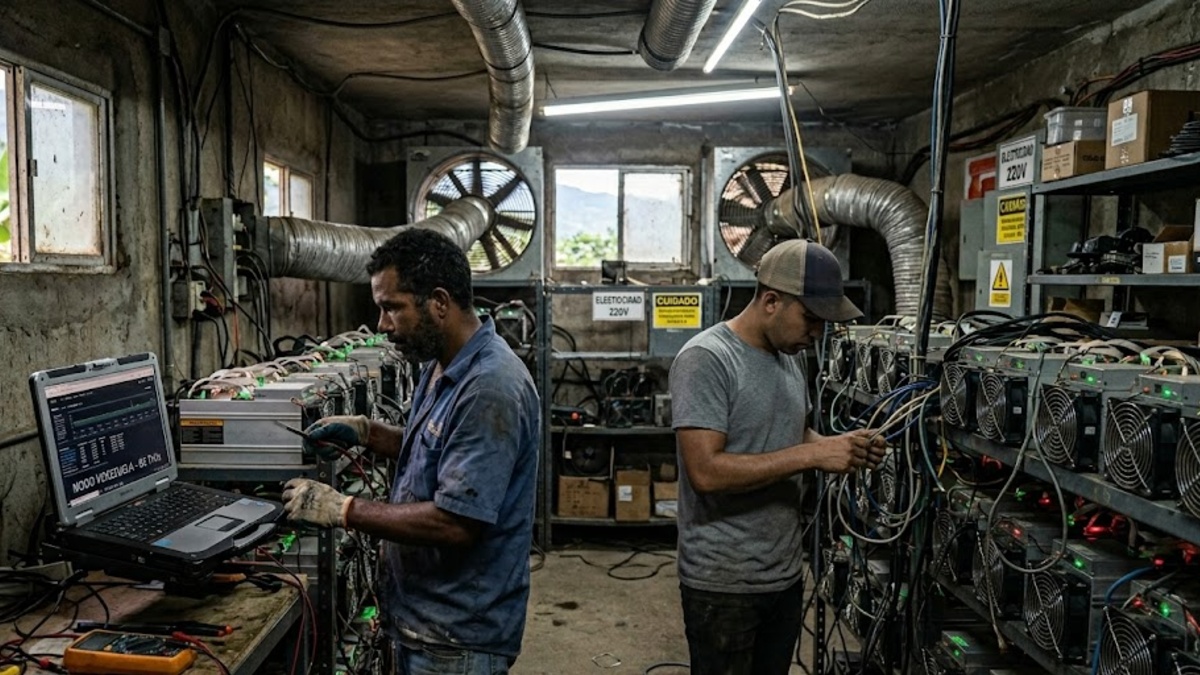
The company Crypto Tools, CA, which was dedicated to Bitcoin mining in Venezuela, issued a legal and technical analysis in which it questioned the legality of the equipment confiscation operations and the absolute prohibition of the activity dictated by the Ministry of Popular Power for Electric Energy (MPPEE).
According to the firm, all State actions must comply with due process, remembering that the regulatory framework that regulates cryptocurrencies and their related activities in Venezuela has not been formally repealed.
The controversy arose after the MPPEE announced the ban on Bitcoin mining throughout the national territory to stabilize the National Electric System (SEN). This measure coincides with a historic peak in the country’s energy demand, which reached 15,579 megawatts, as reported by CriptoNoticias.
In this context, the governor of the state of Carabobo, Rafael Lacava, implemented a policy of economic incentives, offering rewards of $1,000 to citizens who report mining centers, which resulted in the dismantling of facilities in the San Diego municipality and the seizure of Antminer S9 model equipment.
Given these actions, Crypto Tools argument In a statement published on May 11 on Instagram, the Constituent Decree on the Comprehensive Cryptoasset System, published in the Official Gazette No. 41,575 in 2019, remains in force.
The company maintains that the restructuring of the National Superintendency of Cryptoassets (Sunacrip) from 2023 generates a “scenario of operational vacuum or administrative uncertainty, but not necessarily an express repeal of the existing regulatory framework.”
Consequently, they highlighted that Mining activity is not illegal by definition under the Venezuelan legal system.
The company emphasized that respect for private property and legal guarantees is fundamental for the exercise of any public policy.
“Under constitutional principles such as economic freedom, the right to private property, due process and legal certainty, all administrative or criminal actions must be carried out in strict compliance with the procedures established by law,” Crypto Tools said in its statement.
Furthermore, they warned that “no seizure, inspection or sanction procedure can be carried out outside of constitutional guarantees.”
From a technical perspective, the company suggested that the state administration should differentiate between the origin of the energy used by Bitcoin miners.
The firm’s approach is based on distinguishing between “operations directly connected to the public electrical system and those that can operate through independent or alternative energy schemes, such as private plants, solar, hydroelectric systems or other autonomous sources of electrical generation.”
This distinction, the company said, It would allow the development of the technology industry without compromising the stability of the public system.
A critical point mentioned by the firm is the responsibility of the officials who execute these measures. Crypto Tools cited article 49 of the Constituent Decree, which stipulates criminal sanctions for authorities who act without foundation.
The rule establishes that “the public official who hinders or stops without cause justified by the competent authority the materialization of operations related to cryptoassets, will be punished with imprisonment of three to five years.”
The current situation in Venezuela poses a legal dilemma regarding digital mining and technological infrastructure in the country. While the government justifies the forceful measures as a necessary emergency to protect the electrical service that affects a large part of the population, Ecosystem actors denounce that technological innovation is being punished.
Crypto Tools concluded that “technological development and the protection of the national electrical system can coexist through clear regulation, corporate responsibility and respect for the rule of law,” urging a solution that preserves legal security in the nation.