Inside a music studio in Owerri, the capital of Nigeria’s southeastern Imo state, there is no generator noise, no smell of fuel, and no flickering lights. This is considered rare in a country where prolonged power outages are common.
Music producer Somic Chris Ikesom told DW that since switching to solar power he no longer needs to rely on backup generators about 80% of the time. He described his experience with public power supply as, “Whenever it comes, we use.”
Ikesom, who has worked in the music industry since 2007, told DW that relying on generators during frequent blackouts is a reality familiar to millions of Nigerians, many of whom are now actively seeking alternatives to the faltering power grid.
Why is solar energy gaining popularity in Nigeria?
Nigeria has overtaken Egypt to become Africa’s second-largest importer of solar panels, behind only South Africa, according to data Published by global energy think tank AMBER.
But while the numbers indicate momentum, the reality on the ground is more complex.
Installers, analysts and users note that solar energy adoption in Nigeria is progressing unevenly – often limited by cost rather than interest.
“You know what happens with generators,” Ikesom said. “It could start to falter at any time, you know, and you have to worry about the fuel costs and the noise that comes with it.”
Apart from the inconvenience, unstable electricity was hurting his business. “My equipment, they’re sensitive to power fluctuations,” he explained.
“Over the last few years, I was losing some of my equipment… because sometimes when the generator wants to shut down, it shuts down.”
Solar offered something different. “I wanted something stable and reliable,” he told DW, “so that I could walk into the studio at any time and do whatever I wanted.”
The change was immediate. “I no longer have power outages,” Ikesom said.
However, their experience also reflects a central obstacle. “It’s not cheap to install solar these days,” he said. “It’s very expensive. Very, very expensive. It’s in the millions.”
This hurdle is echoed by solar companies themselves.
Gbenga Kogbe, CEO of Lagos-based energy company Sunhive, says interest in solar energy has grown, but high diesel prices have not translated into mass change.
“In the last 12 to 18 months, we have seen a huge increase in demand for solar energy,” he told DW.
But the number of inquiries “has remained relatively stable” because “people’s purchasing power has gone down,” he added.
“The alternative is non-consumption,” Kogbe said. “I’ll just stay in the dark.”
For many homes and small businesses, the choice is not between generators and solar power, but between electricity and no electricity at all. Solar costs have declined rapidly over the past decade, but the upfront investment remains out of reach for most Nigerians.
One response has been to move away from selling systems toward providing electricity as a service.
Why is solar energy still out of reach for most Nigerians?
“In my view, if you look at solar energy as an asset class that individuals have to buy, it becomes inaccessible to the vast majority of Nigerians,” Kogbe said. “But if you look at it as a service, everyone can access it.”
“The heart of renewable energy is the battery,” Kogbe said. “Lithium is at the forefront of energy storage.”
Sunhive is now moving towards owning solar assets and selling power directly, focusing on commercial users, battery storage, electric mobility and rural mini-grids.
Scaling remains difficult.
“The cost of capital in Nigeria is quite high,” Sunhive’s Kogbe said, noting that bank loans can reach the low to mid-30% range. Currency volatility also matters. “As the Naira depreciates, the cost of solar energy immediately increases.”
Government policy has added another layer of uncertainty. Rural Electrification Agency officials have spoken publicly about encouraging local assembly of solar components and reducing reliance on imported panels. Industry players say capacity remains limited.
“There is no Tier 1 Nigerian solar panel manufacturer yet,” Kogbe said. “Solar panel manufacturers in Nigeria probably have the capacity to meet 5% of the demand.”
For this reason, they argue that blanket import restrictions would be counterproductive.
“Banning solar energy imports will only increase the cost of solar energy, not reduce it,” he said. “Imposing a ban, as opposed to helping the local industry grow, could largely destroy the industry.”
Global factors also shape the market.
Godson Ikebe, sustainability and climate change expert at PwC Nigeria, warned that recent changes in China could push prices higher.
“While the government has frozen import duties on solar panels and related accessories and tax incentives for solar production, we need to look at what the Chinese government’s removal of subsidies on solar panel production will mean in terms of costs to Nigeria,” he told DW.
Ikebe said Nigeria’s clean energy industrial policy is still developing.
“I don’t think industrial policy, as it relates to clean energy production, has been deliberate yet,” he said. “There is no clear sustainable financing roadmap for solar energy production.”
Back in Owerri, Ikesom says solar has changed the way he works.
“It’s been more than two years since I’ve been actively using solar energy,” Ikesom told DW. “If I calculate properly, I know I have earned back at least some of my capital.”
But he is clear about the barrier to entry. When other small studio owners ask about the switch, Ikesom says he’s being honest.
“The truth is still I would tell that person it’s expensive, but it’s worth it,” he said.
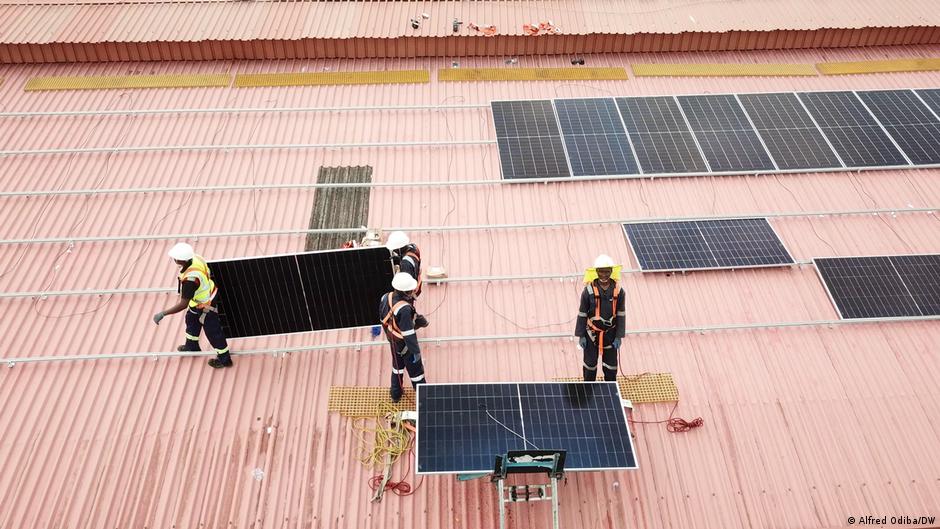
Nigeria’s solar imports are growing, and the technology is increasingly visible on rooftops and in small businesses like Ikesom’s studio.
Yet change remains uneven, influenced more by enthusiasm than economics.
For many Nigerians, the question is whether it is affordable, and whether policy, financing and industrial capacity can align fast enough to turn demand into access.
Edited by: Keith Walker