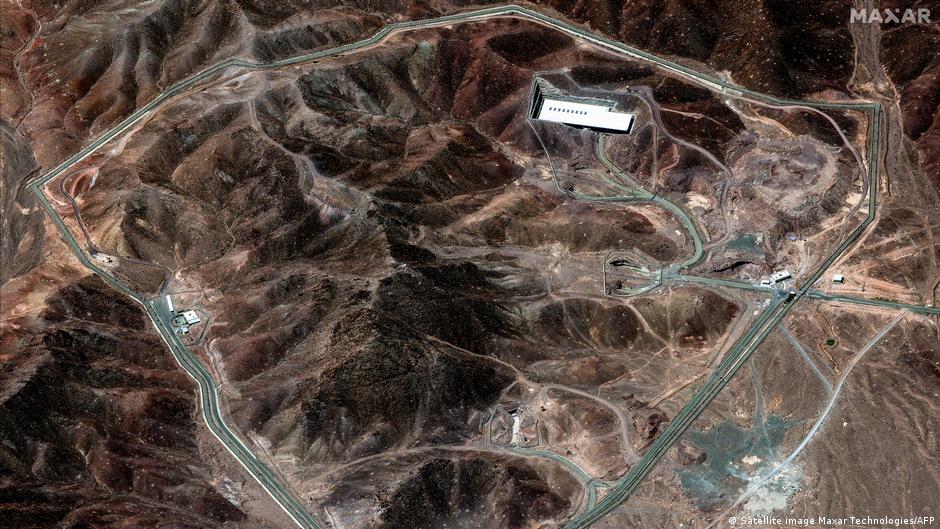
Iran’s nuclear program has been a source of conflict for decades, with some Iranians now associating words like yellowcake, centrifuges and enrichment with crisis, instability and war. The country has faced heavy sanctions due to the regime’s insistence on uranium enrichment, and some estimates put the direct economic damage at around $3.5 trillion (€3 trillion).
During recent military conflicts and the fragile ceasefire between Tehran and Washington, the program has once again taken center stage. The United States appears to be particularly focused on Iran’s nuclear stockpile – Tehran is believed to already have more than 440 kilograms (970 lb) of uranium enriched to 60%, far more than is needed for civilian purposes. Theoretically, this material could be further enriched to reach 90% in a relatively short time, making it suitable for use in nuclear weapons.
Will the US and Iran work together to secure nuclear material?
US President Donald Trump often refers to the material as “nuclear dust” in reference to the June 2025 bombing, which he claims “destroyed” Iran’s nuclear program.
Trump has repeatedly said the US would take it over, but has also made contradictory statements on how this would be done, including the claim that the US would “go with Iran, with a lot of excavators, to dig it out from under the debris”, presumably after a peace deal is reached. In April, Trump said that Iran had agreed to hand over its stockpile, while last week he indicated that the US “will suffer” because “we have to travel to Iran to get a nuclear weapon.”
Iran has not yet confirmed any deal related to uranium reserves. Speaking to US broadcaster CBS in March, Iranian Foreign Minister Abbas Araghchi said the material remained under the debris after last year’s attack and that Iran had “no program” and “no plan” to recover the material.
However, Araghchi was also careful not to exclude the possibility of diluting highly enriched uranium as part of a future deal with the US.
Location of Iran’s nuclear stockpile unclear
Recent media reports also indicated that Iran was ready to reduce part of its reserves and transfer the rest to a third country. This weekend, Russian President Vladimir Putin said his country is ready to stockpile Iran’s enriched uranium.
However, it is still unclear where the content is located and what technical challenges need to be overcome to access it.
Iran’s top three nuclear facilities – Isfahan, Fordow and Natanz – were all heavily damaged during last year’s Operation “Midnight Hammer.”
International Atomic Energy Agency Director General Rafael Grossi said in late April 2026 that most of Iran’s enriched uranium was probably still located at the Isfahan nuclear complex.
According to him, 18 blue containers carrying about 200 kg of enriched uranium are believed to have entered a tunnel at the Isfahan Nuclear Technology Center on June 9, 2025, just four days before the start of the 12-day war.
However, others offer a different view, including speculation that the material is now stored at Fordow or Iran’s Bushehr Nuclear Power Plant.
Iran has indicated that it will acquire the material only under the supervision of the International Atomic Energy Agency (IAEA).
Roland Wolf, an expert in medical physics and radiation protection, said, “It is not technically impossible to remove this material from Iran, but it also depends on many other factors. Under close monitoring by the IAEA, the material can be taken out of the country and transported.”
He added: “Special safeguards must be observed. Since Iran stores enriched uranium underground at Fordow, physical access is difficult.”
Libya as a role model?
The technical challenges involved in removing more than 440 kilograms of enriched uranium from Iran are only one side of the equation, with security issues likely to take priority.
Former US Ambassador to the United Nations John Bolton, who served as national security adviser during Trump’s first term, pointed to dismantling Libya’s nuclear weapons program in the early 2000s. He said the program was “very small” and that initiatives to remove nuclear material in 2003 and 2004 took place in a “permissive environment” rather than in the midst of a conflict.
“US and UK officials came and packed it up and took it to Oak Ridge, Tennessee, where it is now,” Bolton told DW.
“The most important thing is not to let highly enriched uranium or other aspects of the program fall into the hands of terrorists or other rogue nations,” Bolton said.
Bolton described the Iran regime’s ideology as “radical”
Bolton also told DW that the only way to ensure that Iran will not have a nuclear weapons capability is to “remove the regime of the Ayatollahs and the Revolutionary Guard.”
He said, “Their ideology is radical and based on aspirations to achieve dominance within the Islamic community and hegemony in the geographical Middle East. They may make temporary concessions. I would not trust them to follow through on their commitments over the long term, but it looks like we are moving in that direction.”
Edited by: Shamil Shams