
The race for efficiency at quick service windows is adding a new engine to its ecosystem. This, after, starting this May, the Bitcoin (BTC) Lightning network is integrated into the operational flow of food establishments in the United States with the ambition that the payment is confirmed before the order reaches the customer’s hands.
This move evokes the expansion of contactless payments that redefined commerce a decade ago. However, the current proposal, from the company Square, goes a step further by unifying the order and payment into a single native process. With it, attempts to break dependence on traditional credit networks which, for years, have represented a financial choke point for small business owners.
Today many restaurants work to cover bank fees that suffocate their margins. While, on the contrary, the mathematics of bitcoin proposes reduce that traditional charge from 3% to a minimum figure.
Under this scheme, an establishment with sales of one million dollars manages to retain tens of thousands of dollars annually that were previously lost in processing fees. It is a capital that stops feeding the financial system to stay where it should always be, as it is in the restaurant’s cash register.
This optimization of profitability is based on an architecture that prioritizes savings and agility. By relying on the Lightning infrastructure, commissions are drastically reduced compared to the standard of traditional processors, injecting direct liquidity into the business from the first transaction and easing the daily cash flow of the establishment.
For the gastronomic sector, this financial efficiency transcends the percentage rate. By operating over this network, the merchant eliminates the risk of chargebacks, a constant pain point with credit cards, and breaks the cycle of waiting 24 to 48 hours to have your money.
While in the banking system funds are “trapped” in a clearing process, in Lightning the settlement is immediate: the value of the coffee or hamburger that comes out of the kitchen is reflected in the business’s treasury instantly.
In itself, this savings translates into financial relief that positively impacts the restaurant’s daily cash flow, allowing it to reinvest in supplies or payroll without depending on bridge loans or bureaucratic waits.
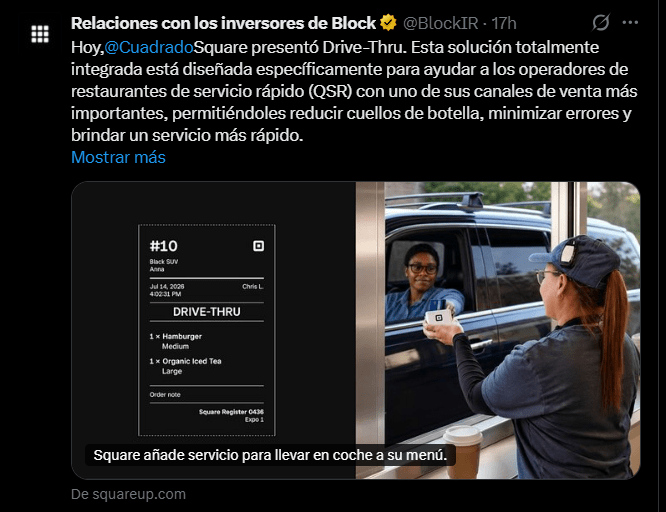
Beyond the savings, the real impact is perceived in the operation of the store, where the synchronization between the ordering systems and the immediate settlement of funds eliminates bottlenecks at the window, making customer dispatch more dynamic and fluid.
This creates an experience where the tool becomes practically invisible because the process is reduced to scanning a QR code that, through instant confirmations, guarantees care without friction or waiting.
This potential is strongly approaching Latin businesses in the United States. In California, Texas and Florida, taquerias and cafes have the option of finding a shield in bitcoin against high banking costs.
Therefore, if expanded to Latin America, this infrastructure would not only serve for daily consumption, but would also lay the foundations for a strategic convergence between local payments and the cross-border remittance system.
However, innovation still hits bureaucratic walls. The BitLicense in New York prevents this solution from achieving national uniformity, evidencing the contrast between the speed of the code and the slowness of the regulatory frameworks.
To mitigate exposure to volatility, the system incorporates automatic conversion tools to dollars, a function designed for the merchant to use this network as a transportation rail without compromising its treasury.
Under this scheme, bitcoin reaffirms its role as a global settlement infrastructure, whose success in retail commerce may now depend on its ability to go unnoticed.
Its true achievement as a payment system for everyday life, according to this experiment by Jack Dorsey’s company, is its silent integration, becoming the rail that the user chooses by pure instinct. This, motivated by the certainty that, when time is of the essence, every second and every dollar count.