LINK is an ERC-20 token available only to authorized investors.
To the creator of Chainlink, current adoption reminds him of the early years of DeFi.
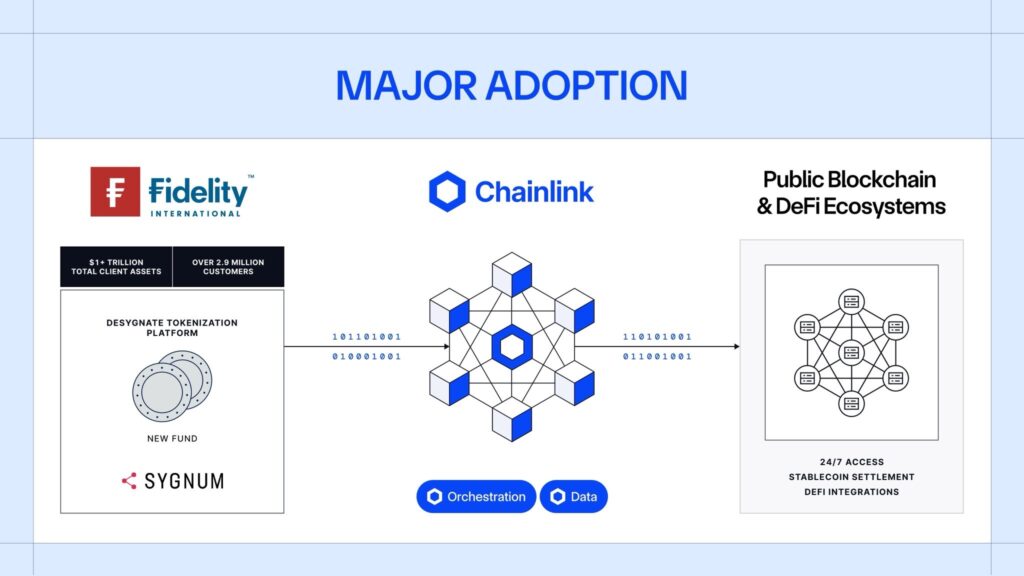
Financial asset manager Fidelity International announced today, May 13, 2026, the launch of its first native tokenized fund: the Fidelity USD Digital Liquidity Fund (FILQ).
He financial instrument this developed on the Ethereum network and uses the infrastructure of the Chainlink oracle network and the Sygnum tokenization platform.
The background, as can be read in the website from Sygnum, has been rated Aaa-mf by Moody’sindicating high credit safety of the underlying assets, primarily comprised of regulated government securities and asset-backed commercial paper.
FILQ’s core technological integration falls on the using Net Asset Value (NAV) data provided by Chainlink. In traditional investment funds, the NAV is usually calculated and distributed during closed banking hours; In this model, information is reported transparently on-chain, allowing a daily assessment accessible to participants in the digital ecosystem.
Sergey Nazarov, co-founder of Chainlink, pointed out today that the availability of NAV data is an essential technical requirement for the existence of tokenized funds.
Furthermore, according to Nazarov, this phenomenon of Chainlink integration into the traditional financial system bears similarities to the early growth of decentralized finance (DeFi):
We saw this pattern with DeFi in the early years of Chainlink: you couldn’t build secure protocols without relying on high-quality decentralized oracle networks. I feel that the trend of tokenized funds, which is part of real world assets (RWA), is in a similar position.
Sergey Nazarov, co-founder of Chainlink
FILQ presents two asset classes For investors:
- 1. Accumulation Tokens: The return generated by the underlying assets is reinvested, increasing the NAV value of the token.
- 2. Distribution Tokens: Maintain a constant face value of $1 and distribute returns monthly in the form of dividends.
The fund operates under the ERC-20 standard on Ethereum, although uses a permitted model. This implies that only wallets verified through KYC (know your customer) and AML (prevention of money laundering) processes can transact with the tokens. Initial access is restricted to institutional investors, with a minimum entry amount set at $100,000.
Unlike traditional stablecoins, which primarily act as means of payment or reserves without accruing direct interest, FILQ functions as a money market fund (money market fund) that seeks to maintain liquidity available 24 hours a day with almost instantaneous settlement.
Chainlink’s expansion among corporate “giants” and traditional finance players generates some optimism about the price of its native cryptocurrency, LINK. For example, financial analyst Ted Stamas expects that in the next 4 years LINK’s performance will exceed that of the S&P500 index, as reported by CriptoNoticias.