Honda, Japan’s second-largest carmaker, on Thursday confirmed its first operating loss since 1957, before it started selling cars in the early ’60s.
After previously betting on more rapid electrification of the industry, the company has begun a massive shift in its electric vehicle (EV) strategy, especially in its core market the US.
Honda had already warned of a major financial loss as a result of this change in March, meaning investors were largely unaffected by Thursday’s financial data. In fact, Honda stock rose sharply as the company even predicted a return to profitability in 2026.
What were Honda’s losses and sales figures?
The company reported an operating loss of 413.4 billion yen (about €2.23 billion or $2.6 billion) amid a sharp decline in its EV operations.
Honda also reported a slightly larger net loss at 423.9 billion yen.
The company sold 3.4 million four-wheelers worldwide in the fiscal year to March, down from 3.7 million last year.
Honda’s older and even more successful motorbike business helped reduce losses, as it sold 22.1 million motorcycles compared to 20 million in the previous financial year. Honda dominates many markets, including India, in sales of new motorbikes, largely thanks to the budget Super Cub models, which have led global sales figures since the 1950s.
The company projected to return to profit for the fiscal year through March 2027, and its share price rose as much as 8% at one point early Thursday in reaction. It fell into less pronounced positive territory as trading continued in Asia.
What factors did the company cite?
Honda said on Thursday that “changes in government policy” under the administration of US President Donald Trump had affected sales and strategy in its biggest market to date and played a large role in the losses.
The US eliminated tax incentives for EV buyers as part of the so-called “Big Beautiful Bill” in September 2025.
Trump’s tariffs imposed last year on imported cars and car parts also served to hurt Honda’s profitability, even though they were reduced from 25% to 15%.
Honda also noted a “decline in the competitiveness” of Honda products in China and other Asian countries, as Western manufacturers – including Germany’s car giants – struggled to keep pace with rapidly improving Chinese competition.
The war in the Middle East, and the subsequent pressure on the supply and price of oil and energy, as well as on some other exports, not to mention its impact on the general economy, also poses a threat to the industry.
Other Japanese manufacturers have also struggled in recent months. Toyota last week forecast a 22% decline in net income this fiscal year.
Nissan reported a loss of $3.4 billion on Wednesday. It is seen as the hardest hit among major Japanese marques, as it is also closing factories and cutting thousands of jobs.
Suzuki is an outsider, Thursday projected an 8% increase in revenue in 2025 Thanks to its focus on the growth markets of India and Latin America.
Hybrids are on show as all-electric plans slow down
Honda displayed a pair of new hybrid prototypes, a family sedan and an SUV tailored to America’s car buying habits, as it presented its performance data.
“Demand for EVs has declined significantly due to rollback of environmental regulations in the US and other factors,” the company said in a statement.
The company last month abruptly canceled its planned development of two electric cars with electronics giant Sony.
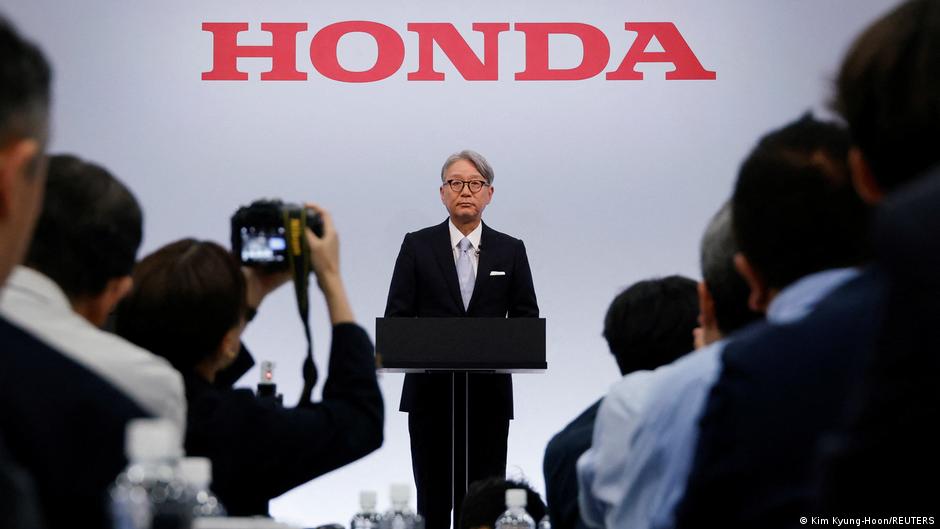
Chief Executive Officer Toshihiro Mibe said the company’s new growth strategy will continue to pursue carbon neutrality. However, he said the company still needs to work on not just EVs but also hybrid and regular internal combustion engine models.
Asked whether he would resign in response to the loss, which may be common among Japanese executives delivering bad news, Mibe said he wanted to work on the revival plan first.
“We will continue our research to develop future technologies, including electric vehicle batteries,” he said. “We will get back on the path of development.”
Edited by: Roshni Majumdar