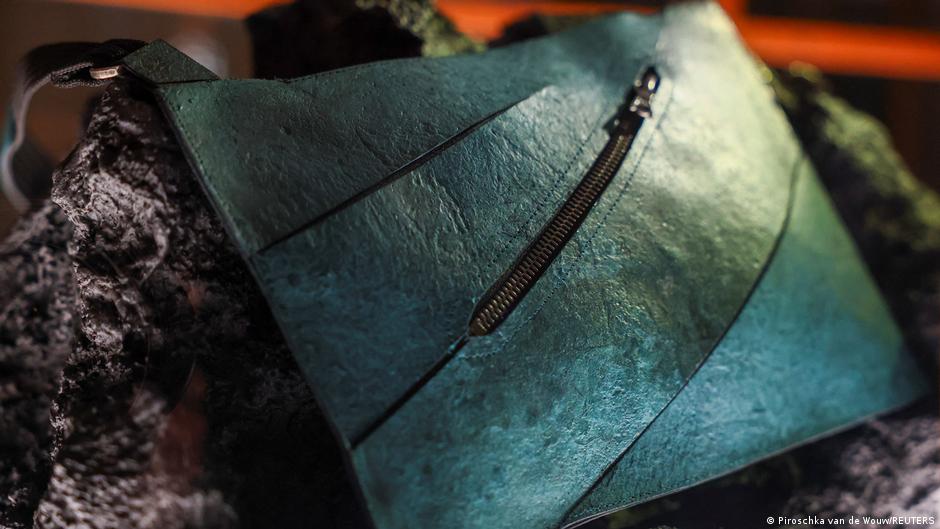
In early April, the Artis Zoo Museum in Amsterdam unveiled a handbag with a giant dinosaur skeleton—made of “lab-grown T. rex leather.”
Polish fashion label Enfin Leve designed the bag as part of its line of experimental clothing. But it was the content, not the design, that attracted the most attention. “Its character is different from anything we’ve handled. Dense, original, working on its own logic,” the label wrote on social media. The company is planning to auction this handbag in Paris on June 11.
But what exactly do they mean by “T. rex leather”?
Dinosaurs died out about 66 million years ago. In the 1990s, the movie “Jurassic Park” sparked global fascination with dinosaurs and speculation about whether scientists could clone them. Researchers have consistently said no: DNA breaks down over time.
Debate about dinosaur proteins
About 20 years ago, researchers in Montana discovered parts of a Tyrannosaurus rex skeleton. The discovery attracted even more attention when paleontologist Mary Higbee Schweitzer announced that her team had identified soft tissue remains, including protein fragments, inside the bones.
Until then, scientists largely believed that such organic matter could not survive for millions of years.
Yet many researchers remained skeptical. There is some argument that bacteria colonizing the bones may have created the structures identified by Schweitzer. What his team actually found continues to be debated today.
According to a preprint by Thomas Mitchell and Ernst Wolvetang, founders of the Organoid company, the Amsterdam handbag project relies on data from a Montana discovery that helped develop the lab-grown leather. Michelle described the process in an Instagram video, saying, “It’s like a puzzle, but you only have a few pieces, and then you have to fill in the rest.” The central question remains whether the available fragments actually came from T. rex.
Jan Dekker, a postdoctoral researcher at the University of Turin, has his doubts. He specializes in paleoproteomics – the study of proteins from archaeological and fossil remains.
“Dinosaur proteins are very controversial,” Decker told DW. “The limit we normally set for how long a protein can live has recently been pushed back to about 20 million in very exceptional circumstances.” However, T. rex died out more than three times a long time ago. With this in mind, Decker does not believe the handbag may have contained any actual dinosaur material.
More chicken than dinosaur?
Lab-grown leather represents a relatively new area of biotechnology. The researchers aim to create a material with properties similar to traditional leather.
To produce the Amsterdam handbag material, scientists used discovered protein fragments – whether or not they actually came from T. rex – as their starting point. They then used artificial intelligence to reconstruct the entire protein sequence. The researchers based this framework primarily on chicken proteins – because birds are the closest living relatives of dinosaurs.
Decker finds the process interesting. But even if the original fragments came from T. rex, he says, about 90% of the resulting protein sequence would still come from a chicken rather than a dinosaur.
“They created synthetic collagen using AI models trained on different species, primarily chickens,” Decker said. “A very interesting evolution in itself, but it’s not a dinosaur. In fact, it’s more chicken than anything else.”
luxury appeal of leather
The company behind the project did not respond to DW’s requests for comment, but in their press release, the handbag’s makers pointed out that lab-grown leather has so far failed to convince the luxury market. “We knew we had to do something fundamentally different,” Bas Corsten of advertising agency VML, who also worked on the project, said in the statement. The T. rex concept offered a natural marketing hook – as dinosaurs hold a continuing fascination for people around the world.
Decker shares that fascination, although his interest lies in research rather than branding. He uses biomolecular analysis to better understand the distant past. The world was completely different in terms of biodiversity during the age of dinosaurs, and scientists hope to learn more about that “completely alien and yet strangely familiar world.”
Although paleoproteomics experts wouldn’t use the term “T. rex leather” from a scientific standpoint, they see a potential benefit: If the idea gets people interested in the science, he said, that’s always a good thing.
This article was originally written in German.