
Murch, Bitcoin Core developer and editor of the official network improvement proposals (BIP) repository, published on-chain data showing that OP_RETURN outputs larger than 83 bytes represent just 0.0032% of Bitcoin’s total block space.
In his publication, he described that percentage as “shocking” (in an ironic tone) directed towards those who warned that Bitcoin Core v.30 would open the door to potentially illegal content and the spam in the Bitcoin network by having enabled these types of outputs.
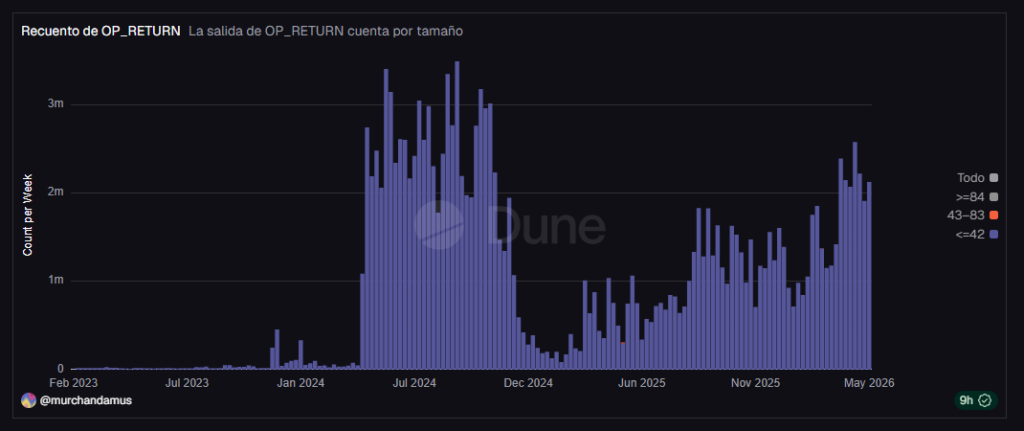
The data comes from two Dune Analytics charts created by Murch himself, covering February 2023 to May 2026. The first records the weekly count of OP_RETURN outputs sorted by size. In the week analyzed by Murch, outputs longer than 83 bytes represented just 0.000075% of the total outputs.
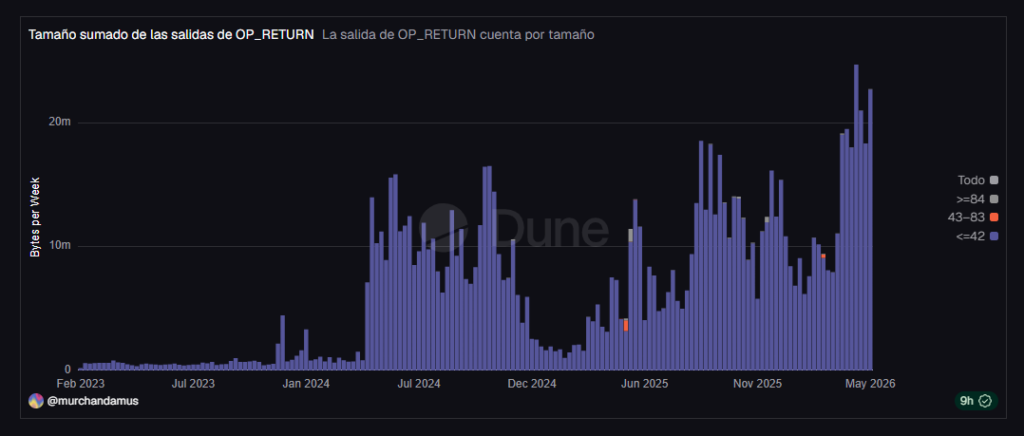
The second graph measures the total space occupied by those outputs in bytes per week: those larger than 83 bytes absorbed 0.14% of the total space consumed by OP_RETURN outputs, equivalent to 0.0032% of Bitcoin block space.
Both graphs exposed by the developer show a low volume of OP_RETURN outputs exceeding the 83-byte limit on network usage.
In front of the data contributed by Murch, a report published in mid-April from a Bitcoin node broker warned that during the last quarter, registrations via protocols such as Ordinals and Runes and transactions with OP_RETURN accounted for 44% of Bitcoin operations; of this percentage, almost 63% were OP_RETURN outputs.
This data, which coincides with what was reported by CriptoNoticias in October 2025, reflects that, considering not only OP_RETURN operations greater than 83 bytes, the percentage indicated by Murch increases considerably.
OP_RETURN is a Bitcoin opcode that allows arbitrary data (text, identifiers, records) to be included within a transaction. Until Bitcoin Core 29, the limit for that data was 83 bytes.
In October 2025, and after a debate that had begun months before, Bitcoin Core 30 expanded that limit to 100,000 bytes by defaulta change criticized by the bitcoiner community since, according to its detractors, it facilitates the use of Bitcoin as a file network, increasing what they consider spam by taking up block space without transferring monetary value.
Same data, opposite arguments
Adam Back, co-founder of Blockstream, also ironically dismissed the alarm. In X wrote that Bitcoin Mechanic (developer and one of the most active critics of the change introduced in Core 30) “definitely worth forking”in sarcastic reference to the position of those who propose, such as Mechanic, the introduction of a soft fork through the BIP-110 proposal to avoid the inclusion of arbitrary data in Bitcoin. For Back, this proposal is disproportionate to an impact that the data does not support.
One miner and node operator noted that “so why was it so important to open it by default in the reference implementation?”, warning that if the use of OP_RETURN outputs larger than 83 bytes is so marginal, the extension in Core v.30 would not have been necessary.
Likewise, another user responded with the same logic: “It’s not about quantity, but about quality,” arguing that the current low incidence does not justify having opened the limit and that the problem is not how many outputs exceed 83 bytes today, but what kind of content could be embedded tomorrow without restriction.
Steve Tippeconnic, a developer specializing in quantum, added a more precise technical criticism. According to him, expanding the limit of OP_RETURN did not solve the problem that its defenders argued, since the use of data embedded in the witnessthe transaction space where digital signatures are stored and where protocols like Ordinals can also embed information.
On the other hand, said the quantum specialist, the change opened up a new vector to embed data more directly and visiblywithout addressing the origin of the debate. “Just as everyone at BIP-110 predicted,” he wrote, tying that result to warnings the proposal had raised before Core 30 was released.
BIP-110: the proposal that wants to reverse the change
BIP-110 is a soft fork proposal created by anonymous developer Dathon Ohm that seeks to restrict non-financial uses of Bitcoin block space, reserving it for payments and settlements. As reported by CriptoNoticias, this proposal was included by default in the latest update of the Bitcoin Knots client, a software that filters the operations that Core v.30 enabled.
Activation of BIP-110 requires that a critical mass of node operators install that client voluntarily to produce the desired effect. If that adoption does not occur, the BIP-110 rules never come into effect, since without enough nodes to reject blocks with arbitrary data, the network will simply continue to accept them as before.
In that context, Murch’s data reignited the debate over whether the expanded OP_RETURN limit represents a real risk for Bitcoin or a disproportionate alarm.