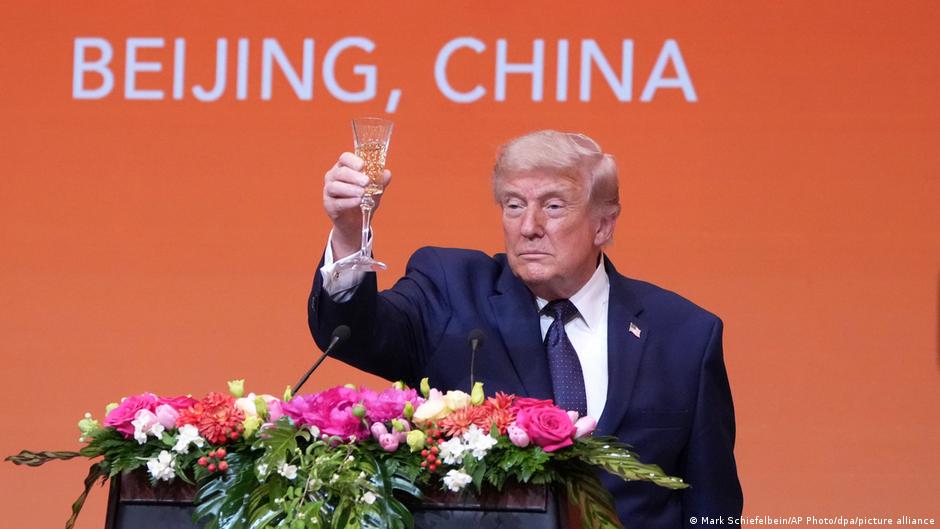
The high-profile Beijing summit between Donald Trump and Xi Jinping ended with bombastic, positive statements – especially from the Trump White House, which called the US president its “dealmaker-in-chief” – but little concrete deals between the two rival superpowers.
During the visit, Trump praised Xi, calling him a “great leader” and “somebody I respect very much.” Addressing reporters at a press event with Xi, Trump also indicated that he and Xi “feel very similarly” about the Iran war, which has been dominating global politics since the US and Israel launched airstrikes on Iran in late February.
“We want this to end. We don’t want them to have nuclear weapons. We want the Straits open,” Trump said.
This echoed Trump’s previous claims that Xi had offered to help broker a deal with Tehran and open the Strait of Hormuz.
Xi issued warning on Taiwan
However, the Chinese leader did not mention Iran in his remarks to the press on Friday. Instead, Xi took the opportunity to warn of potential conflict between China and the US if the two countries fail to cooperate, and highlighted the dispute over the self-ruled island of Taiwan, which China views as its territory.
“The Taiwan question is the most important issue in China-US relations,” Xi said.
“If it is handled properly, bilateral relations will enjoy overall stability. Otherwise, there will be skirmishes and even conflicts between the two countries, putting the entire relationship in great danger.”
With the global economy in turmoil over the Strait of Hormuz, neither side appears willing to return to a catastrophic trade war by 2025.
The US President was accompanied by more than a dozen CEOs, including Nvidia’s Jensen Huang, Apple’s Tim Cook and Tesla’s Elon Musk. On Friday, Trump touted “great trade deals for both countries” without giving details.
Trump in controversy over selling arms to Taipei
Joseph Bosco, a former official on the China country desk in the office of the US defense secretary, told DW that Xi was “trying to take advantage of Trump’s obvious weaknesses at this point.”
“Trump has a thing going on Iran that is not going according to his original plan,” Bosco said. “And I think Xi Jinping thought this was a good time to put a lot of emphasis on the most important issue, which is Taiwan.”
Taiwanese officials fear Beijing will take over the island by force and are heavily dependent on US arms sales to maintain their defense capabilities. Although Washington officially broke its diplomatic relations with Taipei in 1979 in accordance with its “One China” policy, the US also promised to “provide Taiwan with weapons of defensive character” under the Taiwan Relations Act.
The US is currently preparing to sell $14 billion (a little more than 12 billion euros) worth of arms to Taipei. But Trump delayed approving the package before meeting Xi.
In an interview on Thursday, the same day that Trump and Xi held a two-hour closed door meeting in Beijing, US Secretary of State Marco Rubio said arms sales to Taiwan were “not primarily included in today’s discussion” but had been discussed in the past.
During his flight back to the US, Trump told reporters that he had not yet decided on the arms sale.
Is America ready to cede land on Taiwan?
With Trump inviting Xi to visit Washington in September, it looks increasingly likely that the arms package will remain on Trump’s desk by then.
“There may perhaps be a desire within the administration to avoid igniting waters before then, and postponing further arms sales,” said John Dotson, director of the Global Taiwan Institute, a Washington-based think tank.
Asked whether Trump and Xi specifically discussed U.S. arms sales to Taiwan on Thursday, China’s Foreign Ministry spokesman Guo Jiakun said “China’s opposition to U.S. arms sales to China’s Taiwan region is consistent and clear.”
Derek Scissors, a senior fellow at the American Enterprise Institute, also believes Xi’s potential visit could interfere with US arms sales.
“The obvious tradeoff here was Taiwan for Iran,” he told DW. “And I don’t mean like the US gets Iran and China gets Taiwan, but if China cooperates more on Iran then the US will cooperate more on Taiwan.”
Although Xi did not mention the Middle East in his Friday remarks to the press, China’s Foreign Ministry said in a statement that the conflict “is no reason to continue” and “shipping routes should be reopened as soon as possible.”
“China has been helping Iran so far,” Bosco said. “They are providing technical information and weapons material and other things that are assisting in intelligence gathering.”
Bosco believes China’s call for Iran’s dismantling was “a step in the right direction” but “not the whole solution.”
Trouble brewing behind the scenes
However, continuing on the current path has its own risks for China. The emerging superpower is the largest oil importer in the world. According to some sources, China will buy more than 90% of Iran’s oil exports in 2024, and a large portion of crude oil purchases from other countries also need to be transported through the now closed Strait of Hormuz. Another driving factor is US sanctions imposed last week against individuals and companies in China, including commercial satellite operators, with Washington accusing them of supplying Tehran with weapons components, raw materials and targeting data used to attack US forces in the Persian Gulf.
The issue of US sanctions was clearly ignored during Trump’s two-day visit to Beijing. And, despite Trump’s efforts to show optimism, it is unclear what concrete steps China is willing to take to help the US open the Strait of Hormuz.
“I certainly don’t see why the Chinese government, for example, would agree to participate in some kind of naval operation to take ships through the Strait of Hormuz or contribute to some kind of effort to open the strait by military means,” Dotson said.
Edited by: Ole Tangen Jr.