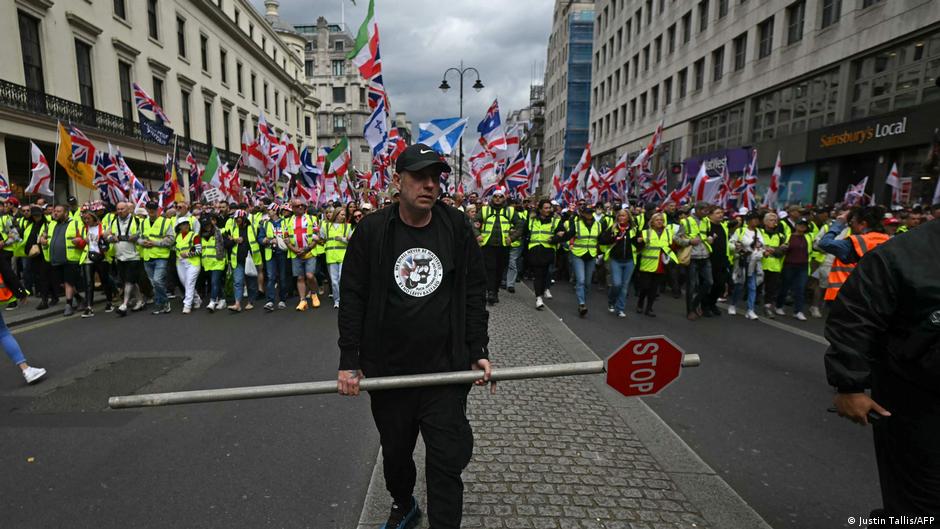
Police in London were on standby on Saturday as thousands of protesters joined the latest rally organized by far-right activist Tommy Robinson.
Robinson, whose real name is Stephen Yaxley-Lennon, rallied 150,000 people in central London last September for a rally proclaiming “national unity, free speech and Christian values”.
Who is Tommy Robinson?
The public profile of the former football hooligan turned anti-Islam activist has risen significantly in Britain in recent years. He also has convictions for assault, stalking and other crimes.
Robinson this week urged supporters to act peacefully in what he described as “the largest patriotic demonstration the world has ever seen.”
London’s Metropolitan Police has said it will deploy 4,000 officers. They will be assisted by horses, dogs, drones and helicopters.
The city’s law enforcement will be weakened as they seek to manage far-right marches and counter-demonstrations, pro-Palestinian protests, as well as the FA Cup final, all at the same time.
Prime Minister Keir Starmer on Friday condemned Robinson’s Unite the Kingdom march for “promoting hatred and division in a clear and simple way.”
Robinson condemns ‘Islamisation’ of Britain
Far-right activists have taken advantage of growing public anger over immigration, as Britain sees thousands of migrants crossing the English Channel in small boats each year.
His followers have also shown dissatisfaction with broader immigration policies, perceived free speech restrictions, and other issues.
Speaking on stage in March, Robinson called on the British people to get involved in politics.
He said, “Are you ready for the Battle of Britain? We have an election in 2029. We’re not asking anyone to go out and fight, but this is the most important moment of our generation.”
“If we don’t send a message in our next election, if you don’t register to vote, if you don’t get involved, if you don’t become activists, we will lose our country forever,” he said.
Robinson has spread his message far and wide, traveling to the US earlier this year to warn about the so-called “dangers of Islam” and the “Islamisation of Great Britain”.
Census data showed that in 2021 only a minority of people in England and Wales still identified as Muslim, around 6.5% of people, up from 4.9% in 2011.
For the first time under official protest restrictions, organizers of the rallies will be prosecuted, as well as any speakers who break the law by using the events as a platform for extremism or hate speech.
Edited by: Rana Taha