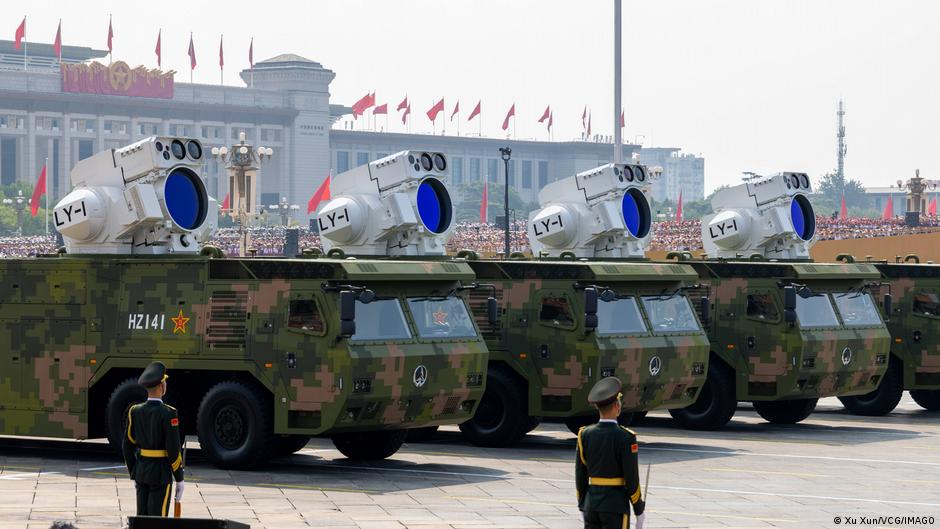
Last week, avid online weapons hunters detected a Chinese-made laser system at Dubai Airport in the United Arab Emirates. The lasers are mounted on a vehicle and are believed to be capable of shooting down drones.
The UAE already has an Israeli-made laser system called Iron Beam that Israel apparently loaned to the Emiratis, and further reports say the UAE is also looking to purchase an American-made laser weapon. The UAE has also signed agreements with European and American companies to co-develop its own laser weapons.
In late 2025, a transportation company posted photos of the military equipment it shipped and inadvertently sent out oman As another buyer of Chinese-made laser weapons. And, following the Israeli attack on its capital last September, Queue Türkiye is apparently considering acquiring elements of the air defense system known as Steel Dome, which also includes laser weapons.
Meanwhile, in Saudi Arabia, the military is also testing Chinese-made laser weapon systems, with some observers suggesting that the Saudis have purchased eight Silent Hunter units from China and are also considering purchasing US-made laser weapons.
Star Wars, anyone?
Laser weapons may sound like science fiction but the Iran war is bringing them closer to common use in real-life conflicts, says former defense journalist Jared Keller. laser warA newsletter that looks specifically at this technology. Recently he wrote that during April and May, the global laser weapons development had accelerated at a pace that he had never seen before.
And “the UAE is gradually becoming the world’s busiest laser weapons market,” he said, noting that the country now has two different types of laser systems and is purchasing a third.
“We’re at a point where many forces are converging to popularize lasers,” Keller told DW. “One is technological maturity.” Keller pointed out that although the US military first shot down a drone with a laser during testing in 1973 and has been working on this technology since then, laser weapons have now become smaller and work better.
Lasers are part of a group called direct energy weapons, or DEW. This group consists of high-energy lasers that have a beam that is used to either damage or blind a target. The group also includes what are known as high-power microwave weapons, which produce bursts of microwaves that cause internal malfunction in the target.
Secondly, Keller adds, it is about the proliferation of drones in warfare. “The rise of unmanned drone warfare complicates the traditional economics of war,” explains Keller. That is, it is not cost-effective to shoot down a cheap drone that only costs hundreds of dollars, while missiles cost hundreds of thousands or even millions, Keller explains.
“It’s an unsustainable cost curve, especially when these drones can be mass-produced quickly and weaponized just as quickly, whereas missiles take a long time and a lot of resources to produce,” says the US-based laser weapons expert. “As a result, governments around the world are trying to adopt low-cost measures.”
For example, manufacturers of high-energy laser weapons often say that each shot costs only between $3 (€2.50) and $5 (€4.30).
And finally, Iran has changed its demand for lasers. Although these are being developed to deal with Russian drone attacks in Ukraine and the Russians apparently have some, but Iran is the first time the US military, its allies in the Gulf and Israel have had to deal with drones in this way.
“Iran has really brought the drone war home,” Keller says, adding that at a March conference senior U.S. defense officials said they wanted to begin fielding the laser weapons on a large scale and within the next three years.
“Any country facing an imminent threat from a regional neighbor is going to want to fast-track these systems,” Keller says, explaining why lasers are proliferating in the Gulf states.
Do lasers really work against drones?
However, lasers are no “silver bullet,” and for Middle East countries purchasing them, Keller thinks such weapons would be most useful as part of a larger, layered air defense system.
This is because of some of the drawbacks that come with lasers. Laser beams travel in a straight line, they can only be used over a certain distance (for example, Israel’s Iron Beam units cover only 10 kilometers at a time) and to be effective, they must be held on target for a certain amount of time. What is known as “dwell time” can be difficult if the target is a fast-moving drone.
Laser rays can also be scattered or obstructed by moisture, rain, mist, fog, snow, sand, dust or sea spray. The high temperatures in the Middle East can also damage the laser’s sensitive components and make them difficult to operate, as more energy has to be spent on cooling. The Saudis have reportedly complained about some of these issues when testing their Chinese-made lasers.
Despite previous publicity about it, Israel’s Iron Beam laser has not yet been fully used in Iran. According to reports, one version has shot down a drone launched by the Lebanese group Hezbollah jerusalem postThe Israeli Air Force says the laser requires at least 14 more batteries to be effective, which the country does not currently have.
That’s why sending the Iron Beam 100-kilowatt laser to the UAE “may be more of a diplomatic maneuver than a practical one,” says Keller, founder of Laser Wars.
There is also clearly a geopolitical aspect to who has laser weapons in the Middle East.
Buying laser weapons from different sources, as the UAE and Saudi Arabia are doing, is one way Gulf countries are able to diversify their defence, says Andreas Craig, a senior lecturer at the School of Security Studies at King’s College London.
“Overdependence on the United States has not been profitable,” Craig told DW. “There is a realization that in the short term it cannot be broken, but in the mid to long term the Gulf countries will have to find ways to increase their self-reliance.”
The threat posed by Iran and – as senior Saudi leaders discussed this week – Israel is not going away, even if the war ends.
Craig argued, “So it is clear that they need to complement diplomacy with a strong ability to deny Iran the opportunity to disrupt trade and stability.” “One way to do this is to create a leaner, more self-reliant air defense umbrella that is less dependent on U.S. munitions, which is difficult to achieve.”
Edited by: Andreas Illmer