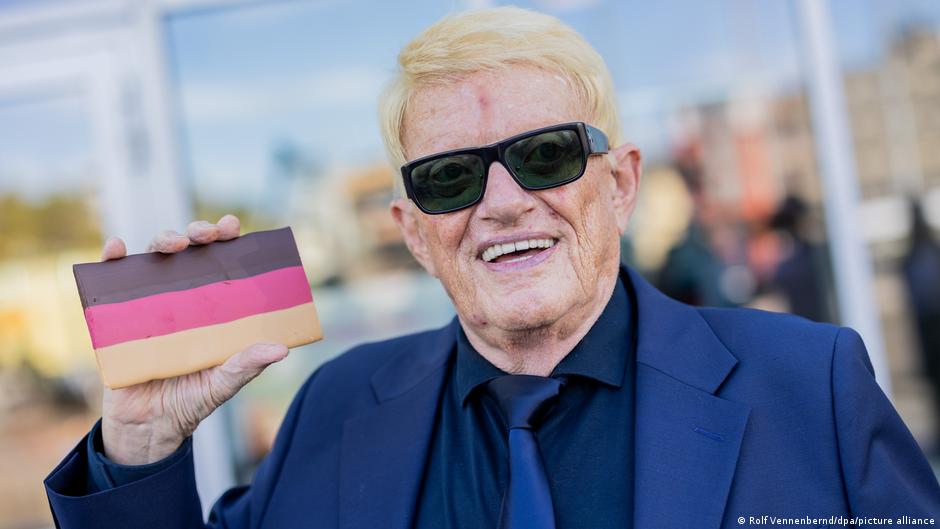
Heino is much more than just a “Schlager” (German folk pop) star in Germany: With more than 55 million records and CDs sold and 1,200 songs recorded, the 87-year-old Heino is a veteran and icon of the German music industry. His hit songs still resonate in the hearts of the youth. He has also sung at heavy metal festivals. Before sexual assault allegations surfaced against Rammstein’s lead singer, Heino had also performed with the widely renowned German band.
Heino’s trademarks are his immaculate blonde side-part and his black sunglasses (incidentally, worn to hide an eye condition called exophthalmos). But above all, it is his music: German-language folk songs about love, the motherland and an ideal German world, usually sung in a deep voice with the Teutonic Rold “r” – that led to his lifelong career.
However, this also made him a controversial figure. on 22 October 2005 south german newspaper The newspaper wrote the following: “Germany is a divided country – also in its attitude towards Heino. Some love him; others despise him.”
Heinz Georg Cramm – Heino’s real name – has always been a subject of controversy, not least because of the choice of songs.
When, in 2018, he presented an album to the Minister of Homeland Affairs of the federal state of North Rhine-Westphalia that included songs sung by the notorious Schutzstaffel (SS), a major paramilitary organization of Nazi Germany, it caused a major uproar in the media. Heino defended himself and was quoted by Frankfurter Allgemeine Zeitung Saying at the time: “The songs themselves cannot be attributed if they are instrumental.”
In 1998, the public broadcaster SudwestrundfunkThe “Report Mainz” program reported that a right-wing extremist publishing house was distributing a cassette of songs recorded by Henno – recordings that were originally produced by the EMI-Electrola label. When asked about the matter, Heino told the journalist that he was completely unaware of the publishing house’s involvement in the distribution.
national anthem controversy
Heino’s recording of the German national anthem – “The Song of the Germans” – was a particularly sensitive issue. He sang all three verses of it and released it as a record in 1977. However, the first two verses of this traditional song have been disliked in Germany since the Nazi dictatorship of Adolf Hitler, although they are not banned in Germany.
The first verse begins: “Germany, Germany on everything, on everything in the world.” (“Germany, Germany on top, on top of the world.”) After twelve years of National Socialist terror from 1933 to 1945 under dictator Adolf Hitler and German aggression in World War II, verses expressing grandiose visions of German supremacy were no longer considered appropriate for postwar German society.
Only the third verse of the song is recognized today as the text of Germany’s national anthem: “Unity and justice and freedom…”. These are the words sung at official events, football matches and ceremonies.
In an interview given to a newspaper Frankfurter Rundschau In 2001, Heino himself reported that then-Chancellor Willy Brandt had objected to the recording of all three verses of “Deutschlandlied”.
“Willie Brandt broke up with me,” Heino admitted.
Heino refuses to be co-opted by the far right
Despite his controversial choice of songs, Heino never wanted to be politically co-opted, in the interview quoted above he even talked about far-right fans of the neo-Nazi or skinhead scene: “I hate brown bald heads.”
Brown was the color of the Nazi Party’s uniform.
And now Heino is defending himself in court against being adopted by a politician from Alternative for Germany, the AfD.
Felix Teichner, a little-known regional AfD politician from the state of Brandenburg, posted an election advertisement for his party on social media. His post read: “On Sunday, will vote for Heino Felix.”
Heino is now taking action against him. His manager said on his behalf: “This is an outrage, and it goes too far.”
He said that Heino had already publicly spoken out against the AfD and that it was unacceptable for the party to use him for campaign purposes.
As a result, AfD politicians signed a ceasefire declaration. However, this is not enough for Heino: he is considering a claim for damages.
The case made headlines in Germany, especially because the AfD had been rising in the polls for months. That’s why political scientist Niklas Furch of Justus Liebig University in Giessen doesn’t believe the current scandal will cause any serious damage.
“Within its core voters, the AfD does not lose support over such legal defeats; rather, they reinforce the party’s classic populist narrative of criticizing the elite,” Furch said in an interview with DW.
It is unusual for politicians to adorn themselves with the name of a pop star without permission – but there is no overlap between pop and politics.
“Pop and politics are partly working in the same business,” Ferch explained. “In both spheres of society, it’s about power – in politics as much as in entertainment, especially on stage.”
What Ferch finds interesting about the Heino case is that Heino’s Schlager music generally has a reactionary reputation: Schlager works generally operate under suspicion of being – at the very least – escapist, if not outright reactionary. After all, it caters to specific idealized images of home and homeland and celebrates the “good old days.”
“It is even more remarkable that Heino has taken legal action against the AfD,” Furch said.
Do pop stars profit from political statements?
When pop stars take action against political appropriation, they risk damaging their public image. Claims for damages are often followed by allegations that they simply want to make more money. However, political scientist Furch sees Heino’s apparent statement against the AfD as an economic risk for the artist.
“Those who appeal to all sections of mainstream society, especially those who do not, have nothing to gain by taking a political stance,” he told DW. “You’ll potentially alienate the audience you had before. This will definitely show up in sales figures, whether it’s for concert tickets or streaming.”
On his Instagram account, Heino has already faced the intense anger of some of his fans: “Withdraw the lawsuit,” some posted, or: “Heino will need the money.”
The artist himself declined to engage in further discussion about the matter on Instagram.
This article has been translated from German.