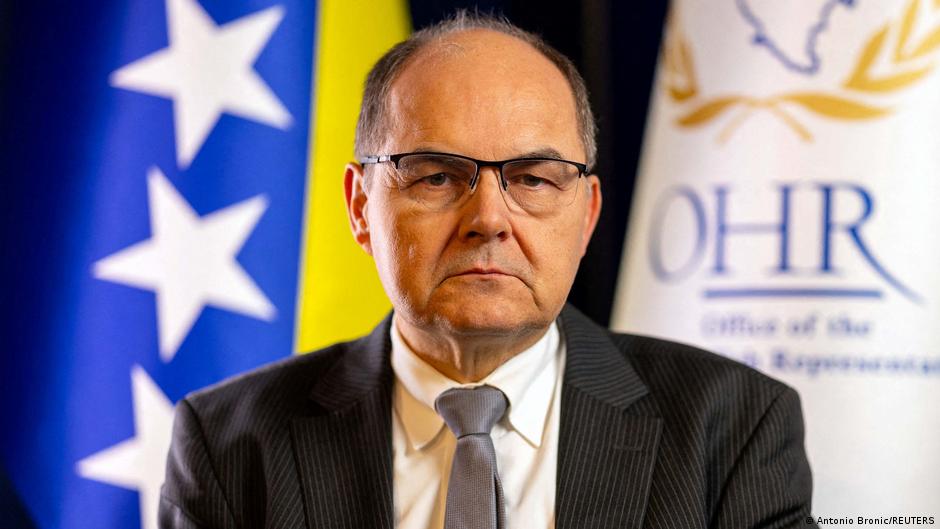
The Office of the High Representative in Bosnia (OHR) confirmed on Monday that the top international envoy to Bosnia and Herzegovina, German politician Christian Schmidt, will resign after five years in office.
The post of High Representative was created to oversee the implementation of the US-brokered Dayton Peace Agreement following the 1992–95 Bosnian War, which divided Bosnia into the Serb-majority Republika Srpska and the Bosnia-Croat Federation of Bosnia and Herzegovina, two entities linked by a weak central government.
Over the years, the post of High Representative has gradually evolved into a position of extraordinary political authority, giving the holder of the post the power to enforce laws and dismiss elected and appointed officials.
This is why any change at the top of the OHR carries much more significance than a simple diplomatic handover.
Not just an individual step?
Although Germany’s Frankfurter Allgemeine Zeitung (FAZ) Citing OHR over the weekend that Schmidt had “personally decided” to step down, it’s hard to read the resignation as a purely personal move.
A more plausible explanation is that key international actors in Bosnia and Herzegovina have re-evaluated what they want from their top envoy to the country.
In that sense, Schmidt’s departure looks more like a natural end of the mandate than an organized political withdrawal from the top.
controversial appointment
Christian Schmidt, a German conservative with a long political career, came to Bosnia and Herzegovina with a reputation as a disciplined establishment figure who would bring credibility and administrative seriousness rather than political reform.
In some parts of the international community and in Bosnia, Schmidt was presented as the legitimate successor to the previous High Representatives.
However, in Republika Srpska, he was never accepted as an uncontested authority, primarily because his appointment was not confirmed by the United Nations Security Council.
It might seem that a procedural technicality turned out to be a grave mistake in Bosnia that had major political consequences.
completely different ideas
For some, Schmidt was a bulwark against institutional breakdown and sought to stabilize the country and prevent deep paralysis.
To others, he was a foreign overseer who ruled without a strong legal order and who issued decrees without the consent of those who were expected to obey them.
These sharply differing views influenced his entire tenure more than any of his personal decisions.
Confrontation with Republika Srpska
While Schmidt’s interventions showed that the international community could still enforce legal and political judgments in Bosnia, they also raised questions about whether such interventions – by an international authority that is above domestic democratic accountability – actually resolved crises or merely postponed them.
Nowhere was this more visible than in Schmidt’s confrontation with the leadership of Republika Srpska and its former president Milorad Dodik.
Schmidt was one of Dodik’s most vocal international opponents. In 2025, Bosnia’s Central Election Commission revoked Dodik’s mandate as president after the country’s highest court sentenced him to one year in prison and barred him from all political activity for six years for disregarding decisions of the High Representative.
Before his sentencing, Dodik had spent several months taking actions aimed at threatening Bosnia’s constitutional order and establishing parallel institutions in Republika Srpska.
Dodik was convicted under an amendment to Bosnia’s criminal code that was imposed by Schmidt himself, which explains why Dodik is now presenting Schmidt’s departure as a moment of triumph for Republika Srpska.
‘Extremely worrying’ development
“The message sent by Christian Schmidt’s forced resignation is extremely worrying,” said Banja Luka political analyst Tanja Topic. “I think many people are still not fully aware of the danger of Bosnia and Herzegovina,” he told DW.
He said, “Dodik and Republika Srpska officials won this battle, which aimed to get Schmidt out of Bosnia and Herzegovina at any cost. Part of that understanding was that Dodik himself would step back, but he still pulled all the strings and showed no signs of retiring from politics.”
Topic warns that the next phase could bring renewed pressure towards Republika Srpska’s state agenda.
According to an article by Faiz On Sunday, Schmidt, who is due to present his twice-yearly report on Bosnia to the UN Security Council on Tuesday, will warn of Bosnia’s imminent disintegration.
geopolitical aspects
However, Schmidt’s departure must also be seen in the broader international context.
Although Bosnia and Herzegovina is a small country, it has for years been a place where the interests of many major international actors such as the EU, the US, Russia and Turkey intersect.
It has also increasingly become a focus for players in the energy and infrastructure sector who view Bosnia and the entire region as a strategic location that offers long-term influence on routes, markets and political leverage.
For this reason, the issue of who makes decisions about Bosnia’s state-owned assets is particularly sensitive as it is not just a question of ownership, but also of who controls the land, infrastructure corridors, energy projects and future investment flows.
That’s why the fight over Bosnia’s state-owned assets is at once constitutional, economic and geopolitical. Whoever sets the rules in that area doesn’t just shape a legal principle, they shape part of the country’s future.
This was recently illustrated by the controversy surrounding the Southern Interconnection Pipeline, when the EU objected after legislation passed by Bosnian lawmakers effectively named a little-known company with ties to individuals close to US President Donald Trump as an investor in the project.
more than personnel changes
In short, Schmidt’s departure could mean more than a personnel change. This may indicate that international actors are closing one phase of external management in Bosnia and Herzegovina and preparing for another – which will require a different figure, a different tone and perhaps a different pressure mechanism.
“The Europeans are still retreating before the Americans, and Schmidt was effectively surrendered without a fight, while Bosnia and Herzegovina has been left with fragile institutions, no real rule of law and constant attacks on its sovereignty,” Tanja Topic told DW.
“At the heart of all this are American and economic interests, which raises the question of whether Bosnia and Herzegovina will pay the price,” he said.
For political Sarajeov, this raises an uncomfortable question.
For years, Christian Schmidt was presented as proof that some form of external reforms still existed in Bosnia and Herzegovina, a figure capable of stepping in when domestic institutions could no longer control the crisis.
If it now turns out that even such power is neither stable, nor irreplaceable, nor politically defensible once it becomes inconvenient for the great powers, the fragility of the entire model is exposed.
Edited by: Angiel Flanagan