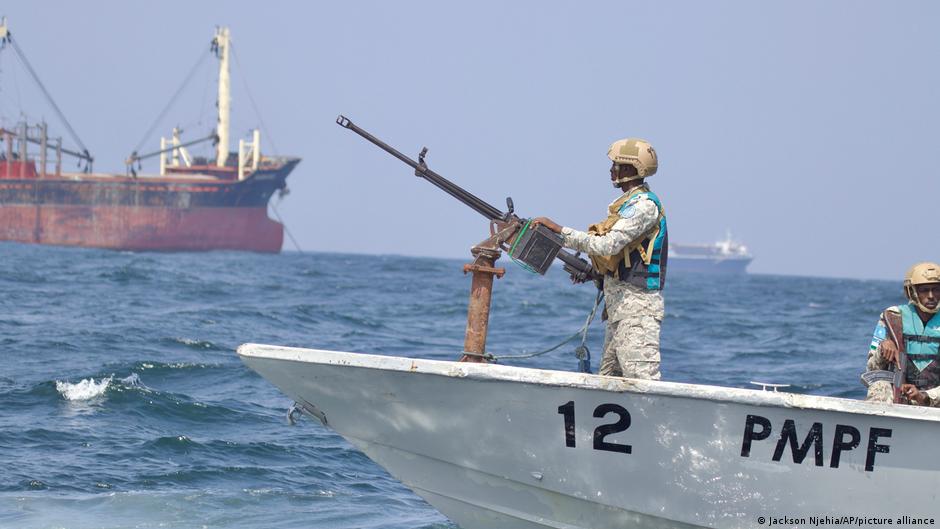
These two months have been a nightmare for global shipping, with the Strait of Hormuz largely closed to commercial traffic and the threat of new attacks on ships in the Red Sea.
Now, a third crisis is brewing – the resurgence of Somali piracy.
Even before the latest tensions between the United States, Israel and Iran, about half of ships sailing to Europe from Asia and the Gulf were bypassing the Red Sea and the Suez Canal due to earlier attacks by the Iran-backed Houthis.
Faced with the threat of attacks around the Bab el-Mandeb Strait, the narrow chokepoint between the Red Sea and the Gulf of Aden, major shipping companies opted for longer detours around southern Africa.
The change adds two to three weeks and thousands of nautical miles to the journey, moving ships just past Somalia’s coastline – the same waters where Somali pirates conducted a multi-year campaign of kidnappings that peaked in 2011. Sporadic incidents have been reported since then.
Piracy makes a disturbing comeback
That part of the sea is now seeing the return of piracy with a vengeance, with three ships hijacked off Somalia and nearby Yemen in the past three weeks alone. As of May 8, 2026, the oil tankers Honor 25 and Eureka and the cargo ship Sward are all under pirate control.
Experts believe organized crime groups in Somalia are taking advantage of the Iran war to carry out kidnappings, as international naval patrols, first deployed in 2008 to combat piracy, have been weakened due to current events around Hormuz and the Red Sea.
Tim Walker, senior researcher on transnational threats and organized crime at South Africa’s Institute for Security Studies, says pirates now feel fewer deterrents along Somalia’s 3,300-kilometre (2,050-mile) coastline, the longest in all of continental Africa.
“Some groups organized by pirate kingpins now seek to seize ships and hold them for ransom along with the crew members still on board – sometimes demanding large ransoms for their safe return,” Walker told DW.
The EU’s Operation Atalanta, the naval mission tasked with protecting shipping off Somalia, maintains a stable presence in the western Indian Ocean, working with the multinational Joint Task Force 151. But it is not an escort force, and is responsible for patrolling vast areas.
Well-funded pirates are using dhows
According to maritime data company Lloyd’s List Intelligence, there are at least two active pirate groups, based mainly in Puntland, a semi-autonomous region in northeastern Somalia. They seem to be well resourced.
Pirates have seized large traditional ships called dhows, used for fishing and local trade, which have been repurposed as mother ships. These allow pirates to remain at sea for weeks before using them as launching pads to extend their range and target commercial shipping.
“Some of the latest hijackings involve large ships, which require navigation kits, weapons and boarding equipment,” Troels Burchell Henningsen, an assistant professor at Denmark’s Institute for Strategy and War Studies, told DW. “It’s a big operation that requires investment.”
“There are a lot of ships in the region and some are not taking the best security measures,” Walker said, describing how a tanker bound for Mogadishu was hijacked close to the Somali coast, where it was most vulnerable.
Piracy may further increase shipping costs
With Middle East conflicts already sending shipping insurance premiums soaring, fuel costs per voyage rising by nearly a million dollars and freight rates rising, shipping industry leaders have warned that any major resurgence in piracy could push costs even higher and disrupt global trade.
At the peak of the last piracy crisis in 2011, the economic loss from piracy was estimated at about $7 billion (€5.98 billion) per year, according to the Japanese think tank Sasakawa Peace Foundation.
This included the cost of military operations, diversions, faster travel – which consumes more fuel – additional security equipment and onboard guards.
The think tank calculated that only a small portion of the total cost, about $160 million, was paid as ransom.
Cut in development funds to Somalia
While Iran posed a useful distraction to pirates, changes in Washington’s policy toward East Africa may also have played a role in the resurgence of piracy.
For years, the US funded development projects in Somalia – particularly in coastal communities – to reduce poverty and prevent youth from joining pirate groups.
However, under the current Trump administration, almost all non-security development assistance has been suspended. Washington has instead focused on direct counterterrorism operations against the Islamist militant group al-Shabaab.
“When you reduce those resources, the intelligence networks and maritime patrols no longer have the same ability to do the job,” lamented Burchell Henningsen.
Meanwhile, maritime organizations have advised shipping companies to avoid Somali territorial waters, including ports. He says the deployment of armed guards on board ships is also highly effective against pirate attacks.
“There has never been a successful hijacking of a ship [off Somalia] With armed guards on board,” Burchell Henningsen said.
Edited by: Tim Rooks