
In Ethereum, every time a block is produced there is a parallel economy invisible to the average user. A process that the next network update, which will be launched in the second half of 2026, plans to make more transparent.
The parallel economy of the network is based on the maximum extractable value, known by its acronym in English as MEV (Maximal Extractable Value). This is the value that block builders can capture and that can be manipulated because it allows certain actors to sort, include or exclude transactions. All this before a block is published on the chain.
The FSM arises because Transactions are not processed in the order they arrivebut in the one that decides who builds the block. This fact allows specialized actors—such as bots or opportunity seekers—detect profitable operations in the mempool (the space where transactions wait), who can anticipate them, reorder them or insert themselves in the middle to obtain profits.
The MEV provides third parties capturing value through practices such as arbitragehe front-running or attacks sandwichjust like the one recently suffered by Vitalik Buterin. The co-founder of Ethereum is one of those actors who has an advantage due to his technical capacity and privileged access to the block construction process.
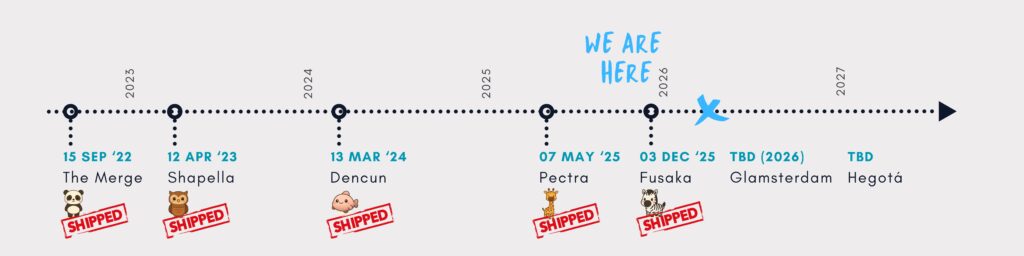
Based on it the Glamsterdam update Its structural objective is to make visible and regulated that MEV process, which today operates in opacity.
The improvement will be applied following the EIP-7732 specificationwhich suggests that the majority of block proponents outsource the construction of execution content to a third party called the builder.
To do it, They must trust an intermediary —the relay server—which offers no cryptographic guarantees about its behavior. That trust model without technical support is the core of the problem that Glamsterdam seeks to solve, among other improvements.
It is worth remembering that the Ethereum improvement proposals (EIP) formalize the changes to the protocol and define how they are implemented. In this context, the separation between proposers and constructors (ePBS, EIP-7732) inscribes in the protocol the role of who selects the consensus block and the one who assembles its content of execution, eliminating dependence on opaque third-party intermediaries.
In simple terms: what today depends on trust agreements between private actors would become a technical guarantee of the protocol itself.
From opaque market to verifiable exchange
The proposal guarantees that an honest bidder will receive payment from the builder, regardless of the actions of the latter, and that the content of an honest constructor will be the canonical head of the chain.
To achieve this, it introduces a new category of participants with a minimum stake of 1 ETH in the consensus chain. These compete through signed offers specifying the block identifier and the amount to be paid to the proposer.
To verify that constructors meet their commitments, EIP-7732 assigns a subset of validators to a committee (Payload Timeliness CommitteePTC). This is in charge of attest whether the constructor revealed the committed execution content in a timely manner and whether associated data were available. This collective verification mechanism replaces the need to trust the relay server individually.
He technical debate on the real scope of the proposal as a solution to the MEV remains active within the research community. EIP-7732 offers proponents the option of using a third-party trustless mechanism, but does not require it.
For extraordinarily high MEV payments or more complex agreements—such as turn-of-validation auctions, preconfirmations for second-layer networks, or zero-knowledge proof auctions—actors They could continue operating through external intermediaries.
According to its designers, the mechanism has been designed to be competitive enough for a significant portion of the network to adopt it as a standard, while leaving incentives for alternatives external to the protocol to continue to exist.