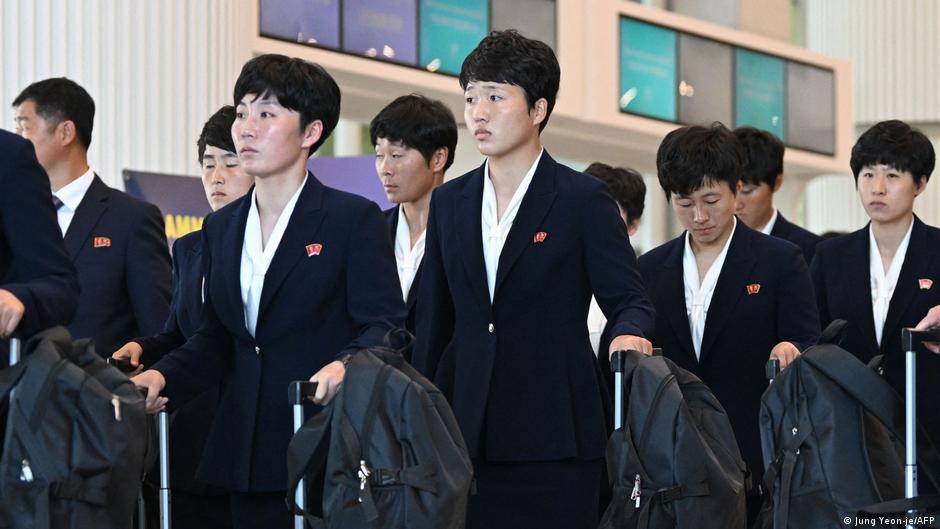
North Korea’s Naegohyang Women’s FC is scheduled to play the South Korean women’s team in Suwon on May 20, the first time Pyongyang has allowed its athletes to travel to the South in more than seven years.
For some, it is a sign that the North is deploying “sports diplomacy” to ease strained bilateral relations.
The rare visit comes as North Korea dubs the South its “primary enemy and irreconcilable major enemy” in a recently rewritten constitution that removes the notion of reuniting the peninsula, which has been divided since the 1950-1953 Korean War.
Victor Cha, Korea president of the Center for Strategic and International Studies (CSIS) in Washington, spoke An article published on the CSIS website on May 4 That, “Sports diplomacy has always been an important tool of inter-Korean diplomacy.”
“It is significant for Pyongyang to allow athletes to travel to the South, given North Korea’s claim of ceasing all dialogue with South Korea and enemy-state declaration regarding Seoul,” Cha said.
“In this respect, football matches can demonstrate the potential to separate cultural exchange from politics,” he said.
The 27-strong North Korean team had been training in Beijing but arrived at Incheon airport on Sunday before traveling to Suwon, about 30 kilometers (18.6 miles) south of Seoul, ahead of the Asian Football Confederation Women’s Champions League semi-finals.
Signs of improvement in North-South relations?
While analysts largely agree that the North Korean team’s visit to the South is a positive development, they caution against exerting too much influence on Pyongyang’s decision.
Hyobin Lee, a professor at Sogang University in Seoul, said, “The chances of this football match becoming an immediate ‘breakthrough’ in inter-Korean relations are limited.”
“But I also don’t think it’s meaningless and I partly agree with Victor Cha’s analysis,” he told DW.
The North Korean women’s football team’s first visit since the 2014 Incheon Asian Games is “symbolically important”, Lee said.
He noted that some South Korean politicians have seen it as “a potential opportunity to ease tensions in frozen inter-Korean relations.”
Limitations of sports diplomacy
South Korean media reported that Unification Minister Chung Dong-young was also considering attending the match.
“There is understandable optimism that a soccer tournament could become a positive case of inter-Korean, people-to-people exchanges after an extended suspension,” Leif-Eric Easley, a professor of international studies at Ewha Womans University in Seoul, told DW.
The rare visit of the North Korean women’s football team has been approved under the inter-Korean exchange law. All 7,087 tickets made available to the general public were sold out within a day.
While Easley feels it is too early to call the event “successful sports diplomacy”, North Korea’s participation “may signal a softening by Pyongyang of portraying Seoul as a hostile enemy.”
Erwin Tan, a professor of international politics at Hankuk University, is more skeptical about the football match.
“Inter-Korean sports and cultural events have taken place frequently in the past, yet there has been no diplomatic breakthrough, so I see no reason to see this development as a sign of something new,” Tan told DW.
2018’s missed opportunity
The last time North Korean athletes were in the South was when five table tennis players competed in Incheon, west of Seoul, in December 2018.
The tournament took place nine months after ten North Korean athletes competed in the Pyeongchang Winter Olympics in the South.
Competitors from both countries attended the opening ceremony under the Korean unification flag and Kim Jong Un’s sister Kim Yo-jong led a high-level delegation from Pyongyang.
And while the Games appeared to usher in a bright diplomatic outlook, cross-border relations soon soured.
Kim Jong Un has since ended rhetoric regarding reunification. Pyongyang has changed its constitution to codify its “hostile two-state” policy.
Lee believes that the North’s participation in the 2018 Winter Olympics “should be viewed as a limited but short-term success” that was ultimately diminished by the collapse of the nuclear summit between President Donald Trump and Kim Jong Un in Hanoi in 2019 and “growing mistrust between Washington and Pyongyang.”
However, Pyongyang agreeing to send the team to the South allows the country to “present an image to the international community that it is not completely isolated or closed off,” he said.
What else could have motivated Pyongyang to send its athletes?
Lee believes Pyongyang had more reasons than just an effort to encourage diplomatic rapprochement for agreeing to send the team to the South.
She notes that since sporting exchanges are less politically risky than formal diplomatic negotiations, these types of events are “useful for testing limited participation.”
“There’s probably a propaganda dimension as well,” he said. “North Korea has long used international sports participation as a way to boost national prestige and regime legitimacy domestically.”
Lee told DW it’s also possible that Pyongyang “wants to preserve selected channels of communication with the South rather than completely eliminate all contact.”
“In this sense, the match may indicate that North Korea is leaving a small diplomatic door open while still maintaining its broader hardline stance,” he said.
Edited by: Amy Sasipornkarn