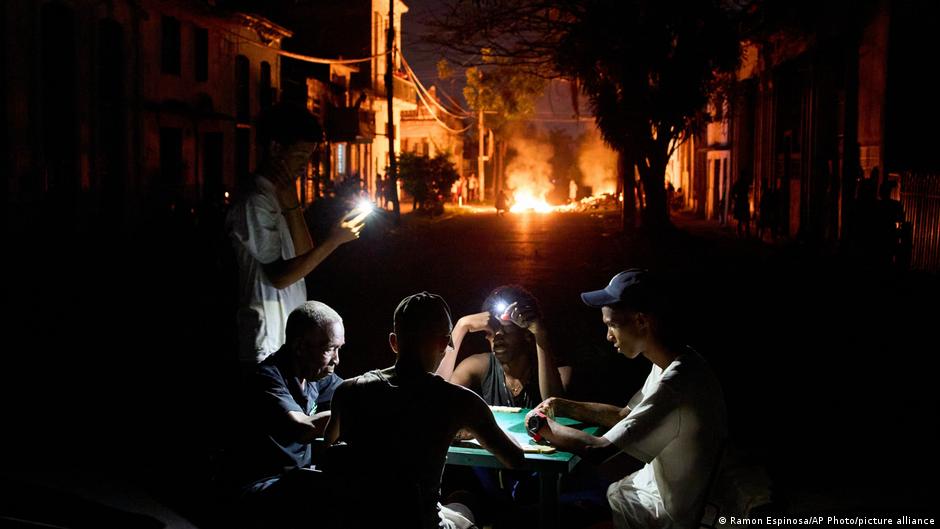
“It’s a joke. If we’re living hand-to-hand, how can we save food for the war?” wrote a Cuban social media user after the publication of an official guide with recommendations on how to prepare for a possible military attack by the United States.
This and other outraged messages reflect the confusion and unease felt by many Cubans following guidelines issued in recent days by Cuba’s Civil Defense, amid rising tensions between Havana and Washington.
“Family guide to the protection of the population in the event of a military invasion” recommends packing a backpack with personal documents, a radio, a flashlight, matches, candles, a first aid kit, food for three days, drinking water, personal hygiene items, as well as medicines for chronic diseases. It also suggests identifying shelters that can be used in the event of an air strike.
The publication of the guidelines comes at one of the most tense moments in decades for already strained Cuba-US relations. In recent weeks, US President Donald Trump has repeatedly hinted at taking action against Cuba, even saying “Cuba is next.”
Drones for Cuba?
Tension increased further after American media outlets Axios Cuba has acquired more than 300 military drones and is evaluating possible scenarios for their use near the US base at Guantanamo, intelligence sources are quoted as saying.
However, analyst Guadalupe Correa-Cabrera said the limited number of drones would not pose any significant threat. “From a military and strategic point of view, 300 drones are nothing compared to the capability of the United States,” Correa-Cabrera, a professor of politics and government at George Mason University in Virginia, told DW. “The disparities are huge.”
The expert believes the current situation should be viewed in the broader geopolitical context, which is marked by tensions between Washington and other global powers like Russia and China.
She explains, “Cuba’s geographical position, beyond its symbolic importance, is fundamental for any country that wants to control the Western Hemisphere.”
According to Correa-Cabrera, it is not only drones that are cause for concern, but also Havana’s potential strategic alliance with countries hostile to the United States and the role that new forms of “irregular warfare” may play.
“We are not talking about a war between Cuba and the United States, but about a global conflict involving other countries,” he explained.
Cubans are bearing the brunt of the humanitarian crisis
Moreover, in a country plagued by power outages, food and health care shortages and record levels of migration in recent years, some observers believe the greatest threat to Washington may not come from military action.
“The most important impact may be psychological or political rather than purely military,” says Juan Batalemé, a senior fellow at the Argentine Council for International Relations (CARI), in an interview with DW.
He argues, “The potential humanitarian crisis would likely be far more sensitive for the United States than the military dimension of the conflict.”
He said that if the unrest led to mass migration, images of Cubans fleeing by sea or seeking humanitarian aid at Guantanamo would have “a huge political cost for Washington”.
According to Battleme, the United States wants to avoid region-wide disintegration. “Washington needs any change in Cuba to be orderly and not create major problems or regional instability,” he says. “Cuba today resembles Venezuela in recent years: an extremely weak country that survives partly on external support.”
Despite the sharp rhetoric and rising diplomatic tensions, the international relations expert believes that the standoff between the two countries is still far from turning into a direct confrontation. Battleme concluded, “The situation is unfolding more on the political front than on the military.”
This article was translated from Spanish.