
On May 12, 21Shares’ first HYPE exchange-traded fund (ETF) debuted.
Coinbase has just joined the Hyperliquid network as a USDC provider.
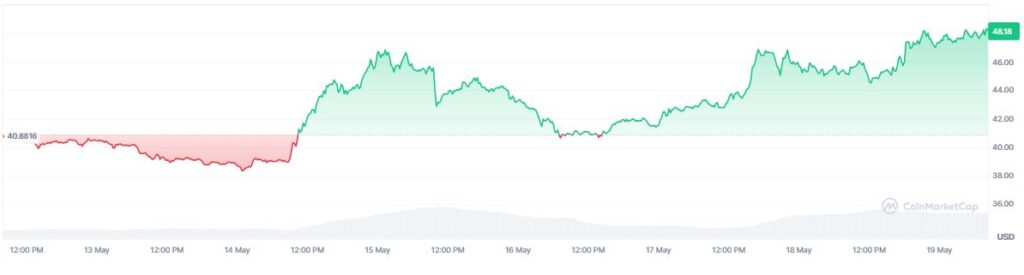
HYPE, the native token of Hyperliquid, a decentralized platform aimed at trading derivatives and perpetual futures contracts, registers today, May 19, 2026, a weekly rise of more than 17%, while a good part of the cryptocurrency market operates in the red.
In the last 7 days, the HYPE price went from 40.88 to 48.08 dollars:
One of the main catalysts was the launch of HYPE-based exchange-traded funds (ETFs) in the United States.
On May 12, 2026, 21Shares launched the 21Shares Hyperliquid ETF (THYP) on Nasdaq. The product offers regulated exposure to HYPE and is structured as an investment trust, allowing you to hold the token and stake part of your holdings.
Three days later, on May 15, Bitwise launched the Bitwise Hyperliquid ETF (BHYP) on the New York Stock Exchange (NYSE). On its first day, The fund reported capital inflows of $750,000.
Unlike 21Shares, Bitwise stakes using its own infrastructure through Bitwise Onchain Solutions, without depending on external validators.
Since their launch on the market, these financial instruments have captured 4.42 million dollars.
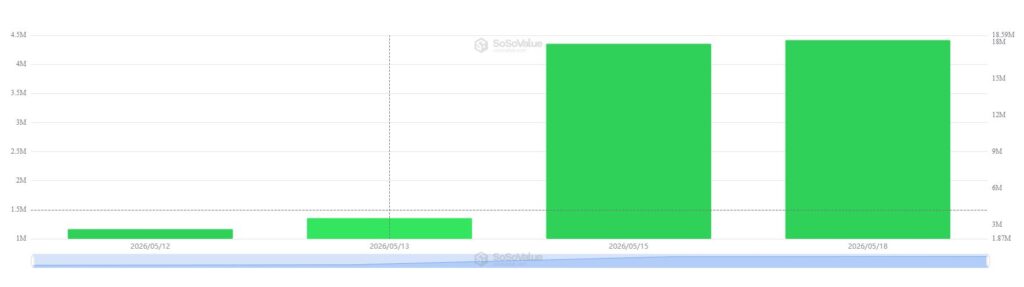
The launch of Bitwise and 21Shares intensify the competition to raise institutional capital towards Hyperliquid. It is worth remembering that Grayscale also submitted regulatory documentation to launch its own HYPE-based fund.
Integrations into the Hyperliquid ecosystem
Another relevant factor was Coinbase’s official integration with Hyperliquid, announced on May 14, 2026. The American exchange will assume the role of official treasury provider and make USDC the platform’s main aligned trading asset.
This implies that USDC will serve as the primary basis for liquidity, collateral and trading pairs within Hyperliquidgradually replacing USDH, the stablecoin previously used on the network.
According to Coinbase, USDC already reaches approximately $5 billion in total supply on Hyperliquid, double what it was a year ago. The integration seeks to reduce friction for institutional and retail traders in a market that operates 24 hours a day.
In turn, the ecosystem gained attention for the launch of SPCX-USDCa market created by Trade.xyz, a platform specialized in synthetic derivatives and pre-IPO markets (before an IPO), on the Hyperliquid order book.
SPCX-USDC is a synthetic perpetual contract that follows an implied valuation of SpaceX. That is, it does not represent real shares or tokenized shares of Elon Musk’s company.
The difference is important. It is that in a synthetic contract, traders speculate on the reference price through a derivative, without any transfer of underlying shares. This model seeks to avoid some of the legal issues that have recently plagued tokenized equity products based on special purpose vehicles (SPVs).
SPCX launched with a price tag of $150, equivalent to an implied valuation of $1.78 trillion for SpaceX. In its first hours, the market recorded $33 million in traded volume and $21.8 million in open interest. Currently, it is trading at $200.53:
The controversial point is that SpaceX is not yet listed on the stock exchange, so these instruments do not represent real shares in the company or grant rights to it.
Just look at what happened with Anthropic. As CriptoNoticias has reported, on May 12, tokenized “shares” fell sharply after the company that created artificial intelligence (AI) Claude will clarify that any transfer not approved by its board of directors was void and would not be officially recognized.
Therefore, although SPCX-USDC tries to differentiate itself from these models by functioning as a synthetic derivative and not as a tokenized share backed by SPV, the underlying discussion remains open: What legitimacy do these markets have to price private companies before a formal IPO?.
Even so, Hyperliquid continues to consolidate itself as one of the fastest growing ecosystems within on-chain trading. HYPE’s recent performance shows how certain assets manage to decouple from the general market trend when they concentrate new institutional vehicles, liquidity expansion and financial products with a strong speculative component.