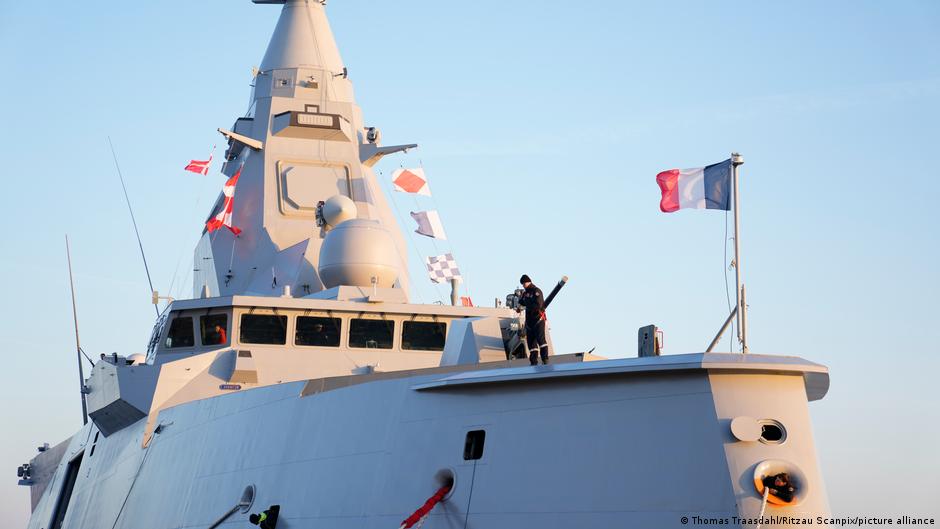
The Swedish government on Tuesday announced a deal to buy four new warships for its navy from France’s Naval Group.
The Nordic country, which remained neutral during the Cold War, applied for NATO membership along with Finland in May 2022, shortly after Russia’s full-scale invasion of Ukraine.
It joined the alliance in March 2024 and is trying to rapidly improve its defense preparedness and expand its military.
What did the government say on the frigate purchase?
Prime Minister Ulf Christerson said the military had completed an analysis of three rival bids in search of the best bid to meet its needs.
“Based on that analysis, the government has now decided that Sweden will buy four new warships in a very large international defence-industrial deal,” Kristersson said at a news conference.
“This is three times Sweden’s air defense capability compared to today,” the Prime Minister said. He described the deal as “one of the largest Swedish defense investments since the Gripen fighter jet was introduced in the 1980s.”
Sweden is buying four of the French Defense and Interdiction (FDI) frigate models sold by Naval Group, in what Kristersson described as the country’s largest military investment since the 1980s.
It expects delivery of the first by 2030, with the remaining three by 2035. Sweden expects each ship to cost “just 10 billion” Swedish crowns (about €0.9 billion or $1.05 billion), which, depending on the exact weapon systems on board, would amount to a potential total of more than €3.5 billion, but ministers insisted these figures were approximate.
Defense Minister Pål Jonsson said the government has requested that the ships be outfitted in such a way that a number of weapons developed in Sweden, including the Saab, can be used on them.
What else do we know about the deal?
The new warships, which the government previously said would have a 40-year lifespan, will represent a significant expansion of the Nordic country’s maritime defense capabilities.
The four ships will be named HSwMS Luleå, Norrköping, Trelleborg and Halmstad.
Sweden’s fleet currently consists of five smaller Visby-class corvettes, as well as a pair of older Gävle-class corvettes. In addition to these warships it operates a small fleet of submarines which are being upgraded, as well as various other command, support, patrol, reconnaissance, training and small attack vessels.
Sweden’s right-wing coalition is one of the most staunch supporters of Ukraine in Europe. It aims to achieve defense spending of 3.5% of GDP by 2030, several years ahead of NATO’s target.
Naval won the contract race with the government in Stockholm despite rival bids from Spain’s Navantia and a joint bid from Britain’s Babcock with Swedish aerospace and defense company Saab.
Neighboring Norway, for example, last year chose another path – ordering Babcock’s Arrowhead 120 frigates rather than FDI from Naval Group.
Defense Minister Jonsson said the reasons for selecting Naval Group’s offer included “quick delivery”, cost-sharing with France and fellow customers Greece and the ability to incorporate a proven air defense system.
Edited by: Dmytro Lyubenko