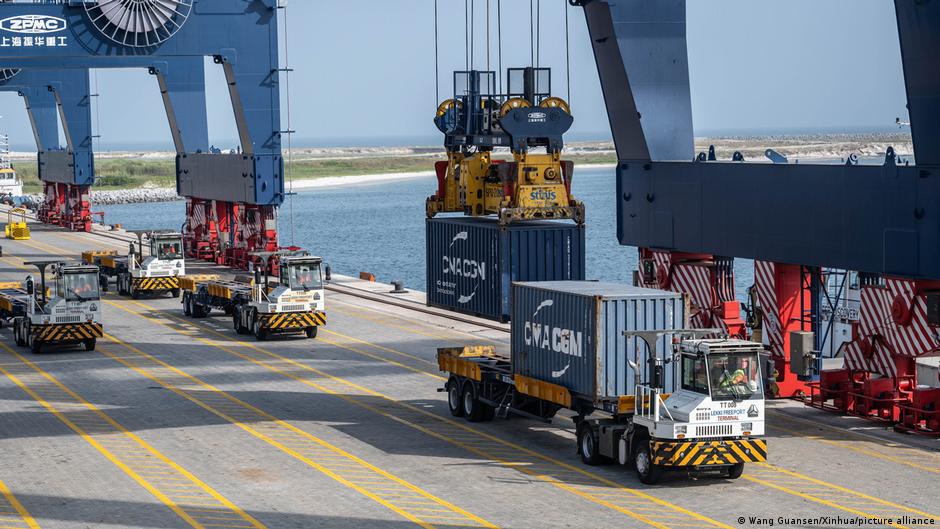
Earlier this month, the first shipment of avocados from Kenya arrived in China under Beijing’s new zero-tariff rule. Analysts say this is a clear sign that the real impact of this deal has started to be seen.
The policy, which came into effect on May 1, gives Africa’s largest economies tariff-free access to China’s market for the next two years.
“China implementing zero tariffs is very encouraging,” Kenyan coffee farmer Olive Gichuri told DW. “This means better earnings for farmers. When our coffee becomes very competitive, it means more demand and also more markets for farmers.”
“They [farmers] They are not limited to selling their products only locally [Kenyan] Market,” Gichuri said, adding that zero tariffs have opened up the market in China.
Lauren Johnston, a senior researcher and international economist specializing in China, Africa and geo-economics at the AustChina Institute in Melbourne, told DW that the policy is “really a gift primarily to the strong economies of Africa which are middle-income countries and which are well-positioned to increase exports.”
In 2025, China and Africa will trade goods worth a record $348 billion (€312 billion), according to the General Administration of Customs of China. China has been Africa’s largest trading partner for 16 consecutive years.
African countries sent about $123 billion worth of goods to China, mostly oil, minerals and other raw materials. In return, they purchased about $225 billion worth of products from China, mainly manufactured goods, electronics, vehicles, and machinery.
Africa’s trade deficit with China increased rapidly, Record earning of $102 billion in 2025That’s up from about $62 billion last year, according to official Chinese figures.
“The export value is low because we do not add value to our exports,” Edu Owusu Sarkodie, an economist and senior lecturer at the University of Ghana, told DW. “The best way to establish ourselves is to add value to our exports, so that we can earn higher prices, more income and then reduce poverty.”
Much of this increase in losses is due to China’s effort to diversify its supply chains amid its trade dispute with the United States. The growing demand for green technologies such as electric vehicles, motorbikes and solar panels in Africa has also led to an increase in imports from China.
Kenya, South Africa and Ghana are some of the zero-tariff ‘winners’
Kenya is one of the most obvious early beneficiaries. China grants almost 98.2% zero duty market access to Kenyan products early harvest agreement.
“If you consider the population of Chinese people and their consumption, it means we will be able to do more business in coffee in China. And then, people in the coffee industry will benefit more,” Kenyan farmer Frederick Gathuma told DW.
In 2024, Kenya imported $4.31 billion worth of goods from China, according to the UN Comtrade database, but its exports to Beijing are much smaller and focus on tea, coffee, cut flowers and fresh produce.
The gap is large, but Kenya’s strong agricultural standards, cold-chain logistics and export ties could help it grow exports faster than many other African countries.
South Africa has one of the most export-ready economies on the continent. South African rooibos tea now has tariff-free access, and the mining sector, including gold, platinum and chrome, could benefit from lower entry costs into Chinese supply chains.
reached ghana Record $14.1 billion trade with China in 2025. The opportunity is real, but so are the risks.
Many economists are urging Accra to avoid focusing only on exporting raw cocoa beans and invest in processing so it can export cocoa butter and finished chocolate. Zero tariffs on processed goods benefit Ghanaian workers, while zero tariffs on raw beans primarily benefit Chinese factories.
Landlocked countries face logistical constraints
Mali and Niger show the limits of the deal for landlocked, resource-dependent countries.
Both Sahel nations face high logistics costs that offset any tariff savings. Their goods have to travel hundreds of kilometers to reach the port, increasing both costs and time. Furthermore, no country has large export industries capable of meeting China’s volume, certification and packaging requirements.
“W“We are training exporters to enable them to comply with China’s customs standards,” Eric Ruto, president of the Kenya National Chamber of Commerce, told DW. “On the issue of phytosanitary standards, we are also training them and providing them market access and right price in terms of goods and commodities.”
Analysts say African producers should invest in testing and certification to meet China’s food safety and phytosanitary standards.
Most shipping between Africa and China still goes through the ports of Dubai or Singapore, increasing costs and reducing the benefits of low tariffs. China is investing in direct shipping links, but this will take time.
For international economist Johnson, a zero-tariff policy could also help boost intra-African trade, thereby boosting growth in least developed countries.
“He [the zero-tariff policy] “The growth of weaker African economies can be boosted, in the context of their own trade, with stronger economies whose economies are not as trade-enabled as countries such as South Africa, Nigeria, Kenya, Ethiopia and Egypt,” Johnson said, referring to countries such as Burundi and Malawi.
Learn from China’s model
Africa’s richest man, Aliko Dangote, recently argued that China dominates African trade not because of its zero tariffs, but because it provides long-term financing for major industrial and infrastructure projects that Western partners are reluctant to support.
“For example, if I go to Italy, and they’re asking me to write a check for a $500 million power plant and the Chinese are saying just give me 20%, the rest I’ll finance for five years, which one are you going to take? Obviously, you’ll take the Chinese,” Dangote said in a recent interview on Nikolai Tangen’s “In Good Company” podcast.
For countries like Kenya, South Africa and Ghana, China’s zero-tariff policy is a real opportunity. These countries have better export infrastructure, quality standards and political support. But for most of Africa’s 53 countries this policy is less a golden key and more a door that was already difficult to open.
“African countries, in a way, want to replicate China’s growth story,” Johnson said. “They need to work out how they can industrialize through this process, just as China did with other border high-income countries through the same process.”
In the long term, this policy could deepen China’s economic ties with Africa while expanding trade flows between the two sides.
Andrew Wasike in Nairobi contributed reporting
Edited by: Keith Walker