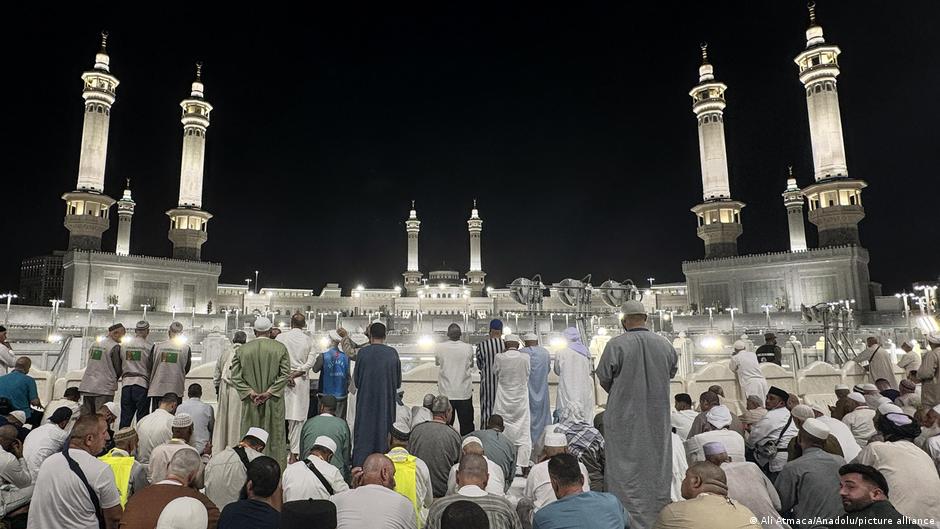
It is the first time this year that Saudi Arabia has decided to go ahead with the annual Hajj pilgrimage, while it is also in the midst of a war that has seen direct attacks on Saudi territory.
The Hajj is a once-a-year event that attracts millions of Muslims to Mecca in Saudi Arabia to perform the ritual which every believer should perform at least once in their life, if they are able. It is one of the largest gatherings of human beings worldwide, and this year’s Hajj will run between May 25 and May 29 and is expected to draw about 1.5 million pilgrims to Saudi Arabia. Over the past three years, 1.7 to 1.8 million people have participated.
Historians say that in 14 centuries, the Hajj has been canceled or restricted only about 40 times; The last time this happened was in 2020 during the COVID-19 pandemic.
More than a million pilgrims descending on a single place to perform a single ritual in less than a week has always been a complex logistical exercise. This includes introducing a ticket lottery system for international pilgrims to Saudi Arabia, tighter security at pilgrimage sites, restricting flights, accommodation, food and water and medical care and crowding amid high temperatures that have proved fatal in the past.
The exercise this year is being complicated by the Iran war, which began in late February when the US and Israel attacked Iran. Iran has responded by targeting Israel as well as the Gulf countries.
The ceasefire is currently in effect but it is unclear how stable it is. Last weekend, Saudi Arabia intercepted three drones it said were likely launched by pro-Iranian militias in Iraq.
US, European countries issue travel advisories
The US government has urged its citizens to reconsider participating in the pilgrimage for the first time in 2026, noting that “non-emergency US government employees were ordered to leave Saudi Arabia in early March”.
Germany, the United Kingdom and other European countries have also issued travel warnings for Saudi Arabia, advising citizens not to travel there during the current conflict or, if they do, to monitor the situation closely. Several travel agencies specializing in hajj pilgrimages in Germany did not respond to DW’s inquiries about how pilgrims would react to such warnings.
But as Germany’s Central Council of Muslims reported, in their experience pilgrims are often disaffected by current events.
“They are motivated by fulfilling a religious duty,” a council spokesperson told DW. “For them, this is much more than a simple trip. And since planning a trip typically takes more than a year and is often associated with a considerable financial commitment, made long before the outbreak of this conflict, the barrier to cancellation is very high.”
The Central Council stated that it had not heard of anyone from Germany canceling the war because of the Iran war and that, as far as they were aware, things were proceeding normally.
“Although there was some uncertainty as to how the situation would evolve, the pilgrims stuck to their plans,” the spokesperson said.
The countries that usually send the largest contingents of pilgrims were also cautious at first. For example, in March, Indonesia – which is sending 221,000 pilgrims on hajj this year – told locals to delay their departure until there is more certainty about the approach of the war.
But since then, Indonesia and other Muslim-majority countries have allowed pilgrims to proceed and have provided assistance with travel and other services as usual. The Indonesian government said it had emergency evacuation plans it could activate if needed, but this week officials from the kingdom also announced they had arrived in Saudi Arabia themselves to help facilitate services for the pilgrims.
Will Iran target Hajj?
Experts say it is highly unlikely that Iran would deliberately target the pilgrimage. Doing so would be extremely unpopular as these sites are sacred to all Muslims and Iran is a theocracy. Additionally, despite the war, about 30,000 Iranian pilgrims will be in Saudi Arabia this year – Iran is usually able to send about 87,000 people.
But there are other war-related fears, primarily related to the risk of aiming mistakes or accidents.
The Saudi government recently released photos showing batteries of Patriot missiles around holy sites, and it has talked about its layered air defense system, which includes everything from high-altitude missiles to anti-drone laser weapons.
But analysts say what happens if a missile is intercepted and debris from the interception falls near pilgrimage sites house of saud media outlets focusing on Saudi Arabia have asked.
“A successful Patriot interception scattered debris over an area of several square kilometers,” the outlet reported in an article published in April. “During Hajj, there will be pilgrims to every square kilometer within 20 kilometers of the Grand Mosque.”
Or, the authors added, a drone could go off course. Worse, across the Persian Gulf, an attack or accident at Iran’s nuclear reactor in Bushehr would see nuclear fallout flowing to Saudi Arabia and its millions of visitors.
House of Saud analysts warned, “Neither of these scenarios requires an Iranian intention to attack holy sites.”
economic impact
The conflict in the Middle East has also had other impacts on this year’s Hajj.
More expenditure is being incurred on pilgrimage. Jet fuel prices have soared and although governments in countries such as India, Indonesia and Malaysia often negotiate flight tickets for Hajj, not all have covered the cost increases demanded by airlines, the new York Times recently reported. For example, while the Indonesian government has agreed to cover the additional costs, the Indian government’s Hajj Organizing Committee has increased the price by about $100 for each pilgrim, the newspaper reported.
Countries that receive large contingents of pilgrims often arrange for a type of airlift, in which planes fly directly to Saudi Arabia. But pilgrims arriving from elsewhere will have to deal with the fact that many airlines have canceled routes to the Middle East and must avoid certain airspaces. This may mean longer and therefore more expensive flights.
Currency fluctuations and inflation have also created more common financial problems for would-be pilgrims with low budgets.
Saudi Arabia has also made travel insurance mandatory for Haj pilgrims coming from other countries. But many insurance packages do not cover military conflict or war. Those that cover conflict areas tend to be more expensive. Some Muslim-majority countries have helped negotiate better insurance deals for their pilgrims. Without additional wartime conditions, passengers are liable for any costs ranging from injuries to flight changes due to fighting.