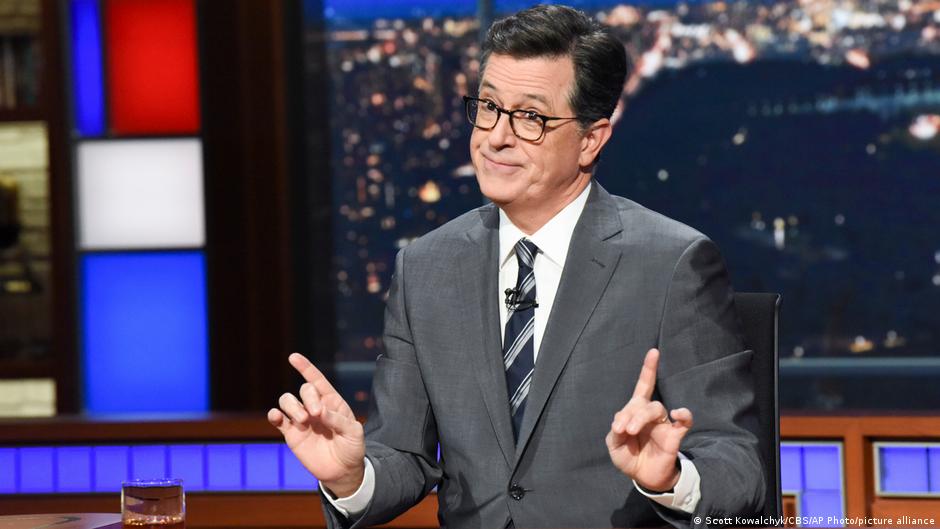
Stephen Colbert told viewers last July, “It’s not just the end of our show, it’s the end of ‘The Late Show’ on CBS. I’m not being replaced. It’s all just going away.” He had said that the long-running program would be canceled at the end of its stated contract. The final episode of the network’s late-night talk show will air on May 21.
According to CBS, the cancellation was “purely a financial decision.”
Although Colbert admits that the economic collapse of the traditional broadcast TV model may have contributed to the decision, “There are many people who believe there was another reason,” the talk show host said in a recent interview. Hollywood Reporter.
Indeed, the announcement came just days after CBS and Paramount agreed to pay $16 million (€13.6 million) to settle a lawsuit filed by President Donald Trump – a settlement that Colbert described on his show as “a big fat bribe.”
The agreement and decision to cancel “The Late Show” also coincides with plans by Paramount – owner of CBS – to acquire film studio Skydance. The billion-dollar merger required US government approval.
Colbert, who has hosted CBS’s flagship late-night show for the past 11 years, is a well-known critic of Trump, and the US president openly celebrated the comedian’s cancellation: “I absolutely love that Colbert was fired,” the president wrote in a Truth Social post on July 18. “His talent was less than his ratings. I heard Jimmy Kimmel is next. He has less talent than Colbert!”
“The Late Show” was the most watched late-night program, averaging over 2.7 million viewers in 2026; Another 10 million people have subscribed to the show’s YouTube channel.
Political twist came late night
The tradition of late night television in America dates back to the 1950s.
As the iconic host of NBC’s “The Tonight Show” from 1962 to 1992, Johnny Carson turned the format into a cultural institution. His witty opening monologues became one of the staples of modern talk shows.
Colbert’s predecessor at CBS, David Letterman, was another key figure in modernizing the format; He certainly added irreverence to his show — and his sarcastic style influenced an entire generation of talk show hosts, including Jon Stewart, Jimmy Kimmel, and Stephen Colbert.
After Trump’s first election victory in 2016, political commentary on late-night shows increased significantly. Colbert leaned more strongly into that trend than some others because it matched his established identity: “Colbert clearly brought his own signature style,” Sophia A. McLennan, a professor of international affairs and comparative literature at Pennsylvania State University and political satire researcher, told DW.
As the author of books including “Colbert’s America: Satire and Democracy” and “America According to Colbert: Satire as Public Pedagogy,” McClellan has been analyzing Colbert’s work long before he became host of the “Late Show” in 2015.
Colbert looks forward to ‘post-truth’ era
The comedian first gained national recognition as a correspondent on Comedy Central’s “The Daily Show” from 1997 to 2005. Colbert then began hosting his own news satire program, “The Colbert Report”, for the same TV network from 2005 to 2014.
In “The Colbert Report”, the comedian played a satirical version of a conservative cable-news pundit. His show revolved around making fun of political media, ideology and public hypocrisy.
Because he was performing as an alter ego, some people did not understand this “highly sophisticated form of satire”, McLennan explained. But he also said that despite the irony and ambiguity of his personality, He was already teaching his audience to be distrustful of authority.
As the professor explained, “In the first episode of ‘The Colbert Report,’ he coined the term ‘truth,’ which the comedian defined as “a belief in what you feel is true rather than supported by facts.”
That was in 2005 – more than a decade before Trump’s first presidency, which notoriously began with false statements about the size of the crowd at his inauguration, lies that were then described as “alternative facts.” Those words became emblematic of the “post-truth” era that characterizes the current political landscape.
An Authoritarian’s Playbook: Silencing Dissent
When he became host of “The Late Show”, Colbert abandoned his pseudo-conservative satire character. But despite the changes, his comedy remained deeply political.
The cancellation of “The Late Show with Stephen Colbert” isn’t just about the careers of one late-night host and his team. This can be seen as part of a broader trend of silencing critics, which is used by authoritarian regimes to dismantle democratic institutions.
“Comedians are anti-establishment by nature,” Colbert said. the new York Times In a recent interview before its final episode. “And authoritarians will never like anyone laughing at them.”
ABC’s move to take Kimmel’s show off air sometime in 2025, following his comments about the murder of conservative activist Charlie Kirk, was condemned as censorship. The decision was reversed after a massive wave of fan boycotts of ABC owner Disney, but the Trump administration is still engaged in a targeted effort to censor Disney through sweeping regulatory actions, according to the sole Democrat on the Federal Communications Commission (FCC), the government agency that regulates media throughout the US.
In a letter sent to Disney on May 11, FCC Commissioner Anna Gomez revealed that there is currently “a coordinated campaign of censorship and control, carried out through the weaponization of the FCC’s authority as a federal regulator and intended to stifle a free and independent press and all media.”
‘Comedy never ends’
Despite this worrying trend, McLennan remains optimistic about the future of political satire.
He said, “Stephen Colbert will no longer be host of ‘The Late Show’ after May 21. But will that mean the end of political satire? Will it mean the end of humor that criticizes the government? Absolutely not.” “The human condition is to use political comedy to make sense of absurd political situations.”
McLennan is currently analyzing satirical news shows produced since the 1990s, “from every continent, from Nigeria, from Nigeria, from Taiwan, from Mexico…” and that research has led him to one conclusion: “Whenever there are attempts to censor satire, it comes back fighting. Comedy doesn’t die. It comes back stronger.”
Edited by: Sarah Huckle