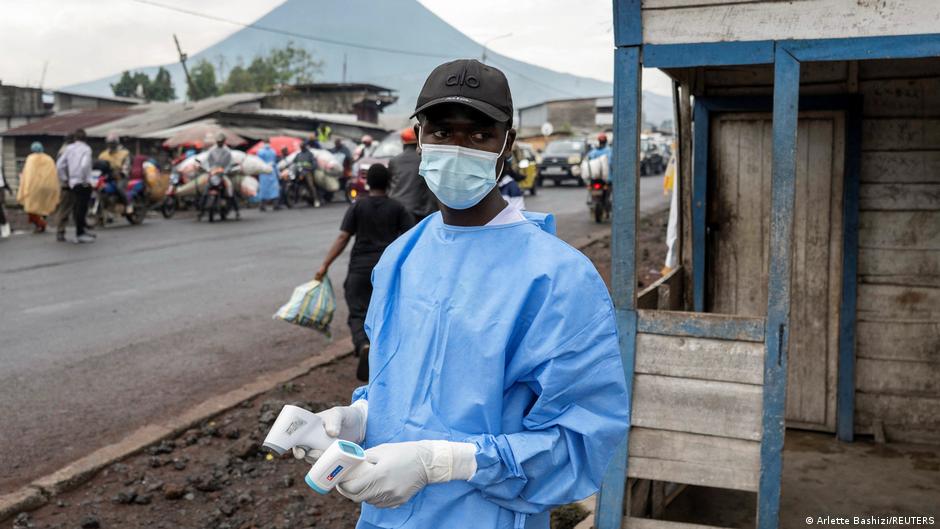
Global health officials have warned that the number of deadly Ebola virus infections reported in the most recent outbreak of the disease in the Democratic Republic of Congo (DRC) represents only a fraction of the actual cases, adding that cases have spread to areas far from the origin of the outbreak.
So far, nearly 600 suspected cases have been confirmed, resulting in an estimated 130 deaths.
On Friday, the World Health Organization (WHO) declared this latest outbreak, the 17th overall in the DRC, a “public health emergency of international concern.”
On Thursday, Uganda suspended public passenger transport to Congo due to the Ebola outbreak. The Health Ministry said the suspension would last for four weeks but would not apply to the transport of food or goods.
Jan Halton, chair of the board of the Coalition for Epidemic Preparedness Innovations (CEPI), a Norway-based global vaccine initiative, described the outbreak as like an iceberg: “We’ve seen the tip of the iceberg. The top, as we get closer to it, is much bigger.”
“We are now investigating hundreds of cases and hundreds of deaths,” Helton told a group of U.N.-accredited reporters in Geneva, Switzerland, “but the truth of the matter is that the real numbers are much larger than that.”
Pressed on whether CEPI has identified potentially safe vaccines that could be effective against the Bundibugyo strain of the virus and could be deployed on a large scale within the next 100 days, he said, “Possibly,” he added, “that’s a big increase.”
Unlike the Zaire strain of the Ebola virus, there are no known vaccines to combat the previously less deadly Bundibugyo strain. And although work on the vaccine began before the outbreak, Halton said jab-makers are in a “very difficult position”.
Ebola cases confirmed for the first time in far-right rebel-held South Kivu
On Thursday, a spokesman for the Rwanda-backed M23 militia said tests had confirmed “a new positive case” in South Kivu, in eastern Congo. The area is under the control of the rebel group and is several hundred kilometers south of the epicenter of the outbreak in Ituri province.
The case was reported near the provincial capital Bukavu, which fell to M23 rebels in February 2025.
The group said the victim came from Kisangani in eastern Tshopo province, where no infection had been previously detected.
The 28-year-old victim is said to have died and was “safely buried”, according to a statement from M23.
According to local officials, another potentially infected person has been isolated in the area.
Although rebels have said they are committed to working with international organizations to combat the spread of the virus, access to the area has been disrupted due to widespread violence.
In addition, aid has also been hampered by cuts in international aid by major donors.
India, AU postpone summit due to concerns over Ebola outbreak
In New Delhi, India’s External Affairs Ministry announced the postponement of next week’s India-Africa summit with the African Union (AU).
“Keeping in mind the evolving public health situation on the continent… both sides agreed that it would be advisable to convene the Fourth India-Africa Forum Summit at a later date,” an External Affairs Ministry statement said.
The statement further said India “stands ready to contribute to Africa CDC-led (Centers for Disease Control) efforts aimed at addressing the emerging health situation.”
The fourth installment of the summit was scheduled to be held in New Delhi between May 28 and 31. No new dates have been announced.
Delhi’s Indira Gandhi International Airport on Thursday also issued a health advisory for passengers arriving from DRC, South Sudan and Uganda, where two cases have been reported.
Overall, more than 15,000 people have died from the highly contagious hemorrhagic Ebola fever in Africa over the past 50 years.
Edited by: Shawn Sinico