Nakamoto Inc., one of the companies that adopted bitcoin (BTC) as a corporate treasury asset, announced yesterday, May 20, 2026, a 1 for 40 reverse stock split with the aim of avoiding being delisted from the Nasdaq stock exchange.
The measure will become effective from the first minute of May 22, 2026at which time the company’s shares will begin to be traded in an adjusted manner always under its usual symbol, NAKA.
This decision seeks to raise NAKA’s share price to regain compliance with the minimum offer price requirement of USD 1.00, required to remain listed on Nasdaq.
Through this reverse split, every 40 current shares will be consolidated into one, which will reduce the number of shares outstanding of the company from 696.1 million to approximately 17.4 million shares.
It should be noted that a reverse split is a common corporate procedure in the stock markets. In essence, it consists of reducing the total number of shares in circulation to proportionally increase the individual price of each one.
For investors, this technical adjustment does not represent any loss of money nor does it change your real position in the company. The reason is simple: although shareholders will have fewer securities in their portfolio, the total value of their investment and their percentage of ownership in the company will remain intact. As an explanatory analogy, it is exactly the same as exchanging fifty one dollar bills for a single fifty dollar bill.
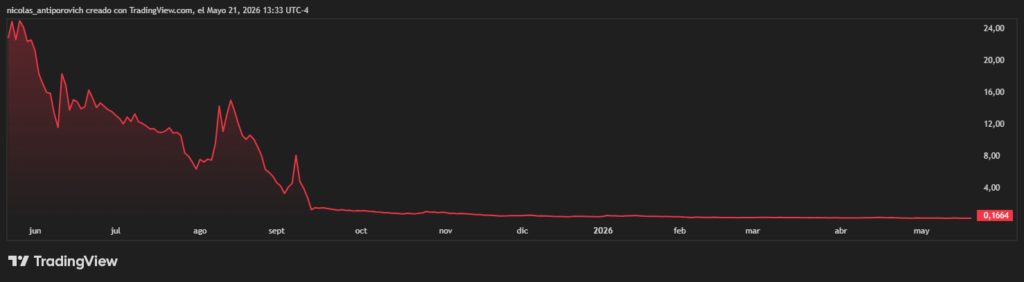
This financial move is the direct result of the severe impact of bitcoin market volatility on the firm’s balance sheet. The company’s quote Nakamoto has been strongly dragged down by the fall in the price of bitcoinwhich after hitting an all-time high of USD 126,000 in October 2025, suffered a collapse of more than 50% to USD 60,000 in February 2026, and is currently trading around USD 81,000.
The chart below shows how the NAKA share price has moved over the last 12 months:
Nakamoto owns 5,058 bitcoin at the time of this publication and, as CriptoNoticias has reported, it has had to sell part of its holdings at a loss to cover operating expenses.
It is thus evident that corporate bitcoin accumulation strategy has started to show cracks. The treasury model, initially popularized by firms like Strategy and later replicated by other companies, exposes companies to enormous pressure when the value of the underlying asset declines and the core business does not generate the cash flow necessary to absorb accounting losses.
Nakamoto’s case is not isolated and confirms a growing vulnerability in this business model. Recently, CriptoNoticias reported that the French semiconductor firm Sequans Communications was forced to liquidate more than 2,000 BTC from its reserve to guarantee its operational survival after suffering an 81% collapse in its shares and being drowned by collateral debts.
Like Sequans, Nakamoto is now experiencing the effects of tying his financial destiny to bitcoin’s volatility. The restructuring of its shares highlights that, without solid operating income to support the treasury, the long-term accumulation strategy may be interrupted by the urgent need for survival in traditional markets.
For investors, these episodes underscore a Irreplaceable golden rule: the importance of risk management. Overaccumulating bitcoin without the support of other, more stable assets or independent cash flow can create critical vulnerabilities during bear cycles.
For this reason, Maintaining a balanced asset is essential not only to mitigate extreme volatility, but to avoid forced restructurings or liquidations at the worst possible time, thus ensuring long-term financial resilience even when the market goes into the red.