
The Ethereum Foundation is suffering a crisis due to the exodus of key developers and leaders, a factor that is hitting the confidence of retail investors and weakening the price of the network’s native cryptocurrency, ether (ETH).
This distrust accelerated following the consecutive departures of several high-profile figures from the organization. Developer Pablo Voorvaart and his counterpart Julian Ma announced their resignations from the institution on May 18 and 19, 2026, respectively. These losses are in addition to the previous departure of Tomasz Stańczak in February, who left the executive co-directorship along with other main developers of the entity.
In tune with these events, the data analysis firm Santiment highlighted that a major source of negativity “has been the growing number of reports about the resignation of members of the Ethereum Foundation and the public distancing of prominent ETH advocates from the ecosystem.”
As a result of this situation, the consulting firm detailed that “the sentiment towards Ethereum has changed drastically, and retail investors have quickly exited.”
Likewise, the company explained that cryptocurrency investors tend to react “very emotionally during periods of underperformance, which is why ETH has increasingly been seen as a worthless investment compared to assets that have shown much greater momentum in 2026.”
To mitigate the operational impact of the casualties, Ethereum Foundation researcher and advisor Dankrad Feist proposed creating an independent external organization on May 21. This entity would have an initial capital of at least 1,000 million dollars and would be financed through staking income, as reported by CriptoNoticias.
Feist argued that this initiative seeks to “save Ethereum” because the original foundation lacks the financial resources necessary to lead development. Regarding this plan, the founder of Bankless, Ryan Sean Adams, proposed as an ally to Tom Lee, president of Bitmine, the publicly traded company with the largest corporate ETH treasury. Lee responded positively and assured that a solid team of leaders will ensure the future of the network.
In the financial sphere, the situation of exchange-traded funds (ETFs) has only intensified these concerns regarding the price of ETH. The funds They accumulate nine consecutive days of capital outflows totaling 464 million dollars between May 11 and 21. In this regard, Santiment commented that this “creates a psychological vicious circle where falling prices generate fear, fear causes capital outflows and, in turn, these outflows generate even more fear.” The firm added that the bearish sentiment towards ETH has increasingly reflected this cycle throughout the month.
Due to this selling pressure, ETH is currently trading at $2,130, reflecting an 8% drop in the last month and a 56% gap from its all-time high of $4,900, reached in August 2025.
This behavior finds its reflection in the market’s graphic patterns, where analysts like Pelin Ay identify warning signs about the direction the price could take in the short term.
The chart below by Ay shows how the price has broken the lower boundary of a consolidation formation, while the lower bars reflect the spikes in volatility in the trading exchanges.
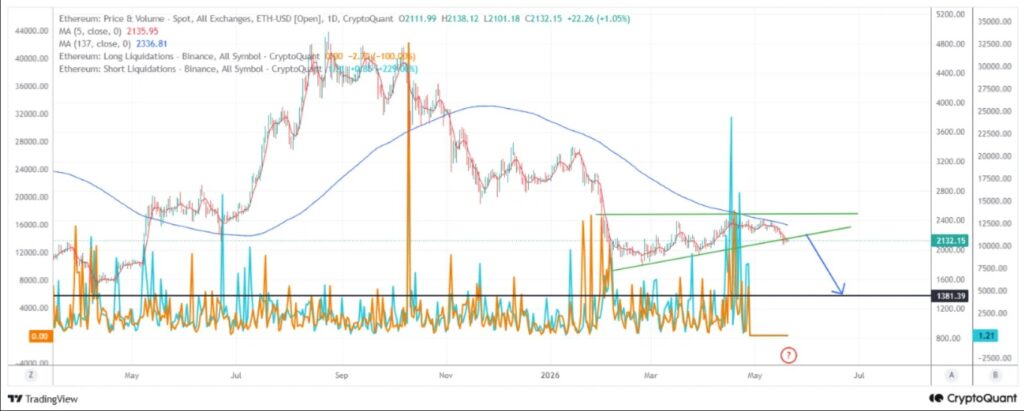
«The market structure appears to be weakening from a technical perspective. In particular, the recent break down from the triangular formation signals that the consolidation phase has shifted in favor of the sellers,” said the specialist.
Ay detailed that moving averages—indicator lines that average past prices to identify the direction of the trend—began to tilt downward.
“Another critical factor on the chart is the Binance liquidation data,” Ay commented, pointing to the vertical bars that represent how abrupt long liquidations wiped leveraged positions out of the market at once. The analyst concluded that if Ethereum fails to recover the broken triangular structure, the selling pressure could accelerate further and the price could head straight towards the key support level of $1,350.