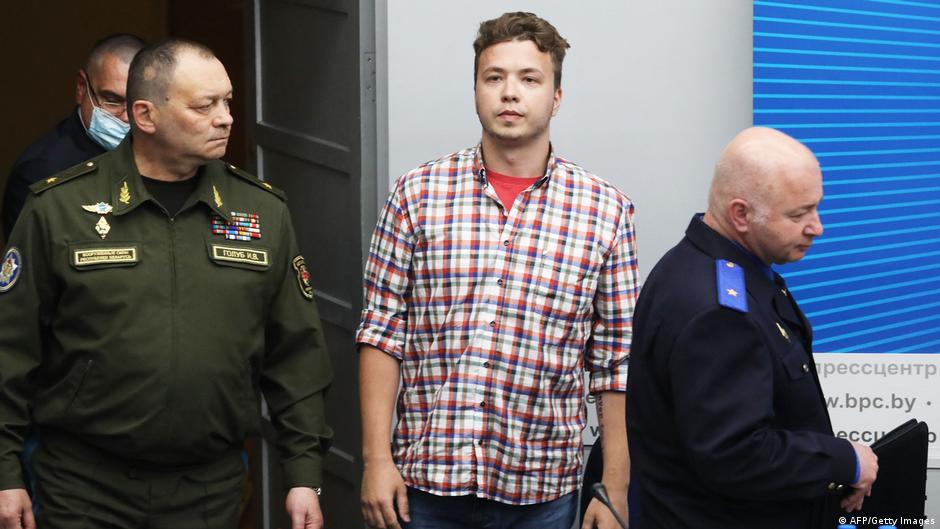
Alexander Lukashenko’s regime made considerable efforts to arrest Raman Pratasevich. On May 23, 2021, Belarusian authorities forced a Ryanair plane flying from Athens to Vilnius, Lithuania to land in the Belarusian capital Minsk, sparking global outrage.
As the plane touched down, Pratasevich, the former editor-in-chief of Nexta, a Belarusian media network distributed largely through the Telegram platform and classified as “extremist” by the Belarusian regime, was deboarded and arrested along with his girlfriend Sofia Sapega.
Nexta, which operates from Poland, was the most important news source on the anti-government protests that broke out in August 2020 after Belarus’s presidential election was rigged. Lukashenko said he had won a landslide victory, but the opposition disputed his claim. Nexta, where Pratasevich worked until September 2020, played a key role in coordinating anti-government protests and sharing the locations and times of upcoming demonstrations.
In May 2021, Pratasevich – who by this time had moved to Vilnius with Sapega – traveled to the Delphi Economic Forum in Greece, where exiled Belarusian opposition leader Sviatlana Tsikhanouskaya was to meet with European politicians.
Later, Pratasevich and Sapega stayed in Greece for a vacation. Before his scheduled flight on May 23, Pratasevich noticed that he was being followed at the airport and was able to inform his colleagues before boarding. Greek authorities later confirmed that three people with Russian passports had also boarded the flight from Athens to Vilnius.
As the plane passed over Belarus, Belarusian air traffic controllers instructed the pilots to divert course and land in Minsk, claiming that the plane was carrying a bomb. However, the real reason for the diversion was to allow Belarusian authorities to arrest Pratasevich and Sapega.
This incident led to the European Union Aviation Safety Agency completely banning European airlines from flying over Belarus. The US Federal Aviation Administration imposed a similar ban on US airlines. Belarusian airlines such as state-owned carrier Belavia are also banned from landing and taking off at EU airports from June 2021.
A year after Pratasevich’s arrest at Minsk airport, the International Civil Aviation Organization concluded in a report that the bomb threat claims were deliberately false.
Change of heart?
Just a day after Pratasevich’s arrest, a video was published on a pro-government Belarusian Telegram channel, showing him in custody and saying that he would now cooperate with investigators and was ready to confess. Deep injury marks are visible on his face in the video.
A German government spokesman said that the treatment of Pratasevich was humiliating. “An opposition journalist and his companion were abducted from the airplane after a forced landing, probably under false pretenses, kept behind bars and put under psychological and possibly physical pressure to force him to give completely incriminating and unreliable statements,” the spokesperson said.
A month later, the Belarusian Foreign Ministry held a press conference – surprisingly attended by Pratasevich. He claimed that he had not come under any pressure and it was not clear whether he was forced to give the statement.
On May 3, 2023, Pratasevich was sentenced to eight years in prison for allegedly organizing mass riots, calling for terrorist attacks, and leading an extremist organization. He was also ordered to pay damages equal to €7 million ($8.1 million) – the estimated cost of suppressing the 2020 protests, according to government prosecutors.
But not even three weeks had passed when Pratasevich was pardoned by Lukashenko. He was then removed from the Belarusian government’s list of terrorists in July. No explanation was given for this sudden U-turn.
Sapega, who was sentenced to six years in prison in May 2022, was pardoned in June 2023 and returned to her home country, Russia.
Pratasevich has since tried his hand as a factory welder, postman and bartender. He has reportedly complained that he is not really getting work because of his past.
It seems that the Belarusian authorities are still trying to exploit him. They wanted him to interview jailed Belarusian opposition politicians Viktor Babariko, Maria Kolesnikova and Sergei Tsikhanousky, who were released in December 2025 as part of a prisoner swap between the US and Belarus. But none of them agreed to provide the “confession video” to Pratasevich.
In 2025, officials begin to create a new image for Pratasevich, presenting him as a state agent. The head of Belarusian state security, Ivan Turtel, said Pratasevich was “an employee of our foreign intelligence service”. [who had] Served in combat operations in various countries and carried out important missions.” Turtel himself described Pratasevich as a ”terrorist” in 2021.
Now, Belarusian state security claims that Pratasevich began sharing intelligence on the protest movement in 2020. This claim also cannot be verified. Similarly, Belarusian officials have failed to explain why Pratasevich’s plane was forced to land in Minsk five years ago, if he was already cooperating with the secret service.
It is entirely unclear whether Pratasevich is working with Belarusian authorities voluntarily, or whether he is being pressured to do so.
But he has apparently now taken on the role of regime loyalist, and since 2025, he has hosted a show on state television that allegedly “exposes” opposition members.
This article was originally written in Russian.