
Grayscale also named Avalanche, Base, Arbitrum, Hyperliquid and Tron as beneficiaries.
Clarity Law seeks to divide market oversight between the US Securities and Exchange Commission.
Asset manager Grayscale has identified four networks with the greatest potential to capture institutional capital flows once the Clarity law moves towards implementation. The selection is made up of Ethereum, Solana, BNB Chain and Canton Network, networks that, according to the firm, already concentrate a significant part of on-chain financial activity.
From the perspective of GrayscaleEthereum maintains leadership as the network with the greatest functionality within the smart contract ecosystem, while Solana and BNB Chain occupy relevant positions due to their scale of activity and adoption. These three networks also stand out in key metrics such as stablecoin supply and the total value locked (TVL) in decentralized finance (DeFi) protocols, which is around $82.08 billionfactors that reinforce its attractiveness for institutional capital.
The firm’s central thesis is that regulated flows will tend to be directed towards already integrated networks with traditional financial infrastructure. In that sense, each network plays a specific role within the ecosystem: from execution of general-purpose smart contracts, to high-performance solutions aimed at the retail user and settlement systems designed for institutions.
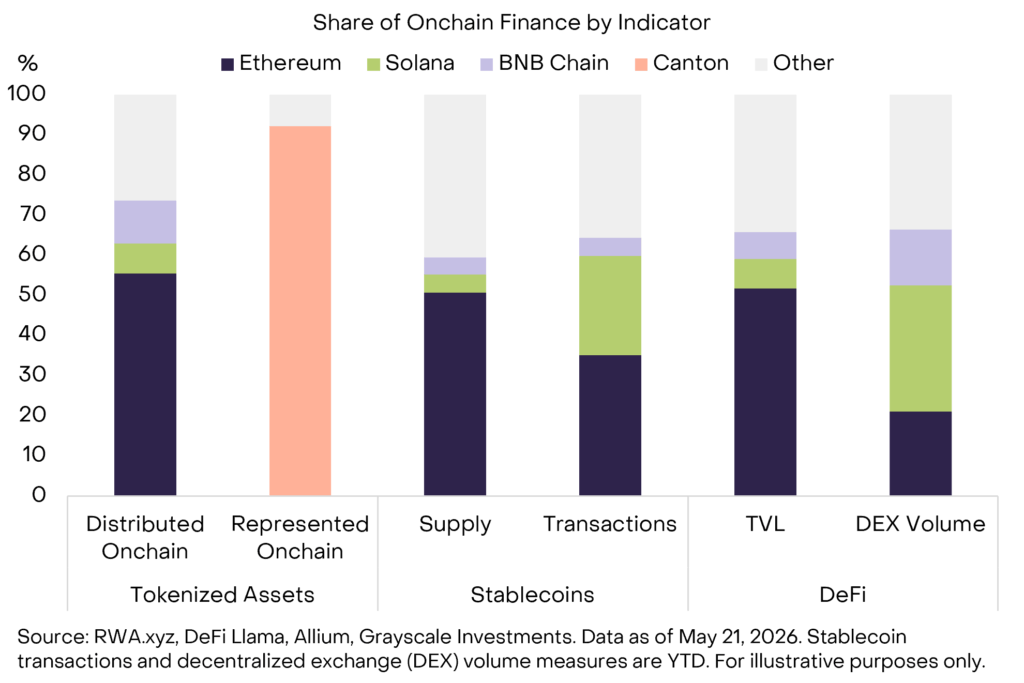
The report also highlights that these same four networks had already been included by Grayscale in its previous analysis of the asset tokenization trend. Under this vision, the consolidation of the regulatory framework could accelerate the migration of capital towards networks with greater depth of on-chain markets and greater connection with traditional financial instruments.
In parallel, The market closely observes the progress of the regulatory framework. The progress of the Clarity Act is seen as a potential turning point for the industry, providing clearer definitions of regulatory powers and enabling a more predictable environment for exchanges, custodians and asset managers.
However, the regulatory landscape in the United States also shows signs of caution. The SEC has temporarily halted publication of a proposed “innovation exemption” that would have allowed trading in tokenized versions of stocks and other traditional assets. The delay responds to observations from market actors, especially around the so-called “third-party tokens”, which could generate conflicts in the management of dividends and voting rights, as detailed by CriptoNoticias.
On the other hand, Grayscale highlighted a list of secondary level platformswhich include Avalanche, Ethereum Base and Arbitrum, Hyperliquid, focused on perpetual contracts, and Tron, with a large presence of stablecoins, as possible beneficiaries.
Zach Pandlhead of research at Grayscale, noted that while Bitcoin does not natively support smart contracts, will continue to benefit from greater regulatory clarity being the safest asset in the sector and the main guarantee.
Taken together, Grayscale’s vision reflects a possible change of stage for the cryptocurrency market. If institutional capital begins to focus on networks with greater financial integration and regulatory clarity, platforms such as Ethereum, Solana, BNB Chain, and Canton Network could further strengthen their dominance within the digital economy. For consumers and retail users, this could translate into greater legitimacy for the sector, more accessible financial products and an expansion of web-based services. However, it also anticipates a more regulated ecosystem, where large financial institutions and legal frameworks will have an increasingly determining role in market development.