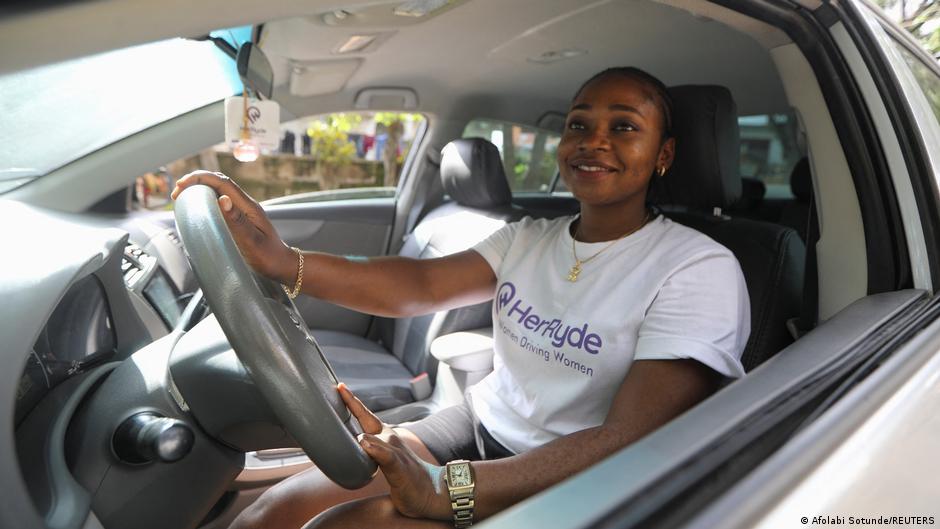
Every weekday morning, Blessing Ade leaves her home in Lagos, Nigeria, carrying her baby in her swaddle. The first-time mother, who lives in a two-storey building, steps out only to find her rider already waiting at the gate.
“I book my ride before I leave the house,” she told DW. “The ride has to be in front of my gate, not like I’m outside and then standing in the sun.” Public buses are not an option for them. “Right now, I’m just not thinking about it. I don’t even see it as an option. I’ve canceled it,” she said.
Rising fuel prices and fare hikes are changing the way ride-hailing is used in Lagos. Some passengers say they rely on ride-hailing more than ever, while others are doing less, switching between apps, or abandoning trips as prices rise.
Fuel prices in Nigeria began rising sharply after President Bola Ahmed Tinubu announced the removal of long-standing petrol subsidy during his inauguration speech on May 29, 2023. The increase significantly affected transportation, food prices and the overall cost of living in Africa’s most populous country.
Pemi Aderogba, 29, who lives in Lagos, a city that is home to an estimated 20 million people, says ride-hailing remains central to the way she gets around, according to the United Nations. “Often I feel like if I had to go out seven days a week, I would probably use them six days or even all seven,” Aderogba, who works as a development professional, told DW.
She combines different methods depending on the purpose. For work, she uses shuttles and buses, but for most other trips, ride-hailing dominates. “Most of the times I go out, except for work, I always use Uber and InDrive,” she said, adding that she stopped using one platform because “they became too expensive.”
His approach is practical. “It’s always about distance and comfort for me,” she insisted. “I always want to be comfortable.”
Does fuel hike threaten Nigeria’s ride-hailing sector?
However, the rent increase has motivated some Lagos residents.
For Sanu Olomoda, a 35-year-old media businessman, ride-hailing once played a huge role in his daily routine. “If this was 2 or 3 years ago, I would have said yes. Ride-hailing apps played a huge role in my daily life,” Olomoda said. “But not anymore, they play a smaller role because nowadays I hardly use them.”
She still checks prices before a trip, but often abandons the apps when fares rise.
“What I do when the price seems too high is I close the app and go to take the yellow bus.” The iconic, bright-yellow commercial minibus with two black stripes, popularly known as the Danfo, serves as the primary mode of informal public transportation in Lagos. The cancellation has also affected his plans. “I remember when I had to commute early in the morning; drivers were canceling, so I had to wait before getting another ride.”
Daniel Bjorkgren, a researcher who studies transportation patterns in Lagos, says such behavior reflects the structure of the city’s transportation system. “Since private minibuses (danfos) form such an extensive network, it would not be at all surprising if they were the main option,” he told DW.
Ozioma Okafor describes a pattern that has remained largely unchanged, combining ride-hailing with public transportation depending on distance and cost. “On a normal day, I travel around in public transportation most of the time. Sometimes, I admire the apps,” he said. “It depends on where I am going, how much funds I have available and the distance to cover.” He still uses ride-hailing, but less frequently. “I only use them occasionally now.”
It’s not ‘business as usual’ for Lagos drivers
Drivers say they’re seeing the same pressure in demand. Enahoro Mudi, a full-time driver in Lagos, says the economics of the job have changed rapidly. “Two to three years ago the driving experience was much better,” he told DW.
“Imagine you buy fuel for about 20,000 naira ($14, €13) or more, and you use it to make about 15,000 or 20,000 before the cut,” he said, noting that demand is now concentrated at specific times. “Between 5 a.m. and 7 a.m. and on weekends are the peak periods,” he said. “Normal days aren’t worth it.”
Seun Ola, another driver, says riders’ behavior changes when prices rise.
“Whenever there is rush hour, prices go up,” he said. “Most riders will switch to another app because they cannot afford such prices.” Some people step away from the stage completely. “Either they switch to another app or discuss it with the drivers,” he said. Those discussions included negotiating fares directly outside the app, he said.
Still, for some, like Blessing, ride-hailing has become essential. Even when she is not traveling with her child, time remains the deciding factor. “Most times, even if I’m not with my child, the mentality is that I have to get home on time to be with my child.”
Edited by: Crispin Mavakideau