Inflation and the regulation of the MiCA law directly influence the use of cryptocurrencies.
For the CEO of Crypto Finance, the cryptocurrency debate is no longer focused on speculation.
The demand for services based on cryptocurrencies at an institutional level registers a significant increase in Spain, consolidating these assets within the traditional financial infrastructure and moving the sector away from a purely speculative approach.
According to a study carried out by the firm Crypto Finance, part of the Deutsche Börse Group, the combination of persistent inflation, pressure on household finances and the acceleration of the European MiCA regulation, They act as the main drivers of this emerging market.
The firm’s analysis ensures that the rise in inflation and the war situation in the Middle East reinforced the integration of digital currencies in traditional banking, displacing the debate on retail speculation.
According to Crypto Finance CEO Stijn Vander Straeten, the current market “focuses on regulated infrastructure, institutional participation and the incorporation of distributed network-based systems within the overall financial sector.”
Indeed, inflationary pressure in Spain, affected by the volatility of energy markets and geopolitical tensions in the Middle East, directly influences companies’ treasury management. In fact, during the last year, inflation in Spain has had a behavior that limits the ability of traditional investors to mitigate the impact on their assets.
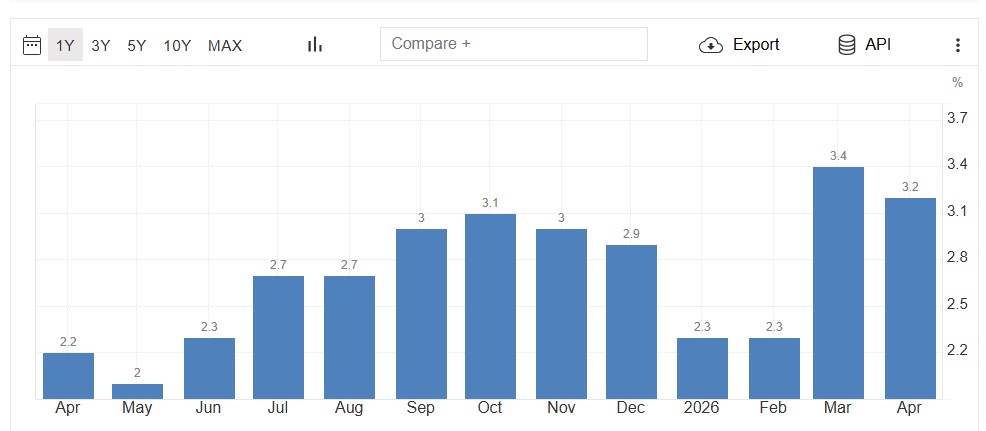
Only in April of this year, inflation in Spain reached 3.2%. Although less than in March, it represents a notable jump compared to January, when the indicator stood at 2.3%, as seen in the following graph:
Given this scenario of volatility and inflation, Crypto Finance highlights that institutions they reformulate their liquidity operations and they seek diversification in digital assets and Bitcoin technology to safeguard value.
At the regulatory level, the Spanish authorities extended the transition period of the MiCA regulation until June. At the same time, the National Securities Market Commission (CNMV) evaluates a growing number of authorization requests submitted by companies in the sector and financial entities. For the analytical firm, This regulatory advance provides legal certainty to the local market.
Spain at the forefront of cryptocurrencies
In fact, the report “Spain: Europe’s hidden champion in digital assets”, developed by the research firm Blockstories in collaboration with Blockchain Observatory, complements this vision by highlighting that the Iberian country is ahead of markets such as Germany and France regarding legal integration.
What’s more, Spain became the first State in the European Union (EU) to formally integrate decentralized technology into its securities market law through Law 6/2023. Furthermore, unlike other nations where growth came from native startups, the Spanish ecosystem It has been built institutionally from the top downled by regulators and supervised banks.
Blockstories points out that, to capture this demand and retain customer capital, the main Spanish banking institutions are actively entering the digital space.
Entities such as BBVA and Santander offer custody services for digital assets and exposure based on exchange-traded funds (ETFs), while firms such as CaixaBank, Kutxabank and Renta 4 Banco are preparing similar solutions, as CriptoNoticias has reviewed.
According to this analysis and research firm, six of the first seven MiCA authorizations granted in the country correspond to traditional banking.
This transformation towards an institutionalized sector generates a latent debate regarding the control of the ecosystem. While regulation provides legitimacy and legal security for the protection of funds, the digital asset environment is torn between the loss of the original decentralized nature and the need to adopt corporate banking custody.
In any case, the cryptocurrency market in Spain is advancing towards a phase of formal maturity. Driven by the need for coverage against the devaluation of purchasing power and supported by the advances of the MiCA regulation, large banking entities integrate digital assets into their service portfolios, transforming the perception of these financial tools towards a key component of the Iberian corporate structure.