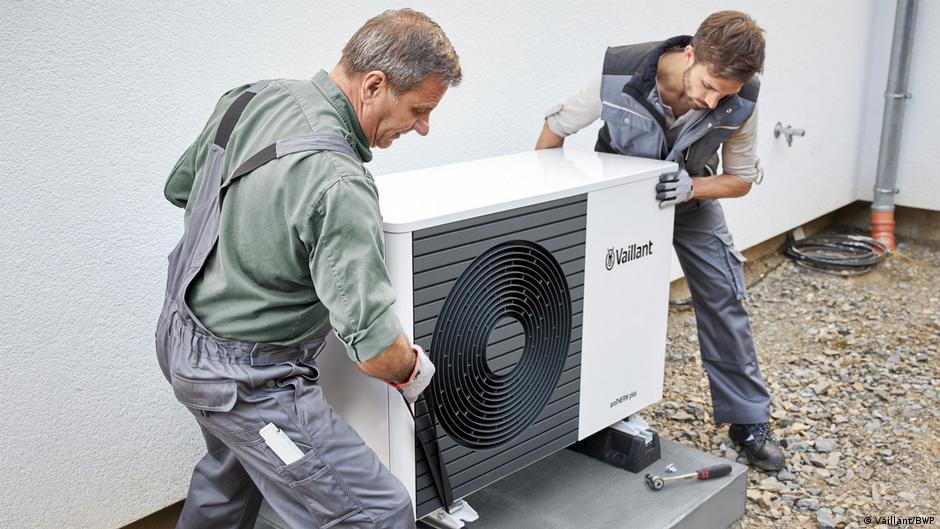
Germany’s coalition government of Christian Democrats (CDU) and Social Democrats (SPD) is seeking to overturn a central provision of the heating law introduced by the previous administration.
The original legislation stipulated that all newly installed heating systems must run on at least 65% renewable energy, a requirement that will apply to all new heating installations in the coming years.
However, under the new proposals, oil and gas heating systems with a significantly lower share of climate-friendly gases would be allowed in existing buildings for the long term. The cabinet approved the plan based on a draft bill submitted by Building and Construction Minister Verena Hubertz (SPD) and Economy Minister Catharina Reich (CDU).
Under the planned legislation, new heating systems would only be required to use at least 10% renewable energy.
‘Impractical piece of legislation’
The new law, called the “Building Modernization Act”, aims to replace the current “Heating Act”. The government hopes to push it through Parliament before the summer recess in mid-July.
However, many observers believe the timetable is too ambitious, especially since the draft law has garnered not only support but also vocal criticism.
One of the most vocal critics is the National Regulatory Control Council (NKR), an independent advisory body to the German government.
Its president, Lutz Goebel, described the draft bill in comments to the newspaper. Picture “One of the weakest and most impractical pieces of legislation presented to the National Regulatory Control Council in recent years.”
He said that parts of the text were “barely comprehensible” and warned that there were likely to be problems enforcing the law. According to Goebel, “Such laws contribute to growing frustration among citizens toward the state and politicians.”
‘Take steps in the right direction’
However, others have defended the proposal. “The Building Modernization Act is better than its reputation,” said Carsten Rolle, responsible for energy, mobility and environmental issues at the Federation of German Industries (BDI), according to a press statement.
Peter Adrian, president of the German Chamber of Industry and Commerce (DIHK), also called the draft law “overall a step in the right direction.” He said it would reduce stringent requirements and give companies “greater flexibility towards climate neutrality in the building sector”.
Frederick Lippert of heating system maker Vaillant said that “some changes could help calm the debate.” This includes eliminating the 65% rule, which many in the market view as coercive.
Is the new law a climate policy failure?
For Julius Neu of the German environmental organization BUND, the proposed law amounts to “declaring bankruptcy in climate policy.”
“By eliminating the 65% rule, the most effective tool for the heating transition is being eliminated,” he told DW. He argued that it would “artificially prolong fossil-fuel technologies and trap people with rising gas costs.”
Manufacturers of heat pumps share that criticism. “The federal government is reducing the requirements for new heating systems from 65% renewable energy to initially only 10%,” Katja Weinhold, spokeswoman for the German Heat Pump Association, told DW.
“In view of the crisis in the Middle East and its impact on energy prices, Germany’s energy security and climate goals, this sends completely the wrong signal,” he said.
A spokesman for the communications department of Robert Bosch GmbH said that the industry, first of all, needs certainty of planning. “To achieve final clarity, it is important to complete the legislative process quickly. The same applies to subsidies – credibility is essential to have the desired impact.”
Weinhold argued that the current debate should focus less on political goals and more on what solutions make technical and economic sense. Heat pumps, he said, are “an energy-efficient and high-quality technology that can make heating cleaner, cheaper and more independent in the long term.”
He said consumers need clear and easy to understand information about fuel availability and the long-term risks associated with rising energy costs. At the same time, stable subsidy programs are necessary to encourage investment in modern, future-ready heating technologies, he said.
Will the new law promote renewable energy in Germany?
Heating systems maker Vaillant remains broadly optimistic, according to Frederick Lippert. “We expect the heating market to continue to change under the new legislation.”
He said current geopolitical developments are likely to accelerate this trend. The Iran conflict and disruption to shipping through the Strait of Hormuz have once again highlighted how dependent Germany and Europe still are on fossil fuel imports, he said. As a result, demand for renewable energy – including heat pumps – is expected to continue to grow.
Julius Neu of the environmental organization BUND shares this view: “It is to be hoped that the current energy crisis linked to the Iran conflict will encourage many people to choose heat pumps despite this irresponsible draft law.”
This piece was originally published in German.