
Hyperliquid processed $2.9 trillion in perpetual futures volume in 2025.
The HYPE token has a market capitalization exceeding $15 billion.
Hyperliquid has become one of the fastest growing phenomena within the digital asset market.
In less than three years, the decentralized exchange (which has its own network) specialized in perpetual futures managed to position itself among the largest platforms in the sector, competing directly with giants such as Binance, Bybit and OKX.
That breakthrough caught the attention of Grayscale, a digital asset management firm. In his most recent reportpublished on May 27, 2026, the manager’s specialists highlight: “Hyperliquid is the outstanding success story of the modern digital asset industry”
“Imagine a startup that managed to break through in a highly competitive industry in less than three years,” says Grayscale.
For the firm, one thing to highlight about Hyperliquid is that it generated around $800 million in revenue during 2025 “even though many potential customers in the United States and other large markets still cannot access it.” In saying this, Grayscale refers to the fact that citizens of that country and those who live in the United States are prohibited from operating with the decentralized exchange Hyperliquid (not with the HYPE cryptocurrency or with ETFs that follow its price).
Futures trading powers Hyperliquid
The core of the Grayscale report is on perpetual futures. These instruments allow you to operate on the price of an asset without an expiration date.unlike traditional futures, as explained by CriptoNoticias.
Grayscale maintains that this market is already huge: “volume averaged around $200 billion per day in the digital asset industry during 2025.”
The firm highlights that the majority of that business continues to be dominated by centralized exchanges such as Binance, OKX and Bybit. However, he highlights that “Hyperliquid is the first decentralized project that captured a significant share in volume and open interest.”
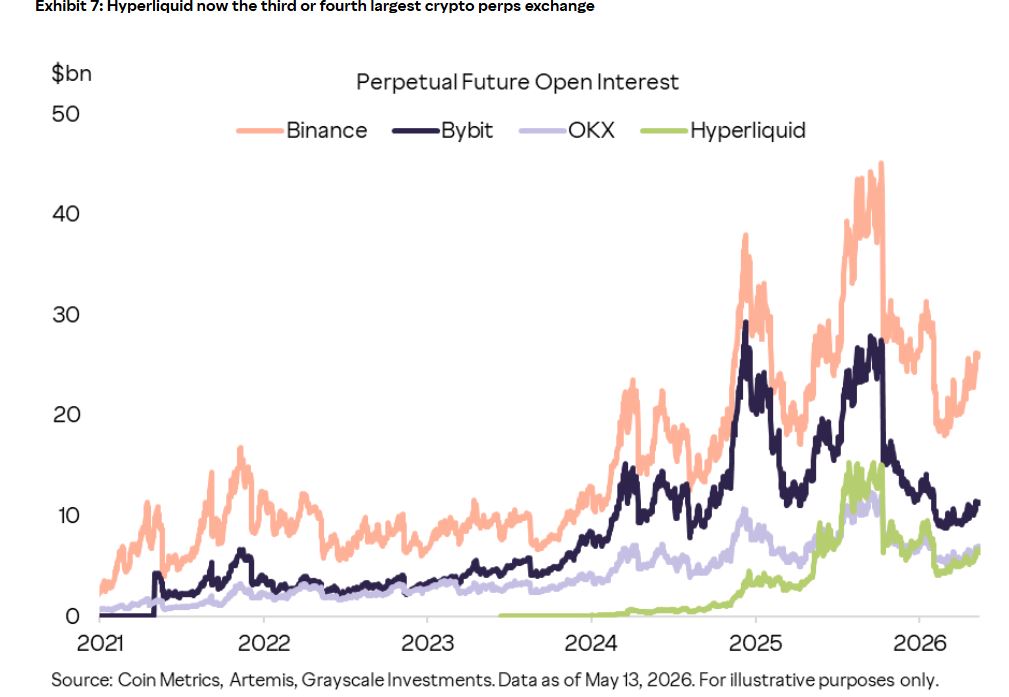
The chart above compares the perpetual futures open interest between Binance, Bybit, OKX, and Hyperliquid. Open interest represents the value of contracts that are still active and have not been closed.
The orange line corresponds to Binance, the dark blue to Bybit, the light purple to OKX and the green to Hyperliquid. As seen, Hyperliquid had almost no relevant weight before 2024, but then accelerated its growth until it was among the largest perpetual futures markets.
“Hyperliquid processed $2.9 trillion in perpetual futures volume in 2025 and currently maintains nearly $7 billion in open interest,” Grayscale details.
This growth is best understood by looking at the weight that perpetual futures have within the bitcoin (BTC) market. The following graph shows the comparison between the volume traded in the spot market with the volume of perpetual futures.
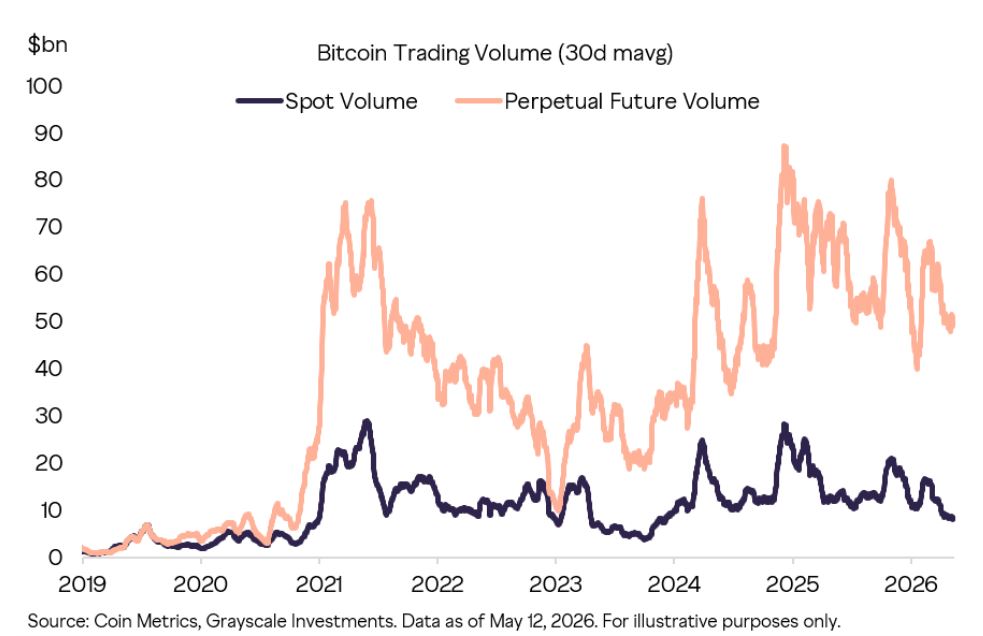
The purple line shows the spot volume, that is, direct purchases and sales of BTC. The orange line represents the perpetual futures volume.
The chart smoothes out daily variations by taking the average volume of the last 30 days, allowing you to see the general market trend more clearly.
As seen, from 2021 perpetual futures move much more volume than the spot market. This explains why Hyperliquid was able to grow rapidly by focusing on one of the most liquid and active segments of the market.
But the operation of these contracts requires an additional mechanism to prevent their price from detaching too much from the real value of the underlying asset. To explain how that balance occurs, Grayscale uses a BTC-based example.
In the chart below, the dark purple line shows the spot price of BTC, that is, the value at which the asset is directly bought and sold. The light orange line represents the price of the perpetual contract.
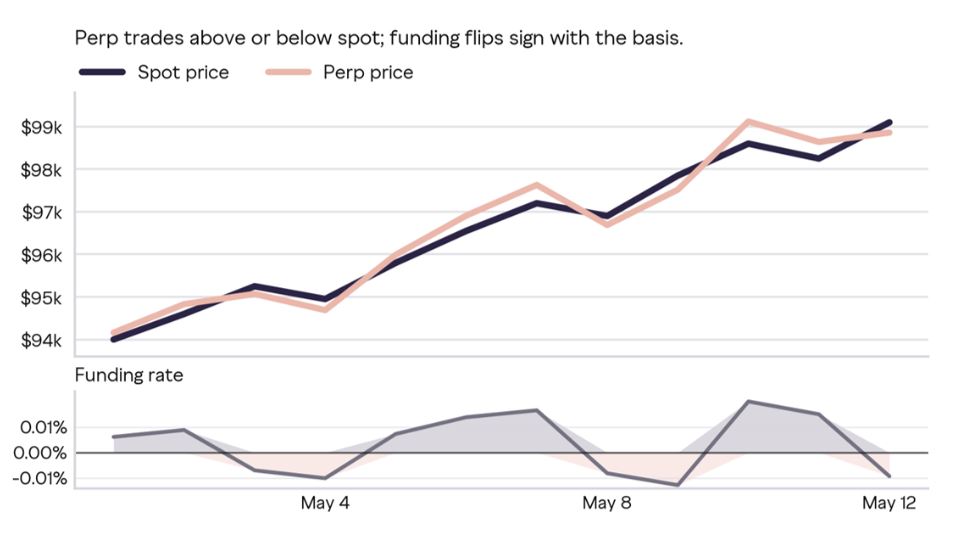
It should be noted that the values shown do not correspond to the current price of BTC (it is trading below $75,000 at the time of writing), but to a technical example used to visualize how the spot market, perpetual contracts, and financing rates interact.
What the graph shows is that when the price of the perpetual contract is above the spot market, bullish positions predominate and traders who are betting on an increase must pay a periodic commission to those who maintain bearish positions. When the perpetual contract trades below the spot price, the opposite occurs.
These commissions are precisely the “financing rates.” Its function is to generate economic incentives so that the price of the perpetual contract does not stray too far from the real value of the asset.
According to Grayscale, this system “creates an economic incentive to drive the price of the perpetual future back toward the underlying market.”
That dynamic is central to understanding the product that fueled Hyperliquid’s growth. For the manager, the protocol’s differential is not only in offering perpetual futures, but in combining typical tools of centralized exchanges with transparency and self-custody.
HYPE Price Increase
The report notes that Hyperliquid’s growth was also reflected in HYPE, the ecosystem’s native token. The asset reached a market capitalization of more than $15 billion, which places it among the ten most valuable in the market.
At the time of publishing this article, the price of the token exceeds $59.
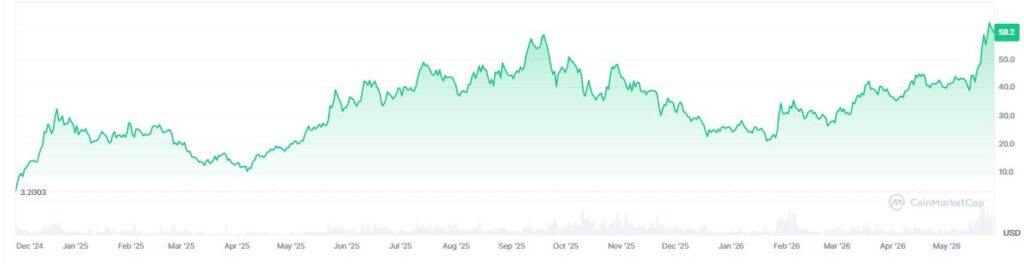
In this regard, Grayscale points out that HYPE “drives the Hyperliquid ecosystem.” Its function is linked to the use of the network: staking, gas payment, commission discounts and validator participation.
This activity is also reflected in the protocol’s accumulated commissions, which have been growing steadily since January 2025 to exceed $1 billion, as seen below:
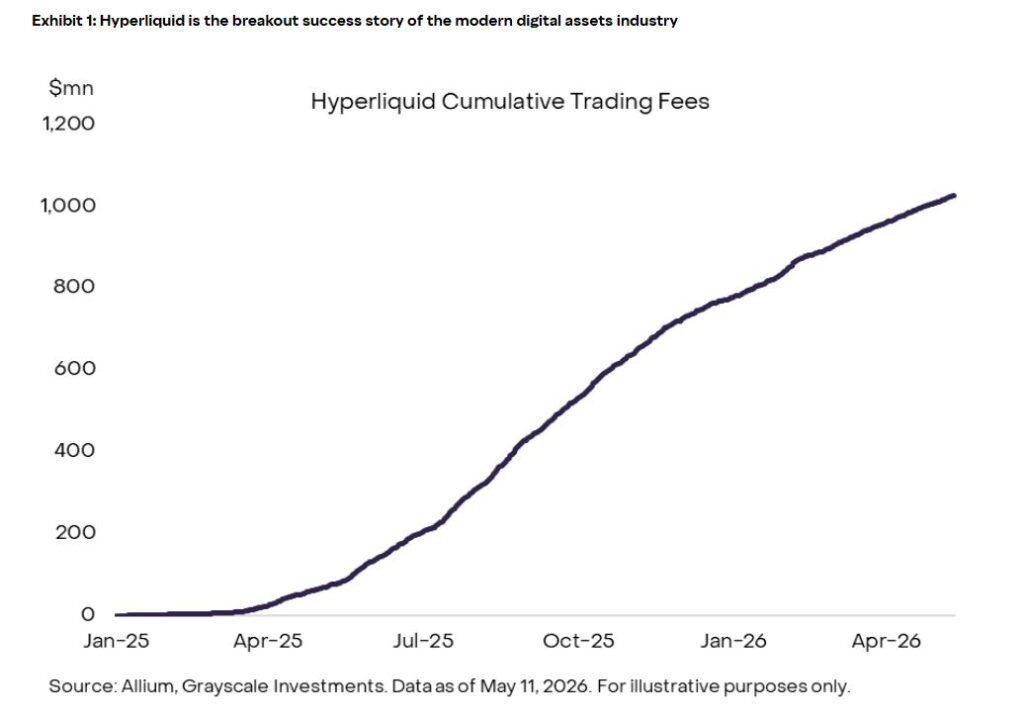
For Grayscale, this point is key because it shows that Hyperliquid does not depend only on expectations about HYPE, but of a measurable operational activity within its market.
Even so, the manager warns of risks. For example, he points out that HYPE has an annualized volatility close to 80%, a high level even within the digital asset market.
This represents a risk because a sharp drop in the token can affect the perception of the entire Hyperliquid ecosystem. If HYPE loses value quickly, Incentives to stake, operate within the network, or participate as a validator may be reducedin addition to deteriorating the confidence of users and investors in the growth of the protocol.
Additionally, it warns that Hyperliquid has a more concentrated set of validators than other networks. There is 24 active validators on the Hyperliquid network at the time of this publication. Validators are the participants in charge of processing operations, ordering transactions and ensuring the operation of the system.
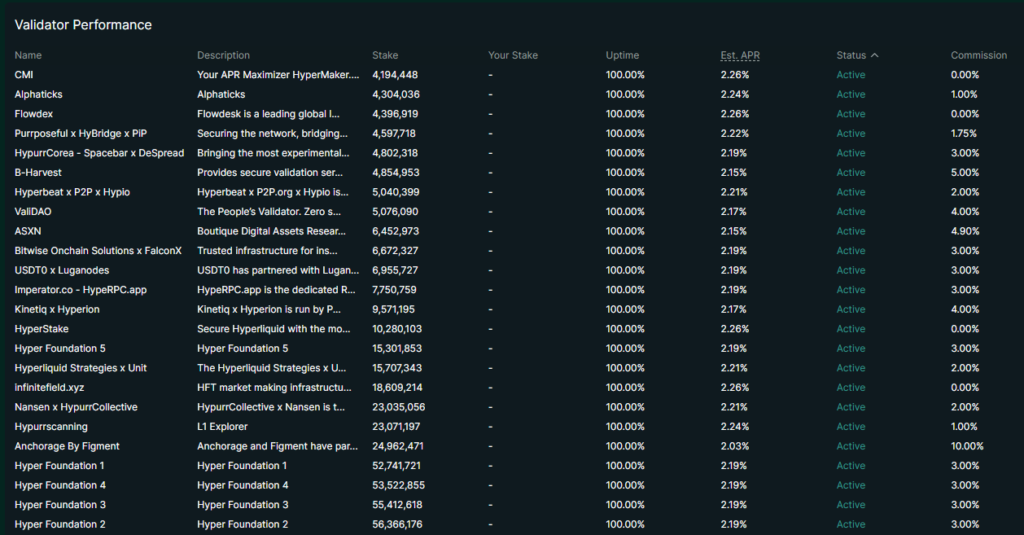
If that group is small, the network may depend more on few actors to maintain its security and operational continuity.
On the other hand, part of Hyperliquid’s future expansion depends on regulatory changes in the United States, especially so that perpetual futures can be offered under clearer frameworks and with access to a broader user base.
Despite this, the conclusion of the report is clear: “Hyperliquid is not directly comparable to another project, neither in digital assets nor in traditional finance: it breaks the mold.”