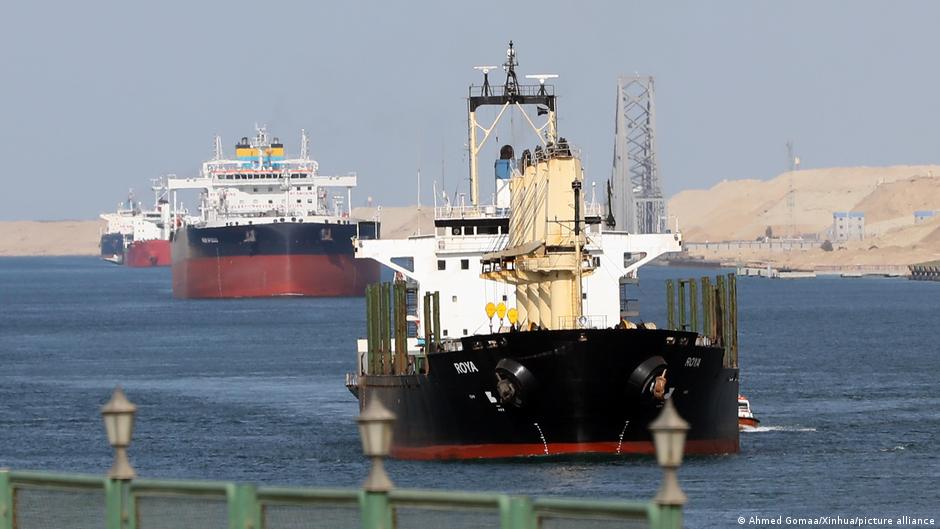
The Iranian regime has been accused of extortion and threatening global energy security after reports emerged that Tehran has started charging $2 million (€1.7 million) per ship for “safe passage” through the Strait of Hormuz.
This strait is the world’s most indispensable energy corridor, located between Iran and Oman. Before the Iran war, it transported one-fifth of all the oil and gas consumed worldwide.
Tehran has justified the fee as war reparations for damage suffered during US-Israeli attacks on the Islamic Republic, as well as payments for “navigation services”, environmental protection and enhanced security.
Iran said it was drafting a joint protocol with Oman that would require ships to obtain permits before transiting the strait.
While some Asian shipping firms and smaller operators have gone silent, major global players are refusing to pay Institute for the Study of War The (ISW) think tank labeled tolls a maritime “protection racket”.
Reuters news agency quoted a US State Department official as reporting earlier this month that the United States and China had agreed on joint opposition to the levy. Gulf countries have also rejected this move.
Maritime experts insist there are good reasons why Iran cannot charge fees in Hormuz, while other important chokepoints – such as the Suez Canal and the Panama Canal – charge similar tolls for passage through their waterways.
What are the rules for straitjacket?
Under international maritime law, natural straits used by shipping are governed by a special set of rules designed to protect global trade and freedom of navigation.
The United Nations Convention on the Law of the Sea (UNCLOS) gives ships – and aircraft – of all countries the right of so-called transit passage through international straits that connect two parts of the high seas.
To qualify for transit passage, a ship must pass through the strait without delay except in emergencies and without anchoring.
According to UNCLOS rules those transits should be allowed to take place without interference by the coastal state.
Coastal states may charge only limited service charges including pilotage and towing.
Why might canal operators charge fees?
Canals such as the Suez and Panama are man-made waterways built, owned and maintained by sovereign states at enormous cost.
Egypt generates annual revenue of about $4 billion in fees for ships passing through the 193-kilometre (120 mi) Suez shortcut.
The Constantinople Convention of 1888, signed by the major powers at the time, explicitly allows the Egyptian government to charge tolls to cover maintenance, operations and upgrades.
Meanwhile, the Panama Canal Authority, which runs the US-built canal on behalf of Panama, is also allowed to charge fees under separate treaties.
Completed in 1914 to link the Pacific and Atlantic oceans, the Panama Canal requires heavy maintenance, including constant dredging to combat sedimentation and landslides.
Both canal operators typically charge less than half the fees Iran reportedly charges.
Are there any exceptions?
Gray areas exist where fees may be charged for passage through straits and even along oceans.
For example, Russia charges icebreaker escort fees, pilotage, and service fees on the Northern Sea Route (NRS) along the country’s northern coast.
The NSR provides a much shorter route between Europe and Asia than the Suez Canal. It passes through the Arctic Ocean, connecting the Atlantic to the Pacific Ocean through the Barents Sea and the Bering Strait.
This route is mainly used in summer when the ice melts and is frequently transited by ships from Russia, China and South Korea.
Moscow considers large areas as internal waters or ice-covered areas under UNCLOS Article 234.
Canada has a similar sovereignty claim over the Northwest Passage, a sea route through the Canadian Arctic Archipelago connecting the Atlantic and Pacific oceans. From time to time, the Ottawa government considers imposing tariffs only to face American opposition.
Another long-term example is the Turkish Straits. The Bosphorus and Dardanelles, which connect the Black Sea to the Mediterranean through Türkiye, are governed by the 1936 Montreux Convention.
Under this treaty, Turkey must allow freedom of passage for merchant ships and can only charge limited service fees for navigation aids and lighthouses, not full transit tolls.
What are the chances of this dispute going forward?
The Hormuz charging dispute remains a major obstacle to ongoing peace talks between the US and Iran aimed at reopening Hormuz.
Washington insists that the strait should be fully reopened as international waters, allowing ships from all countries to pass without Iranian controls, fees or special permission.
“The strait will be open to all; it is international waters,” US President Donald Trump told reporters during a White House Cabinet meeting on Wednesday. “We will keep an eye on it, but no one will control it.”
He also took aim at Oman’s apparent involvement in Tehran’s plans, saying: “Oman will behave just like everyone else, or we will have to blow them up.”
Washington continues to urge shipping companies not to pay tolls and warned that companies that do so could face secondary US sanctions for doing business with Iran.
While a comprehensive US naval blockade of Iranian shipping remains in effect during negotiations, the US and the UN are working on plans to protect shipping after the war ends.
This includes the use of multinational naval patrols to protect shipping, surveillance in the straits, and increased mining operations.
Edited by: Rob Mudge