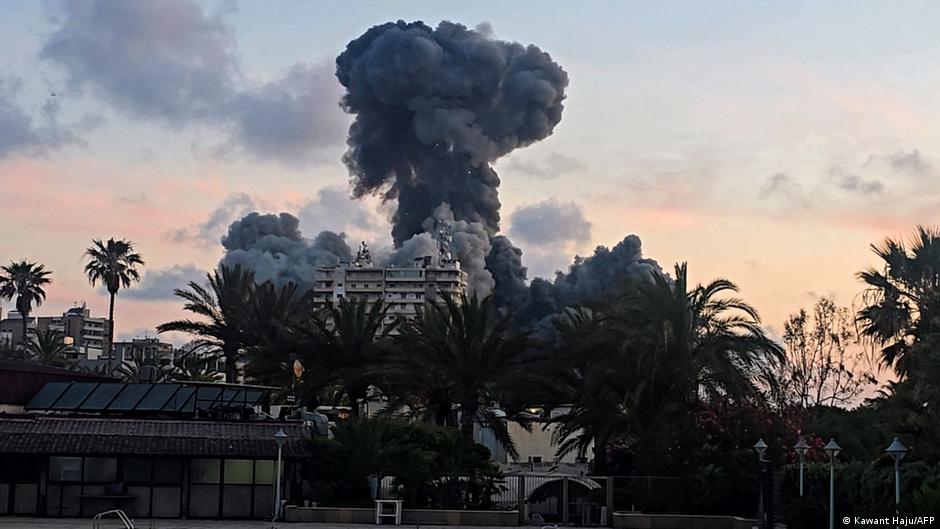
The latest tensions between Israel and the Iran-backed Hezbollah group are worsening Lebanon’s dire humanitarian situation.
“Lebanon is in a state of panic,” Kelly Pettillo, program manager for the Middle East and North Africa at the European Council on Foreign Relations, told DW. “Thirty-one people killed on the eve of this week’s Eid holiday.”
On March 2, 2026, Lebanon became involved in the wider Middle East war when Hezbollah fired on Israel, two days after the US and Israel attacked Iran. More than 3,213 people have been killed and more than 1 million displaced following nearly three months of Israeli attacks, according to Lebanon’s health ministry.
This week, hopes for an end to the fighting were further dashed when Israeli Prime Minister Benjamin Netanyahu said Hezbollah’s increased use of explosive drones threatened the lives of civilians in Israel’s north and “we now need to increase the attacks, increase the intensity. We will hit them in the hip and the thigh.”
Israel is attacking Hezbollah infrastructure and building up an increased military presence in southern Lebanon. Meanwhile, Hezbollah is targeting Israeli forces in the north of Israel and in the south of Lebanon.
This current escalation is likely to play a role in the ongoing US-Iran talks. The US and Israel view the conflict in Lebanon as separate from peace talks with Tehran, while Iranian officials insist on including this front in a deal.
“Israel and Hezbollah have entered a very dangerous escalation cycle,” David Wood, a Beirut, Lebanon-based senior analyst at the International Crisis Group, told DW. “If the situation continues like this, it could have disastrous consequences for Lebanon.”
Beirut also under domestic pressure
Hezbollah’s military wing is classified as a terrorist organization by the US, Germany and several other countries. The Lebanese government, led by President Joseph Aoun, already banned all military action by Hezbollah in March 2026 and continues to push for Hezbollah’s disarmament. This was set out in the November 2024 ceasefire between Israel and Hezbollah, which ended more than a year of clashes and two months of full-scale war in Lebanon with nearly 4,000 deaths and major destruction. However, tensions and attacks between Israel and Hezbollah continued until the situation escalated again in early March.
“Hezbollah feels that the net is tightening around it in the domestic landscape,” explains Wood. “Hezbollah not only sees Israel as waging a war against it, but it also believes that the Lebanese government is waging a confrontation against both the group’s military and social institutions.”
Meanwhile, Naim Qassim, secretary-general of the Iran-backed Hezbollah group in Lebanon, warned Beirut that his group would oppose any government efforts to close the Hezbollah-linked al-Qard al-Hassan financial institution.
“People have the right to take to the streets and topple the government,” he said.
Regarding the increasing Israeli military presence in the south of the country, Qassim said that “If this government is unable to guarantee sovereignty, it must go.”
Sami Halabi, policy director at the Lebanese think tank the Alternative Policy Institute, says Hezbollah may genuinely believe that another government would better serve its interests.
“Hezbollah is now planning to topple the government through a popular uprising,” he told DW. In his view, this proposal is a dangerous one, even though “at the moment it is more verbal than anything else.”
However, he said it could develop into a more serious option if plans move forward to disarm Hezbollah by force rather than through a process.
He warned, “Disarmament by force will certainly lead to civil conflict in Lebanon.”
Lebanese diplomacy
Nominally, the most recent US-brokered ceasefire between Israel and Lebanon, which took effect on April 17, 2026, still stands and was extended for 45 days on May 15, 2026. However, despite being signatories, the Lebanese government is not a party to the conflict, while Hezbollah, on the other hand, did not sign the agreement. In turn, the ceasefire has become fragile due to almost daily attacks by Israel and Hezbollah. This situation is likely to continue until the third round of direct Lebanese-Israeli peace talks in Washington on June 2-3, 2026.
Meanwhile Lebanese President Aoun defended holding the next round of direct talks between Israel and Lebanon, saying his demands for lasting peace and Israel’s complete withdrawal from southern Lebanon were non-negotiable.
“The liberation of the south is a duty borne by the state with the support of its people,” Aoun said.
However, as David Wood states, Hezbollah points to developments on the ground as justification for keeping its arms, and argues that diplomacy is ineffective.
Hezbollah has long said its weapons are necessary to deter Israeli attacks, while critics say the group undermines the sovereignty of the Lebanese state by operating an independent armed force.
Wood said, “While Hezbollah also needs to stand down under any ceasefire agreement, Israel, by intensifying its operations in Lebanon rather than abiding by the ceasefire, is undermining the Lebanese government’s ability to deliver meaningful progress in the talks still ongoing in Washington.”
Hunger increasing across Lebanon
Amid this escalating standoff between the Lebanese government, Hezbollah, and Israel, conditions are becoming increasingly dire for Lebanese citizens.
a fresh AnalysisThe Integrated Food Security Phase Classification (IPC) warns that nearly one in four people in Lebanon – approximately 1.24 million – are expected to face acute food insecurity between April and August 2026. The Lebanese Agriculture Ministry also warned that about 22% of agricultural land in the affected areas has been damaged, further reducing food production and livelihoods.
Furthermore, the UN secured only 51.3% of the required funding by May 26, 2026 in a $308.3 million (€264m) flash appeal for March to May 2026, the UN said in a statement This week.
In turn, aid agencies warnThe lack of funding is forcing humanitarian groups to reduce essential services not only for the Lebanese population, but also for the thousands of Syrian refugees in the country.
“Since all water service provision for Syrian refugees will cease from June 1, 2026, the risk of the spread of waterborne diseases such as hepatitis A, typhoid and cholera is extremely high,” Suzanne Tackenberg, Lebanon regional director at Action Against Hunger, told DW.
Edited by: Carla Bleiker