The four-party coalition governing Romania until just weeks before the summer of 2025 was seen by many as the country’s last chance to prevent the far-right from coming to power. The hope was that solid governance and reforms would keep extremists in check.
Yet this strategy seems to be failing. Romania’s right-wing extremists rank high in opinion polls, while its liberal parties are mired in political infighting. It has been three weeks since the government of liberal Prime Minister Ilie Bolojan fell after his own camp tabled a motion of no confidence, and none of the country’s liberal parties have yet been able to agree on who should succeed him – even though President Nikosor Dan has tried his best to mediate talks.
But not only this. While the Bologna government formally remains in power until it is replaced, Romania’s Social Democrats (PSD), who hold the majority of seats in parliament and are believed to support the EU, are increasingly cooperating with the far-right Coalition for the Unification of Romania (AUR). Indeed, political scientist Raluca Alexandrescu says that Romania is witnessing a “normalization of right-wing extremism”.
The far right is a threat to Romania and Europe
Large-scale upheaval could occur if the pro-Russian, anti-Ukraine and anti-EU Auer comes to power, or even plays a supporting role in the Romanian minority government.
After all, Romania is the sixth largest country in the European Union and the most important NATO member state in Southeastern Europe. It hosts some of the largest and most important NATO bases in the region. Romania has the longest EU border with Ukraine of all member states and has consistently supported the embattled nation fighting Russian invaders.
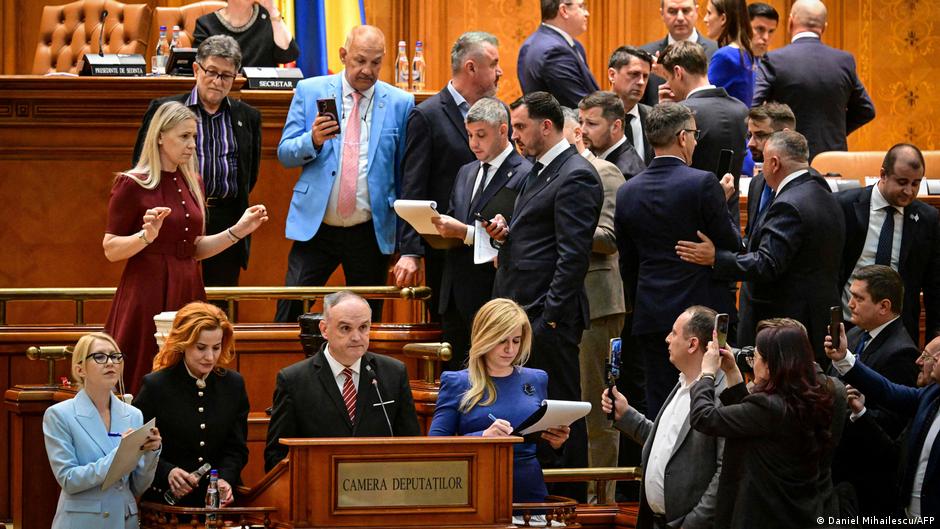
May’s no-confidence vote, initiated by the PSD together with Auer, was evidence that the dangerous normalization of the far right continues. The PSD, for that matter, was part of Bologen’s coalition.
While there have been previous examples of collaboration of liberal parties with right-wing extremists in the Romanian Parliament, this was the first time they joined forces to topple a government. This was the moment when the rightmost firewall collapsed.
While the PSD has often said that its goal is not to form a coalition with Auer, its actions speak another language. In mid-May, the PSD joined Romania’s three far-right parties in supporting a legislative project in the Parliament’s Human Rights Committee to overturn the ban on anti-Semitic, fascist and racist propaganda. The move sparked a public outcry, causing the PSD to step back, with party leader Sorin Grindeanu claiming it was merely a “mistake”.
Last week, the PSD and Auer once again voted together, this time in Romania’s upper house, the Senate, in favor of a non-governmental organization (NGO) law based on the Putin-Orbán playbook. As a result, NGOs are now required to publish the names of donors if they contribute more than the equivalent of €1,000 per year. Several hundred NGOs have protested against the legislative project, but so far to no avail. NGOs operating in Romania are already subject to strict transparency rules.
In late May, the PSD voted together with the far right in support of the so-called “We are not selling our land” law, aimed at preventing the sale of minority shareholdings in state-owned companies. Incidentally, the name of the law is reminiscent of a nationalist slogan from the 1990s.
The project was initially launched by the Bologna government to boost the efficiency and transparency of state-owned companies suspected of corruption, while also generating revenue for Romania’s beleaguered state treasury.
symbol of romanian corruption
It is rather symbolic that the PSD supported the “We are not selling our land” law, as this slogan dates back to the post-communist era, when it was used by the party’s predecessor organization to call for violent action against anti-communist protesters, civil rights activists, and opposition parties. After all, it was the PSD that ruled the country after the fall of communist dictator Nicolae Ceaușescu in 1989. It was first known as the Front for National Salvation (FSN), later known as the PSD. PSD never apologized for this.
After the fall of Ceaușescu’s regime many former Ceaușescu cadres, security secret police officers and communist company directors joined the PSD, ensuring that the same old elites remained in power after 1989/90. The party has therefore become a symbol of Romanian corruption. Despite calling itself social democratic, its ideology is right-wing nationalist-populist. So, it is no surprise that in the 1990s it was already ruled by ultra-nationalist, extremist parties.
Several other democratic parties have played a role in legitimizing Romania’s far right in recent years. Among them was the liberal Union Save Romania (USR), which joined Auer in introducing a censure motion against the government in September 2021, although that vote never advanced. Still, it was a big step toward normalizing extremists.
Romania’s three far-right parties – AUR, SOS Romania Party and the Party of Young People (POT) – currently control about 35% of the seats in both houses of the Romanian Parliament. According to recent surveys, AUR alone can currently secure 32% of the votes. This puts it well ahead of the second most popular party, the PSD, with an estimated vote share of 24%.
Therefore, snap elections are not in the interests of Romania’s democratic parties. Yet observers fear that the current crisis, as well as the PSD’s political maneuvering, will strengthen the far right ahead of parliamentary elections in late 2028.
Political scientist Cristian Pirvulescu warns, “The PSD’s collaboration with Auer is a huge strategic mistake that could turn a government crisis into a systemic crisis.”
This article was translated from German