
The European Commission is studying the possibility of creating a common tax on crypto assets throughout the European Union (EU).
This follows from a document internal leaked and revealed by Politico this May 29, 2026. The writing was known in advance of the upcoming discussions on the long-term community budget.
The text offers concrete details for the first time on how Brussels evaluates taxing the sector as a new source of financing for the European budget. Among the options analyzed are a tax on transactions with crypto assets, something that is not currently done in any country in the European Union, and another tax on capital gains obtained by investors.
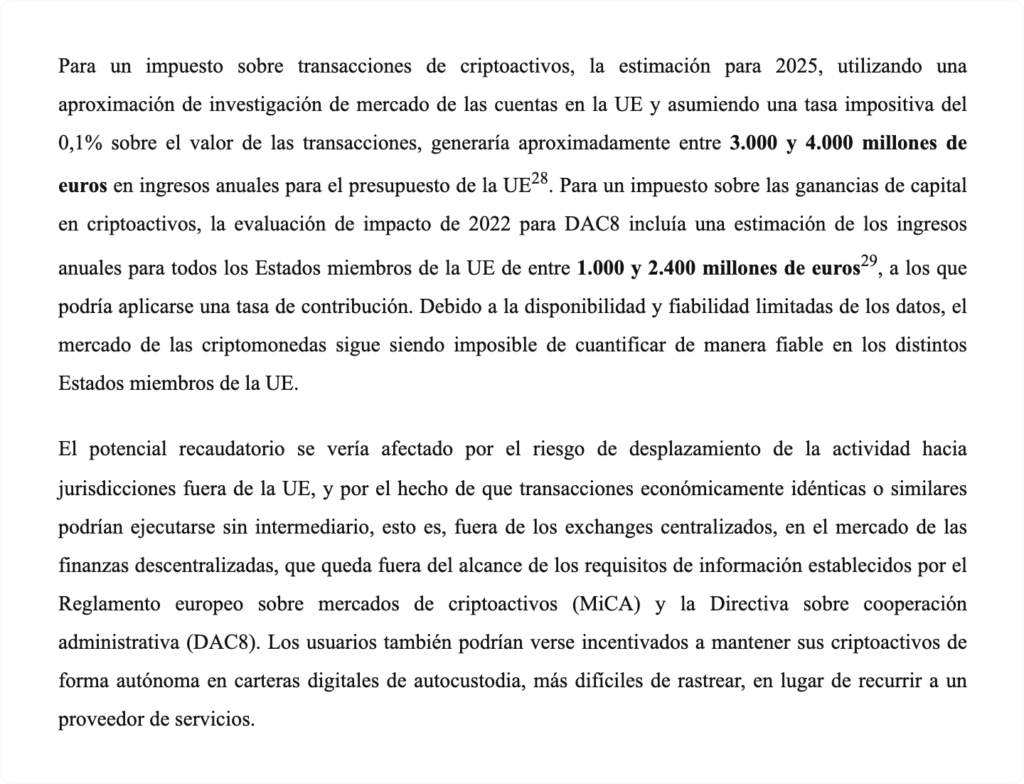
According to the document, the alternative that would generate the most revenue would be a tax on operations carried out with cryptocurrencies.
“For a tax on transactions with cryptoassets, the estimate for 2025 (…) would generate approximately between 3,000 and 4,000 million euros in annual revenue for the EU budget,” says the European Commission.
The proposal takes as a reference a rate of 0.1% on the value of each operation and considers cryptoasset service providers (CASP) as possible collection and reporting points.
In the case of a capital gains tax, the collection potential would be lower. The Commission considers that This alternative could generate between 1,000 and 2,400 million euros annually for Member Statesdepending on market conditions.
Stablecoins would be left out
One of the most striking aspects of the document is that stablecoins used as a means of payment would be excluded from a possible transaction tax.
The document notes that capital gains taxation would normally also not apply to stablecoins, due to their nature and price stability.
Despite revenue projections, The European Commission dedicates a good part of the document to explaining the obstacles faced by an initiative of this type.
One of them is the lack of reliable data. “The cryptocurrency market remains impossible to reliably quantify between the different EU Member States,” the text admits.
The Commission also recognizes “the revenue potential of both options will likely be volatile,” while warning on strong oscillations in both prices and traded volumes.
Another important challenge is the behavior of the users themselves. “Revenue potential would be affected by the risk of activity shifting to non-EU jurisdictions,” warns the Commission.
The document adds that economically equivalent operations could be carried out outside of centralized exchanges, directly in decentralized finance (DeFi) protocols, which are currently left out of part of the reporting mechanisms contemplated by MiCA and DAC8as explained by CriptoNoticias.
Likewise, the Commission recognizes that “users could be incentivized to hold their crypto assets independently in self-custody digital wallets, which are more difficult to trace.”
It will be difficult for the tax to prosper
The lawyer specialized in financial regulation and digital assets, Cris Carrascosa, consider that The document is relevant because it represents the first concrete evidence of how Brussels is evaluating taxing the sector.
“This is the first time we are seeing concrete details about how the EU is thinking about taxing crypto assets,” he noted.
However, he recalled that There is still no formal legislative proposal and the initiative faces important political, technical and regulatory challenges.
Among them he mentioned the need for unanimity among all Member States, the creation of a harmonized tax base for the entire European Union and the possibility that some of the activity ends up migrating towards DeFi or self-custody systems.
A similar vision express Patrick Hansen, director of strategy and policy for the European Union at stablecoin company Circle. “The substantive political, legal and operational challenges outlined in the document make me hope that crypto taxation at the EU level will not become a short-term policy priority,” he stated.
Hansen also questioned the collection estimates made by Brussels due to the changes in behavior that a new tax could cause.
“Any transaction-based crypto tax would likely accelerate migration towards untaxed channels (e.g. DeFi, self-custody or non-EU actors),” he maintained.
According to the specialist, a relevant part of the activity could shift towards alternatives that would be outside the scope of the European tax system, significantly reducing the income potential projected by the Commission.
There is no formal proposal yet.
For now, the initiative is in a very preliminary phase. The leaked document does not constitute a legislative proposal and any progress would require overcoming important political and legal obstacles.
Furthermore, it does not clarify how the proceeds would be distributed. However, as it is a possible “own resource” of the European Union, the objective would be to finance the community budget. It is not yet defined whether Member States would act solely as collectors of a European contribution or whether the new scheme would coexist with current national taxes on cryptoassets.
These include the need to previously harmonize the tax base throughout the European Union and obtain unanimous approval from the Member States, a requirement that has historically made it difficult to create new taxes at community level.
For this reason, although the document shows that Brussels is already analyzing specific mechanisms to tax cryptoassets, There is still no certainty that any of these alternatives will become law.