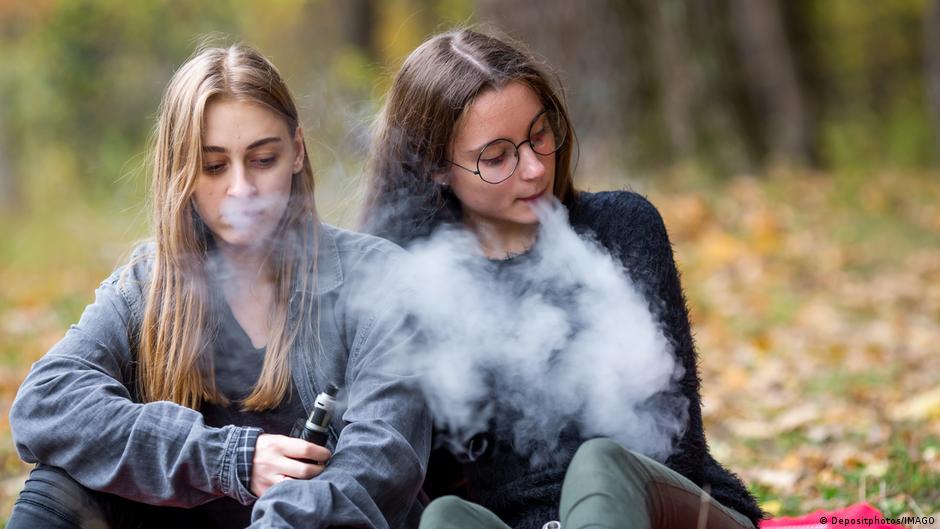
At least Antonia S* has no desire to smoke cigarettes anymore. He started smoking at age 18 and started vaping six years later. The watermelon flavor is his favorite, and a ten milliliter bottle of e-liquid, which is equivalent to about 60 e-cigarettes, lasts him a week.
“I’ve tried to quit smoking over and over again. It never worked until I tried vaping. I think it’s made me healthier. But on the other hand, I think I’m much more dependent on vaping than smoking. Everyone I know says they vape a lot more than they smoke,” the 30-year-old told DW.
From a consumer perspective, the advantage of vaping is that it doesn’t smell like a normal cigarette. Antonia also vape at home; Smoking was strictly prohibited in the apartment but the sweet vapor of blueberry, cola or apple peach from his e-cigarette is no problem. Most of all, it is possible anytime, anywhere.
Antonia says, “You’re on it all the time. With cigarettes, you’d be like, ‘I only have five minutes, this isn’t enough,’ and then you’re not aroused at all. I don’t even have to go out to vape.” When will she stop using e-cigarettes? “Right now, I feel like it’s doing me more good than harm. But if I get pregnant, I’ll stop immediately.”
The number of young people smoking is increasing
Health experts in Germany are concerned that young people in particular are once again turning to e-cigarettes and even regular cigarettes more frequently than the generation before them. According to a recent survey, about 10% of Germany’s 12 to 17-year-olds would smoke in 2025, compared to only about 6% four years earlier. About 7% of people in this age group use vapes regularly, more than double as of 2021.
Hendrik Streeck, the federal government’s drug commissioner who initiated the study, sees a reversal in the trend.
“Tobacco prevention in Germany has been successful for years, but this success is no longer guaranteed,” Streeck said. “Starting with vapes causes young people to become dependent on nicotine and often leads them to smoke cigarettes long term. Nicotine itself is not harmless. Nor are the additives in vapes harmful.”
The Federal Institute for Risk Assessment has identified 13 additives that are harmful to health and, in some cases, carcinogenic: “Tobacco and nicotine are highly addictive products. We should not underestimate this. In Germany, 360 people die every day as a result of their consumption.”
Tobacco industry: ‘E-cigarettes less harmful’
The streak is calling for a ban on flavors that appeal to young people, higher tobacco taxes with additional revenue flowing directly into the health system, and stricter age controls. According to the Youth Protection Act, the purchase, possession and consumption of tobacco products and nicotine-containing products is prohibited for persons under the age of 18 – this also applies to nicotine-free vapes.
And what about the tobacco industry? The German Association of E-Cigarette Retailers told DW that e-cigarettes are clearly not a product for young people or non-smokers.
“With regard to health risks, there is a broad international scientific consensus that e-cigarettes are significantly less harmful than traditional tobacco cigarettes. This clearly does not mean that e-cigarettes are harmless, but according to current scientific understanding, they represent a significantly lower risk alternative to tobacco cigarettes for adult smokers.”
Primary school children in danger?
For Bob Bloom, the idea of a low-risk option is a double-edged sword. Germany’s most famous education influencer, with nearly 240,000 Instagram followers, used to be a social smoker himself, he told DW, until he switched to vaping. He puffed on an e-cigarette first thing in the morning, happily smoked cigarettes while sitting at his desk, and managed to stay smoke-free for more than two months as an adult. This was reason enough for him to clearly warn about the dangers of its high addictive potential on social media and in his podcast “Die Schule Brannant” (“The School is on Fire”).
“Vaping has a certain coolness factor and ‘coming of age’ factor,” he said. “Many teachers report that vaping is happening in school restrooms. After my video on this topic, I received comments and messages saying that this is already starting to happen in elementary schools.”
Bloom sees a certain helplessness about how to deal with this issue: “It’s probably something that vaping and smartphone use have in common.”
Social media influencers promote promotion
Since e-cigarette use has been increasing rapidly since 2010, long-term studies on their health effects are still lacking. While scientists generally agree that electronic cigarettes are less likely to cause cancer, researchers at Oxford University have warned that nicotine-containing vapes are carcinogenic to the mouth and lungs and more than double the risk of serious lung disease.
To protect minors, Blume is calling for a massive campaign against vaping – and also sees arrest warrants for famous German influencers like Montana Black and Zarbex, with their millions of followers, as a responsibility.
“Those influential people have a lot of power; they don’t even have to be active vapers,” Bloom said. “He’s my idol, who has achieved everything I wanted. He’s cool, funny and eloquent, and he casually buys a Porsche. And vaping is a common pastime. It definitely has a huge impact.”
This article was originally published in German.