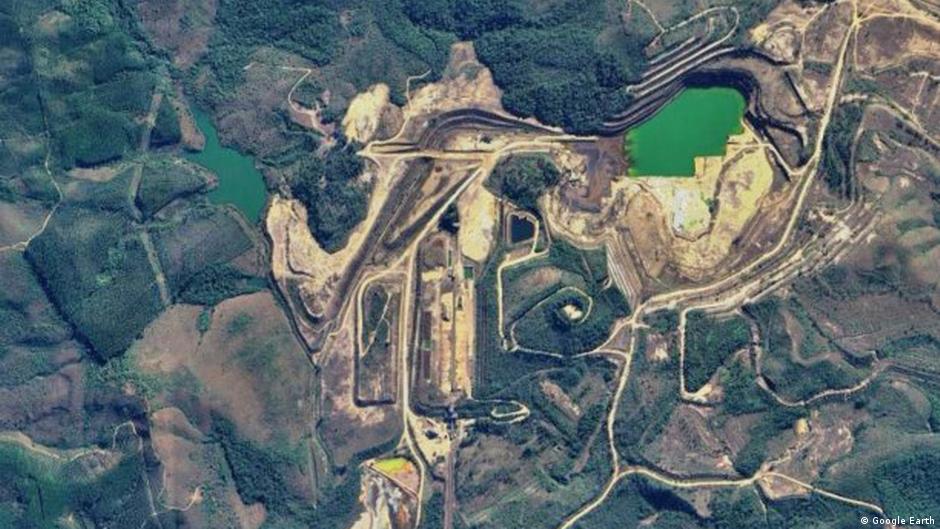
A new race for resources is taking shape in Brazil. But this time, it is not about gold, coffee or rubber. Instead, the focus is on the gold of the artificial intelligence and renewable energy era: rare earths.
“The next big, rare earth projects in the world will be in Brazil,” Andrew Tunks, geologist and CEO of Australian mining company Meteoric Resources, told DW. “I don’t know how long it will take,” said Tunks, “but I think in time [Brazil] Will compete with China.”
Meteoric is investing heavily in rare earth mining in Brazil. Its so-called Caldera Project, located in the state of Minas Gerais, is considered the world’s largest deposit of ionic clay.
Ionic clay deposits are among the most important sources of “medium” and “heavy” rare earths, such as dysprosium and terbium, which are needed for high-performance magnets used in wind turbines and electric vehicles.
Run for rare earth deposits
According to the International Energy Agency (IEA), “Demand for magnetic rare earth elements (neodymium, praseodymium, dysprosium and terbium) has doubled since 2015 and is set to expand by a third by 2030 under today’s policy settings, thanks to increasing electrification and the rapid deployment of new energy technologies such as EVs and wind turbines.”
The IEA says growing demand for automation, robotics and digital technologies will further increase the need for rare earths, which are essential for electric vehicles, AI data centers and advanced robotics.
Brazil has the world’s second largest rare earth reserves after China, with estimated reserves of about 21 million tonnes. China continues to lead the global ranking with 44 million tonnes.
The growing global demand for rare earths has created an explosion of mining applications at Brazil’s National Mining Agency (ANM). Currently 2,758 projects are under consideration.
For comparison, more than 250 applications for rare earth mining were filed in Brazil between 1975 and 2020. Between 2023 and 2024 alone, this number will increase to 1,662.
American company acquires Brazilian mine
The effects of Brazil’s new “gold rush” are also being felt on the stock market. Share prices of companies investing in rare earth mining in the country have increased. Over the past 12 months, shares of Meteoric (Australia), Resouro Strategic Metals (Canada), Apia Rare Earths and Uranium Corp (Canada) and USA Rare Earths (US) have risen between 65% and 122%.
In April, USA Rare Earths acquired Brazil’s only active rare earth mine at Minacu in Goiás state from Brazilian mining company Serra Verde for $2.8 billion (€2.4 billion).
CEO Barbara Hampton said following the acquisition, “Serra Verde’s Pela Ama mine is a unique asset and is the only producer outside Asia capable of supplying all four magnetic rare earths at scale.”
He pointed to the strategic importance of the mine, highlighting a 15-year supply agreement with several US government agencies.
According to the German-Brazilian Chamber of Industry and Commerce in São Paulo, German companies are still only “selectively” involved in the extraction of raw materials in Brazil.
Bruno Wath Zarpelon, head of business development at the chamber, told DW that Germany nevertheless wants to expand its partnership with Brazil in areas such as critical minerals, energy transition, green industry and supply chain security.
Can Brazil compete with China?
Serra Verde remains an exception in Brazil’s rare earth region. Unlike China, Brazil has so far largely restricted itself to exporting raw materials rather than processing and refining them domestically.
According to the International Energy Agency (IEA), China now accounts for more than 90% of global rare earth refining capacity. It also dominates the production of permanent magnets, with a market share of about 95%.
The electronics industry felt the impact of this dependence last year. Supply declined after China imposed export controls on rare earths during its tariff dispute with US President Donald Trump.
Brazil – along with other resource-rich countries such as India, Vietnam, Sweden and Norway – now wants to create its own rare earth value chain. But Meteoric CEO Andrew Tunks says it will take time.
“Brazil could become competitive in mining relatively quickly,” Tunks said. “But when it comes to manufacturing, it will still take some time.”
Easy withdrawal of deposits in Brazil
From a geological perspective, Brazil has an advantage over other countries in having large, rare earth reserves. According to the Brazilian Geological Society (SBG), about 73% of the country’s reserves are ionic clay formations.
“These are reserves where nature has already done part of the processing work,” said Francisco Valdir Silveira, head of the SBG. “The original granite rock has already been altered or weathered over time. This makes it easier to extract ionic clay deposits.”
Geologist and mining entrepreneur Tunks sees additional benefits in the extraction and processing of rare earths in Brazil.
“Separation requires a lot of electricity and water. Our mine in Brazil runs entirely on renewable energy, and electricity is cheap,” Tunks said. “You don’t have that in Australia. It’s very dry there and electricity is very expensive.”
Tunks expects Brazil’s “gold rush” to take a different path than the one seen in his home country.
“In Australia we extract huge quantities of raw materials and send them to China,” he said. “We don’t create any added value from them. I hope Brazil can do better.”
Heloisa Mundt contributed to this piece, which was originally published in German.